
At a glance
- Location
- Ķekava
- Service
- Rodent control — rat and mouse extermination
- Price
- From €40 — the figure quoted is the final price
- Availability
- 24/7, weekends and nights included
- Getting there
- We travel from Riga; arrival time agreed per address
- How to book
- Enquiry form only — we reply within 5 minutes
Rodent control in Ķekava: a district centre under two kinds of pressure
Ķekava is the administrative centre of Ķekava district and at the same time a southern suburb of Riga, where areas of detached houses, newer residential developments and commercial buildings along the main roads sit a few hundred metres from one another. So rodent control in Ķekava is almost never one standard job: one address is a family house with a basement, the next a production plant with a goods-in bay. The inspection starts by establishing what the property is used for, because that determines whether rodent control is built around the perimeter with bait stations or mainly indoors with control points. Both the brown rat and the house mouse occur in Ķekava, but in very different settings, and the right answer in each case is different.
Food industry and manufacturing: control points and records
Manufacturing and the food industry take up a large place in Ķekava's economy, and on those sites the presence of rodents is not merely a nuisance — it puts the product at risk and brings work to a halt. In such businesses rat extermination and mouse extermination are organised as a permanent system rather than a one-off callout: numbered control points around the perimeter, separate interior monitoring positions by the raw material and finished goods areas, and a regular inspection routine. On each visit we record which points show activity, what has been changed and what building faults have been observed. A written record of the work carried out stays on site and makes it possible to follow the trend over time. For commercial properties prices start from €70, depending on the floor area and the number of control points.
Commercial buildings along the main roads and the goods-in route
A strip of shops, service premises and warehouses has grown up along the main roads in Ķekava, and the route goods travel is the one rodents most often use to get inside. The goods-in doors stand open during unloading, the bins are behind the building, and between them lies a strip of unmanaged grass. A house mouse squeezes through a 6–7 mm gap and a brown rat needs only 20 mm, so a gap under a door or a damaged threshold seal is a fully serviceable entry. When inspecting such properties we follow the grease marks 5–10 cm above the floor along the walls — they show the established route more precisely than a single pile of droppings that happens to be found.
The Ķekava river, the closeness of the Daugava and the town–country fringe
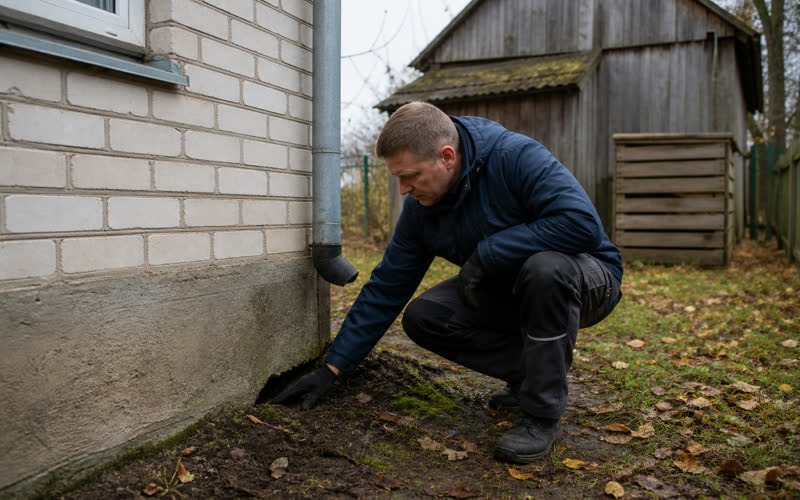
The nearness of the Ķekava river and the Daugava, together with the town–country fringe, creates exactly the environment the brown rat likes best: damp banks, overgrown ditches and, next to them, occupied buildings with a steady food source. A rat burrow entrance is a hole 5–8 cm across in the ground, usually at the edge of the foundations, under a deck or screened by shrubs, and it is one of the first things we look for during an inspection. In autumn, as the temperature drops, movement from the riverside towards buildings becomes more pronounced. On such properties rodent control in Ķekava is built on the external perimeter — bait stations are placed between the likely wetland source and the building, so the rodent is intercepted before it reaches the foundations.
New detached-house developments: unsealed service entries
In newer residential developments and areas of detached houses the problem is usually not age but shortcomings in the finishing stage. Water, drainage, electrical and heating pipe entries through the foundations are often left filled with expanding foam, and that does not stop rodents — the foam is gnawed through in a few nights. Only metal mesh with a 5 mm aperture combined with cement mortar works, and that is exactly how we seal entry points. We also check ventilation shaft outlets, basement windows and the bottoms of plant room doors. Without that step, any mouse extermination is only a temporary reduction in numbers. Treating a private house in Ķekava costs €90–110, treating a flat €40–80, and the minimum callout charge is €40.
Commuting: why the problem is noticed too late
Ķekava is very much a commuter town for Riga — many residents spend the day in Riga, and the house stands empty from morning until evening. Rodents are active in precisely those quiet hours, so the first signs often go unnoticed, and the enquiry only reaches us once the noise starts being heard at night. Check the basement, the boiler room and the pantry: house mouse droppings are 3–6 mm long, rat droppings 15–20 mm, and that immediately shows what you are dealing with. The brown rat is wary of anything new, so for the first 3–7 days after the stations go in it may not approach them — that is not a sign of failure. We work 24/7, emergency callouts included. Fill in the form — we reply within 5 minutes.
Frequently asked questions
Do you cover the whole of Ķekava district?
Yes. Besides the town of Ķekava we travel to Baloži, Baldone and the rural parts of the district. It is roughly 8.7 km from Ķekava to Baloži and 13.8 km to Baldone, so several properties can often be combined on one route. Describe the address and the type of property in the form and we will tell you the terms for the callout.
How much does rodent control in Ķekava cost?
The minimum callout charge is €40. Treating a flat costs €40–80, treating a private house €90–110, and for commercial properties the price starts from €70 and depends on the floor area, the number of control points and how often we inspect. We set the exact figure after the inspection, once the scale of the property is clear.
Does a production plant need ongoing service rather than a single callout?
On food and manufacturing sites a single treatment is not enough, because the rodent pressure from the surroundings never stops. The practical answer is permanent control points around the perimeter and indoors, with regular inspections. After each visit a written record of the work carried out is left behind, with notes on activity and on the faults found.
Is foam around the pipe entry in the foundations a good enough fix?
No. Rodents chew through expanding foam and the entry is open again. The durable solution is metal mesh with a 5 mm aperture together with cement mortar. Remember that a mouse needs only a 6–7 mm gap and a rat 20 mm, so every service entry, ventilation shaft outlet and door bottom gets checked.