
At a glance
- Service
- Rodent control in warehouses
- Area covered
- Riga and the surrounding region
- Price
- From €40 — the figure quoted is the final price
- Availability
- 24/7, weekends and nights included
- Reply time
- Within 5 minutes of the form being submitted
- How to book
- Through the enquiry form only
In a warehouse, rodents cause a double loss: damaged goods and damaged packaging that makes a consignment unsaleable. Over large areas a one-off treatment does not work — you need a system of control points.
Perimeter control points
We place numbered bait stations around the perimeter and inside, building up a map of control points. At every check we record the activity at each point — that shows which side the influx is coming from.
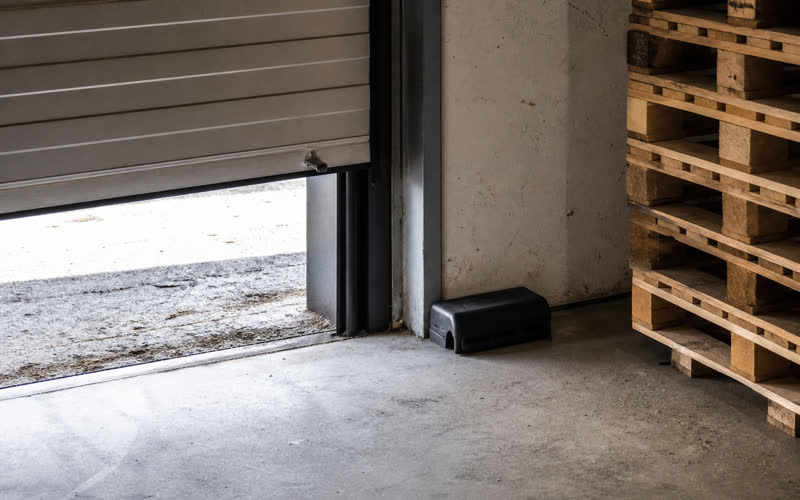
Loading bays
Bays and gaps around the doors are the main entry point. Often replacing the threshold seal is enough to reduce the problem substantially.
Pallets and stock layout
Pallets pushed up against the walls create hidden corridors. We recommend leaving a clear strip along the walls — it makes both control and inspection easier.
Goods-in as the most common way rodents are brought in
Most rodent problems in a warehouse do not walk in through the door — they roll in on a pallet. Wooden pallets that have spent the night in a supplier's yard, corrugated cardboard boxes with warm, dark cavities between the walls, and stretch wrap that forms hidden pockets make an ideal transport container for a mouse. In the goods-in area we recommend a simple routine: every incoming pallet is looked over from the sides and underneath before it goes on the rack, especially for food, pet food, seed and grain products. The signs are specific — gnawed cardboard corners with tooth marks roughly 3–5 mm wide, black droppings the size of a grain of sand in the folds of the wrap, spilt pellets. One unchecked pallet can carry a pregnant female deep into the centre of the warehouse, where she sits ten metres from any perimeter control point and outside its range.
High racking: where the evidence is actually visible
On racking six to twelve metres high, a visual check from the floor achieves nothing — the human eye simply does not reach the upper levels. In practice we work in layers. At floor level we check the bases of the rack uprights, where dust gathers and paw prints show up well; at the middle levels we use picking equipment or an access platform in the rows where the stock is in the risk group. On the top shelves the evidence usually appears as droppings on the shelf edge, gnawed corners of wrapping and characteristic grease marks along the vertical uprights the rodents climb. Mice move up vertical perforated steel without difficulty. That is why control points are planned not only along the walls but also in selected racking runs and on intermediate platforms — where the activity actually happens, rather than where it is convenient to walk.
Cold and dry storage areas need different approaches
In a freezer or chiller at minus eighteen or plus two degrees, rodents do not build nests — they come in for food and leave again. The real problem is the technical periphery: the compressor room, evaporator units, condensate drain pipes and the joints in insulated wall panels, where there is constant warmth and moisture. It is in these recesses that we find nesting material — shredded cardboard and insulation foam. In dry storage the picture is the opposite: there the stock itself is food, the temperature is stable, and a colony can live for months if stock rotation is poor. The solution differs accordingly. In cold areas we work mainly with mechanical monitoring and sealing structural gaps; in dry storage, with a denser network of control points and a firm requirement to keep the floor along the walls clear to a width of at least 40 cm.
Damaged stock, write-offs and packaging contamination
Losses caused by rodents in a warehouse rarely stop at the item that was gnawed. If droppings or urine traces are found on an opened pallet, the whole pallet has to be written off, because contamination in food and pet food products cannot be pinned down visually. The typical picture: one gnawed corner of a sack, pellets spilt across the pallet deck, and thirty sacks that can no longer be sold. That is why we recommend photographing every find with its location and the date — it gives a clear basis for an internal write-off and lets you see later whether the damage is concentrated in a particular run. It is also worth knowing that gnawed packaging is a signal that a nest is close by: mice do not damage stock ten metres from where they live. In practice a damage map tells you which racking sector to search for the colony itself.
Door seals and thresholds as a lasting solution
An adult mouse passes through a gap from 6 mm, a young rat from 20 mm. In industrial warehouses gaps like these are almost always present, and they are measurable. After a few years in service the bottom edge of a roller shutter door is deformed and no longer sits against the floor in several places; personnel doors have a worn bottom seal; ventilation openings have no mesh; cable entries are filled with hardened foam that a rodent gnaws out in a few hours. The practical answer is simple and long-lasting: a metal or hard rubber threshold seal on every external door, adjustment of the bottom edge of roller shutter doors or a new seal strip fitted, stainless mesh with an aperture of up to 5 mm on every ventilation opening and service entry, and cement or metal filling for holes in the wall. Treatment reduces the population, but only sealing stops new arrivals.
Working at night and at weekends without stopping logistics
In an active warehouse, forklifts, pickers and deliveries are moving through the racking runs during the day, and a proper inspection is simply not possible — half the risk areas are occupied. That is why we plan most of the work for the end of a shift, at night or at the weekend. In a quiet warehouse we can get freely to the floor edges along the walls, check under the racking with a torch, open technical recesses and work with an access platform without traffic restrictions. There is a behavioural benefit too: rodents are nocturnal, so in a dark, quiet building with a torch we often see the animals themselves and the routes they take, rather than just their traces. The exact time window is agreed in advance with the person responsible for the site. If the situation is acute, we will arrange a callout overnight as well — we work around the clock. Fill in the form with the floor area and your operating hours, and we reply within 5 minutes.
Frequently asked questions
How often should checks be carried out?
In warehouses usually once a month or less often, depending on the activity.
Do you provide documentation?
Yes — a written record of the work carried out and the layout of the control points.
Does the treatment disrupt operations?
No, the stations are placed where they do not get in the way of the work.
Can rodents get into a warehouse with deliveries?
Yes, and in practice it is one of the most common routes. Mice travel in the gaps in wooden pallets, in the cavities of cardboard boxes and in the folds of stretch wrap. So incoming pallets are worth looking over from the sides and underneath before they go on the rack, especially loads of food and pet food.
How do you check high racking if nothing can be seen from the floor?
We work level by level. The floor zone is checked visually, the higher shelves with the site's own picking equipment or an access platform in selected risk runs. The evidence there is usually droppings on the shelf edge, gnawed corners of packaging and grease marks along the vertical uprights.
How small does the gap under a door have to be to keep a rodent out?
A mouse passes through a 6 mm gap, so in practice you should aim for a full fit with no gap at all. Roller shutter doors are helped by a new bottom seal strip and adjustment, personnel doors by a threshold seal, and ventilation openings by mesh with an aperture of up to 5 mm.