
At a glance
- Service
- Rodent control in Riga
- Area covered
- Riga and the surrounding region
- Price
- From €40 — the figure quoted is the final price
- Availability
- 24/7, weekends and nights included
- Reply time
- Within 5 minutes of the form being submitted
- How to book
- Through the enquiry form only
Rodent control means a planned programme, not a one-off laying of poison. The difference is that the treatment starts with an inspection: first we establish where the rodents are living and how they get in, and only then choose a method.
We deal with rodents only. That means the behaviour of rats and mice, their travel routes and the methods of controlling them are the only things we work with every day — not one service among many on a list.
What rodent control involves
Rodent control covers inspecting the site, identifying rodent activity and entry points, assessing the scale of the problem, choosing the most suitable method, placing bait stations and mechanical traps, and a follow-up check. A full cycle of work ends with advice on how to stop it happening again.
Bait stations and mechanical traps
Tamper-resistant bait stations are lockable boxes that only a rodent can get into — not a child, not a pet. Mechanical traps are the answer where bait is not wanted: near food, in children's rooms, or in spaces where it matters that the rodent does not end up inside the structure. Often the right answer is a combination of the two.
When rodent control is needed
If you hear noise in the walls or ceiling at night, find droppings, notice gnawed packaging, cables or insulation, or smell a persistent sharp odour — the rodents are already inside. The longer a population is established, the more expensive and the longer the treatment.
What rodent control is, and how it differs from setting traps yourself
Rodent control is a planned programme in which the treatment is based on a prior inspection rather than on traps put down at random. The technician first establishes which species is active on the site: the brown rat moves along horizontal route lines beside walls and sewer stacks, while the house mouse tends to nest closer to the food source and travels within a small radius. Identifying the species changes all the tactics that follow, because a mouse needs only a 6–7 mm gap while a rat needs 20 mm. Setting traps yourself usually covers only the spot where the rodent was seen and ignores how they are getting in. Professional rodent control involves placing control points along the whole contour the rodents move on, documented monitoring and a follow-up check, so the result holds even after the activity has visibly stopped.
Inspection: how rodent signs are read on site
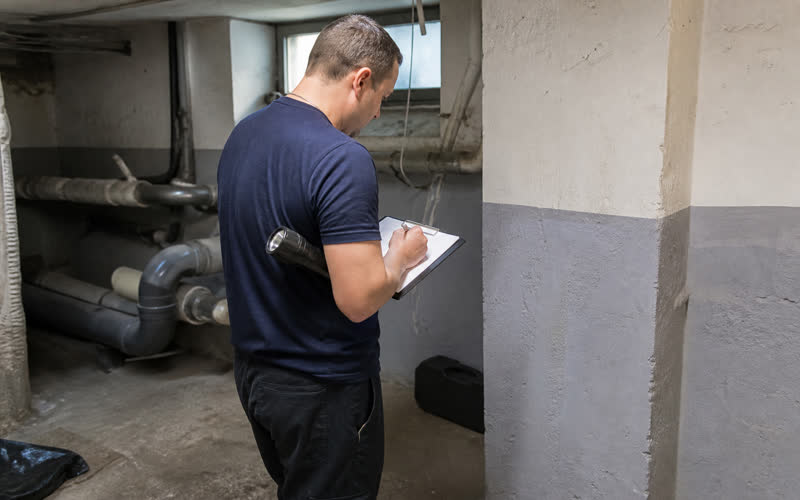
The inspection starts with the basement, the heating substation and the service shafts, because that is where a permanent population establishes itself in Riga blocks of flats. The technician looks for specific signs: droppings, roughly 3–6 mm long for mice and 15–20 mm for rats, grease marks along the bottom of walls, gnawed cable sheathing, and prints pressed into a layer of sand or dust. It also matters to say how fresh the finds are — dry, crumbling droppings indicate old activity, soft and shiny ones current activity. Ventilation openings, drainage entries, floor-to-wall junctions and gaps under doors are all checked. The result is a plan of the site with control points marked on it, on which all the subsequent rodent control is based.
Rodent control methods: chemical, mechanical and combined
The chemical method uses a rodenticide formulated in wax blocks, granules or paste and always placed inside a tamper-resistant bait station. Second-generation anticoagulants act with a delayed effect, so the rodents do not connect the bait with being poisoned and do not start avoiding it. The mechanical method relies on spring traps and enclosed traps, and it is chosen in food handling, children's institutions and flats where chemicals are unwanted or where it matters to remove the dead rodent immediately. The combined approach is the most common in Riga buildings: bait stations go in the basement and around the perimeter of the building, while mechanical traps do the work inside the flat and in the plant rooms. The choice of method is determined by the type of site, the presence of children and pets, and the size of the population.
Rodent control in Soviet-era apartment blocks
In a Soviet-era apartment block with a damp basement and an uninsulated heating substation, rats find everything they need — warmth, condensation and protected nesting places between the pipes. The typical way in is a damaged drainage entry, a collapsed basement window reveal or an open shaft base. Treating a single flat in such a building is pointless: the rodents travel vertically up the risers and are back within a few weeks. An effective approach covers the whole basement contour, the lower part of the stairwell and the bin area beside the building. At the same time the physical gaps have to be closed — pipe entries are filled with metal mesh and mortar, because a rodent gnaws through expanding foam in a couple of nights. Treatment without that building work gives only a short-lived effect.
Monitoring after treatment and re-inspection
The first treatment is followed by a monitoring stage in which the amount of bait taken at each control point is assessed. In the first week the take is usually highest at the most active points, and after that it should gradually fall — if it does not, that points to a further population or an influx from the neighbouring area. The second visit usually takes place within 10–14 days: bait is topped up, traps are checked, dead rodents are removed and ineffective control points are moved if needed. On sites with a permanent risk, such as food shops, warehouses and catering businesses, monitoring becomes a regular service with a fixed map of points. The findings of each visit are recorded so that changes in activity can be compared over time.
Rodent control services for private houses and commercial premises
At a private house the work starts outside: bait stations go around the perimeter roughly every 8–10 metres, with attention to the log store, the compost, the greenhouse and the foundation vents. Inside, the basement, the attic and the points where services pass through the foundations are checked. On commercial premises the logic is different — what matters there is an unbroken barrier: an outer line around the building, an inner line along the walls, and mechanical traps in food areas where a rodenticide is not permissible. Prices are final: one room €40, two rooms €55, three rooms €70, four rooms €80, a private house €90–110, commercial premises from €70, minimum callout €40. You can make a request by filling in the form on the website — we reply within 5 minutes and work across Riga 24/7.
What to do before and after the treatment so the result holds
Before the technician arrives, clear access to the basement, the bathroom and the space under the sink, and clear the floor edges along the walls, because that is exactly where the control points go. Keep food in sealed containers or glass jars — a plastic bag will not stop a rodent. For a week after the treatment, do not touch the bait stations and do not move the traps, even if they seem to be in an awkward place: every point is chosen according to the travel route, not convenience. Empty the bins regularly and do not leave pet food out overnight. If an unpleasant smell appears in a wall or partition during the treatment, it usually means a dead rodent in an inaccessible spot — that is dealt with separately, by opening an access point, and you can request it through the same form.
Frequently asked questions
How long does rodent control take?
The first treatment usually takes from 30 minutes to a couple of hours depending on the size of the site. The result is normally visible within the first few days, but full control needs a follow-up check.
Is rodent control safe for children and pets?
Yes, provided tamper-resistant bait stations are used and placed correctly. Where there are children or pets we use lockable stations or mechanical traps.
Do we have to leave the house during the treatment?
No. Rodent control does not require rooms to be cleared or occupants to move out — unlike some other treatments.
What is rodent control in plain terms?
It is a planned programme in which the site is inspected first, control points with bait stations or mechanical traps are then put in place, and monitoring follows. Unlike a few traps put down at random, this approach covers the whole route the rodents travel and their entry points into the building.
How many times does the treatment have to be repeated?
In most flats a treatment plus one follow-up visit within about 10–14 days is enough. In private houses and on commercial premises, where there is a constant influx from outside, rodent control services are usually organised as regular monitoring with a fixed map of control points and periodic topping up of bait.
Why do rodents come back after a treatment?
The commonest reason is physical gaps left unsealed — drainage entries, ventilation shafts and basement window reveals. A mouse needs only a six to seven millimetre opening. If only one flat has been treated while the population in the basement remains, the rodents come back up the risers within a few weeks, which is why the whole contour of the building has to be treated.
What rodent control methods are used in a flat with children?
In such cases the preference is for mechanical traps and tamper-resistant bait stations placed out of children's reach behind appliances and in service voids. Rodenticide is never spread out in the open. The technician chooses the specific solution during the inspection, taking account of the layout and the presence of pets.