
At a glance
- Page topic
- Sealing entry points against rodents
- Area covered
- Riga and the surrounding region
- Price
- From €40 — the figure quoted is the final price
- Availability
- 24/7, weekends and nights included
- What works
- Metal mesh with a 5 mm aperture and cement mortar; expanding foam does not
- How to book
- Enquiry form only — we reply within 5 minutes
If you ask which single step gives the greatest long-term effect, the answer is sealing entry points. Without it, any treatment is a temporary fix.
Where to look for gaps
Around pipe entries under the sink and bath, in ventilation grilles, around radiator pipes, under external doors, in foundation cracks, around cable entries and along the bottom edge of the facade. A simple test: if a pencil goes in, so does a mouse.
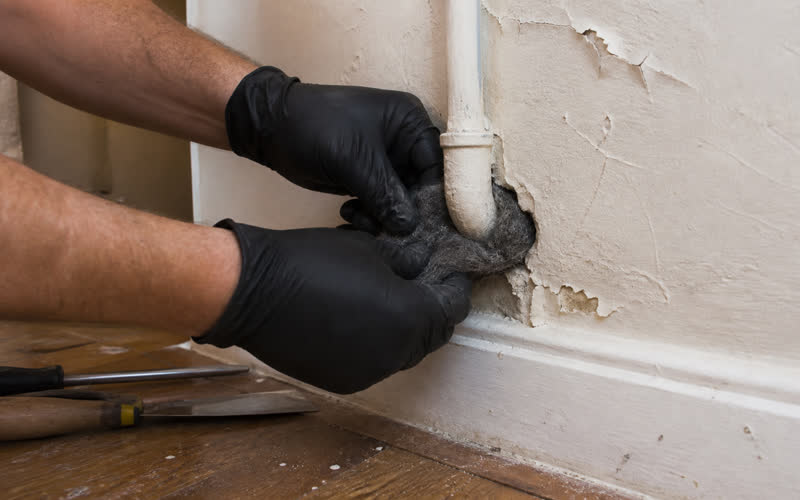
Which materials work
Steel wool, galvanised mesh with an aperture of up to 5 mm, cement mortar and metal plates. Rodents cannot gnaw through these.
What does not work
Expanding foam, silicone, plastic, wood, cardboard and fabric — rodents chew through them within days. Expanding foam is the most common mistake: it looks like a solution, but a mouse gets through it easily.
The order matters
Treatment first, sealing afterwards. If you seal the gaps while the rodents are still inside, they stay in the structure and look for another way out — often into the living areas.
A systematic survey of the building: from the ground up
Sealing entry points against rodents starts not with materials but with a proper walk-round. Go around the building clockwise. On the first circuit look only at the zone from ground level to one metre — that is where the great majority of real entry points are. Clear leaves and grass away from the foundations; the cracks hide right underneath them. On the second circuit check the band from one to three metres: facade joints, window sills, ventilation grilles, the air-conditioning pipe. On the third circuit look up — the roof edge, the eaves, the downpipe fixings and the loft vents. A rat climbs a rough vertical wall and a downpipe, so height is no protection. Photograph every find as you go and order the list by the size of the opening, not by how convenient it is to close. After the walk-round, repeat the check after the first rain and the first frost — damp and freezing are exactly what expose the weak spots.
Typical entry points in Latvian buildings
In older timber and masonry buildings, rodents most often come in through pipe entries. The pipe passes into the foundation through a hole 30–50 mm wider than itself, and that ring-shaped gap stays unsealed for decades. The second classic point is cable entries with cracked sealant. Basement windows are often missing glass or have a rotten frame, while foundation cracks widen with every freeze-thaw cycle. In apartment buildings, check the refuse chamber door and the base of the ventilation shaft. In private houses the trouble spots are the bottom rubber seal on the garage door, thresholds under external doors and the bottom edge of an insulated ventilated facade — if the air gap between the cladding and the foundation is not covered with mesh, a rodent gets into the warm layer and travels the whole perimeter of the building unobstructed. At roof level, check the ends of the eaves and the point where the rafters come through the cladding. Two weeks after sealing, check the work with a thin dusting of flour on the inside: tracks in the powder mean the job is not finished.
Galvanised mesh with a 5 mm aperture — why exactly that
The choice of material comes down to two numbers. An adult house mouse gets through a 6–7 mm opening, a young one through as little as 5–6 mm. A brown rat needs about 20 mm. So any mesh with an aperture above 5 mm is effectively decoration. What works in practice is galvanised mesh with a 5 mm aperture or smaller and a wire of at least 0.8 mm. Aluminium and plastic mesh are no use — a rodent's incisors go through them in a few nights. Galvanising is not a luxury in the Latvian climate: damp at foundation level fluctuates all year, and untreated steel will rust through there in two or three seasons, leaving a hole exactly where you will not think to look. Never screw the mesh over the face of the opening — a rodent will peel back the corner. Push it into the depth of the opening and cover it with repair mortar, working the mortar into the mesh so the filling cannot be pulled out.
Thresholds, doors and garage doors
You open the door yourself every day, which is why it gets underrated. Measure the gap under the external door with a ruler or a coin. If a pencil goes in freely, to a mouse the door is standing open — and on an old timber door with a settled frame the gap is exactly that. The answer is a threshold or a door brush dropped down to full contact with the floor; an aluminium profile with a brush insert lasts better than a soft rubber flap, which a rodent bites through. Face the bottom edge of the door on the outside with a 100 mm strip of sheet metal, because a rodent gnaws timber from the bottom upwards. On garage doors, check the bottom rubber along its whole length, especially at the corners where it is usually cracked and lifting. If the concrete floor is uneven, the rubber only meets it in the middle and a crescent-shaped gap is left at both ends — level it with a strip of mortar or a profiled threshold seal.
Ventilation openings: cover them, do not close them
Ventilation grilles are a frequent entry point, and this is exactly where the most dangerous mistake is made — bricking or foaming the opening shut. These vents carry moisture out of the basement, the floor structure and the ventilated facade. Sealed tight, within a few seasons they produce mould and timber rot — a problem that costs far more than rodents do. The right approach is to keep the airflow and exclude the animal mechanically. Fit galvanised mesh with an aperture of up to 5 mm on the inside of the opening or behind the existing grille, fixed around the entire perimeter. Manufactured plastic grilles often have 10–15 mm holes and will not stop a mouse. Cover the ends of ventilation pipes on the roof as well, along with cooker hood and heat-recovery outlets. Clean the dust off the mesh once a year so the draught does not drop.
Why sealing after treatment decides whether the problem returns
Baits and traps reduce the existing population but do not change how accessible the building is. If the entry points stay open, new animals from neighbouring ground take the vacated space, and a few months later the whole thing starts again. Physical exclusion is the only method there is no habituation to: an animal learns to avoid a trap, but it cannot learn to squeeze through a bricked-up opening. The sequence is this — inspection, then treatment, and only then full sealing once there is no activity left inside; otherwise the animals end up shut inside the structure. Narrow cracks and pipe entries you can close yourself, but a foundation crack running right through, or the bottom edge of a ventilated facade, needs a builder. If you are not confident about mapping the entry points, fill in the form — we work in Riga around the clock.
Frequently asked questions
How big a gap is dangerous?
6–7 mm is enough for a mouse, 20 mm for a rat.
Is expanding foam any good?
No, rodents chew through it.
Seal first or treat first?
Treatment first, then sealing.
What mesh aperture is right against mice and rats?
No larger than 5 mm. An adult house mouse gets through a 6–7 mm opening and a young one through smaller still, so an 8 or 10 mm mesh stops nothing. Choose galvanised or stainless steel mesh with a wire of at least 0.8 mm. Aluminium and plastic mesh are no use, because a rodent chews through them.
Can foundation vents be bricked up to keep rodents out?
No. These vents carry moisture out of the basement and the floor structure; close them tight and within a few seasons you get mould and timber rot. The right solution is to keep the airflow and fix galvanised mesh with an aperture of up to 5 mm behind the grille, covering the full perimeter of the opening.
How big a gap under an external door is a problem?
6–7 mm is already enough for a mouse, and on old timber doors the gap is often 10–15 mm. Measure it with a ruler. The answer is an aluminium threshold with a brush or a stiff rubber blade that meets the floor across the full width. It is worth facing the bottom edge of the door on the outside with a strip of sheet metal, because a rodent gnaws timber from below.
How do you make sure the sealing has worked?
Dust a thin layer of flour or talc along the sealed spots on the inside and check after two nights for tracks in it. After two weeks, walk around the outside of the building looking for freshly dug soil, tooth marks on the mortar and disturbed sealant. Repeat the check after the first rain and the first frost.