
At a glance
- Service
- Rodent control in a restaurant
- Area covered
- Riga and the surrounding region
- Price
- From €40 — the figure quoted is the final price
- Availability
- 24/7, weekends and nights included
- Reply time
- Within 5 minutes of the form being submitted
- How to book
- Through the enquiry form only
In a restaurant a rodent problem is a matter of hygiene and reputation at the same time. One rodent seen by a customer can cost more than a whole year of servicing.
Kitchen and storage
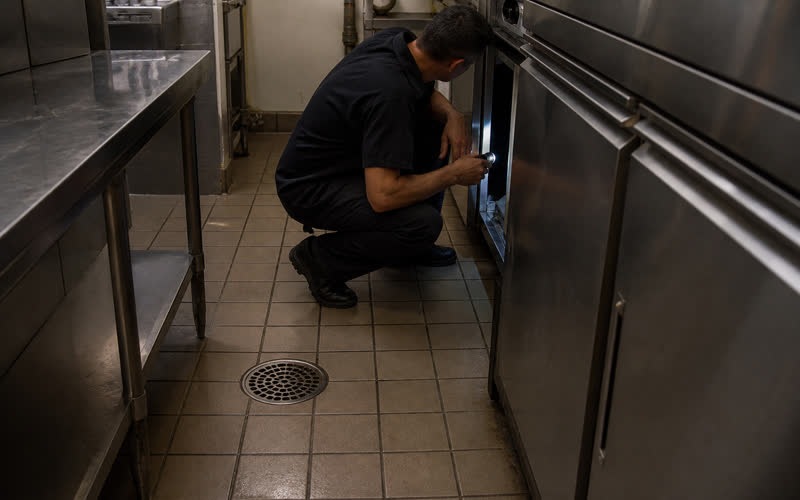
We inspect behind the range and the fridges, the dry goods shelving, the drain entries and the ventilation. Warmth and food make the kitchen the most attractive place on the site.
The waste area
The bin store is the most common source. If the bins stand by the entrance door or without lids, treatment inside will give only a short-lived result.
Work outside opening hours
We work at night or before opening so that treatment never takes place with customers present. That is also why we accept enquiries 24/7.
Grease traps and floor gullies as a way in
In a restaurant the most common route in is not the door but the drains. A rat swims and moves easily along dry rainwater and foul drainage pipes, and in the older building stock of central Riga the sewer stacks are often ceramic with cracking joints. The critical points in the kitchen are floor gullies with no water trap or with a dried-out trap, a grease trap lid with a deformed seal, and an inspection hatch in the plant room that nobody has opened for years. The practical check takes a few minutes: is there water in every gully, is the grating fixed down, and is its slot no more than a couple of millimetres wide. The solution is usually mechanical — a non-return valve or simply a metal grating fixed with screws, a new seal on the grease trap lid, and topping up the traps in those gullies that are not used day to day.
Equipment plinths and voids behind cold rooms
Kitchen equipment creates dozens of hidden cavities that are warm, dark and out of everyone's reach. Tiled equipment plinths with a cracked joint, the wall hidden behind the extraction hood, the service recess behind the range and the oven, the plant compartment of a cold room, and the roughly 5–10 cm gap between the back of the cold room and the wall — this is precisely where we find nesting material, droppings and food debris. During the inspection these places have to be looked at with a mirror and a torch, sometimes by removing a plinth panel. The long-term answer is structural: close the joints in the plinths, fit removable kickplates that can be cleaned, and make sure heavy equipment stands on legs with at least 15 cm of clear space underneath, so that the floor beneath it can actually be washed and checked.
Why bait is not used in food preparation areas
In the kitchen, on preparation surfaces, near open food and utensils, toxic bait never appears. There we work only with mechanical and monitoring devices: enclosed mechanical traps along the wall lines and inert monitoring blocks that contain no active substance and serve only to show whether there is movement in a given spot. Every point is numbered and recorded on a layout plan, so that no device can go missing or end up close to food. A more active approach is used only outside the food handling areas — for example in the waste room, around the yard perimeter or in a service corridor, where food is neither stored nor prepared. That boundary is strict, and it is one of the main reasons restaurant treatment is planned with the site plan in hand rather than improvised on the spot.
Daily staff routines that reduce the pressure
No treatment works against a kitchen where food is left out every night. In practice a few simple actions on the closing shift are decisive. All the bins in the kitchen and the bar are closed with lids and taken outside before the premises are locked up, not in the morning. The floor under the range, the fryer and the prep benches is washed every night, because that is exactly where the grease and crumbs collect that make a full food source for a rodent. Dry goods — flour, rice, sugar, pasta — are decanted into rigid containers with sealing lids, not left in open paper sacks. In the bar area the empty bottles should be rinsed and the sugar and fruit residues cleared. These routines do not replace treatment, but they decide whether the site stays clear for months after treatment or is reoccupied within a few weeks.
One mouse seen by a guest costs more than a year of servicing
In a restaurant the real loss is rarely the spoiled stock. It is one guest who spots a mouse in the dining room, photographs it and posts a review or a social media entry. That entry stays in the search results for years, and its effect on bookings cannot be undone with an apology. That is exactly why it is worth working preventively in restaurants rather than reacting to a visible problem: regular checks of control points, perimeter monitoring and sealing entry points in the structure cost considerably less than one season of falling custom. For commercial premises treatment starts from €70, and we calculate the final figure from the floor area and the type of site — kitchen, dining room, bar, store and waste area taken together. If you would like an assessment for your site, fill in the form and we reply within 5 minutes.
What to do the same evening if a rodent is spotted during service
If a mouse or a rat appears in the dining room or the kitchen during service, the important thing is to act quietly and quickly. First step — calm the situation and make sure the staff do not start chasing the animal around the room in front of guests; that only spreads it into other areas. Second — confine the area as far as possible: close the doors to the corridor, the store or the plant room so the animal stays in one place. Third — after closing, immediately remove and discard all open food in the area where the animal was, and wash the surfaces down. Fourth — record the exact place and time, because at the next inspection that points straight at where to look for the entry point. We carry out callouts around the clock, including the same night after closing. Fill in the form with the address of the site and a description of what happened.
Frequently asked questions
Do you work after closing?
Yes, that is the option we recommend for restaurants.
Does the treatment affect food?
No. In food areas we use mechanical traps and enclosed stations.
How quickly can you get here?
We reply to an enquiry within 5 minutes and work around the clock.
Can rodents get into a restaurant through the drains?
Yes, it is one of the most common routes, particularly in older buildings. The risk points are floor gullies with a dried-out trap, loose gratings, a grease trap lid with a damaged seal and inspection hatches left open. A non-return valve, fixed metal gratings and regular topping up of the traps all help.
Is poison put down next to food in the kitchen?
No. In food preparation and storage areas we use only mechanical traps and monitoring points with no active substance. More active products are placed solely outside the food handling areas — in the waste room, a service corridor or around the yard perimeter.
What should we do if a guest spots a mouse in the dining room during service?
Do not chase the animal around the room. Close the doors to confine the area, discard all open food in that spot after closing and wash the surfaces down. Note the exact place and time — that shows where to look for the entry point. Fill in the form; we come out at night as well.