
At a glance
- Service
- Rodent control for businesses
- Area covered
- Riga and the surrounding region
- Price
- From €40 — the figure quoted is the final price
- Availability
- 24/7, weekends and nights included
- Reply time
- Within 5 minutes of the form being submitted
- How to book
- Through the enquiry form only
On a commercial site, rodent control differs from a flat in three ways: the floor area, the constant pressure from outside, and the fact that the result has to be demonstrable.
A system of control points
On commercial sites we work with numbered control points and a plan of where they are. Every check records the activity at each point, so it is clear where the source of the problem is.
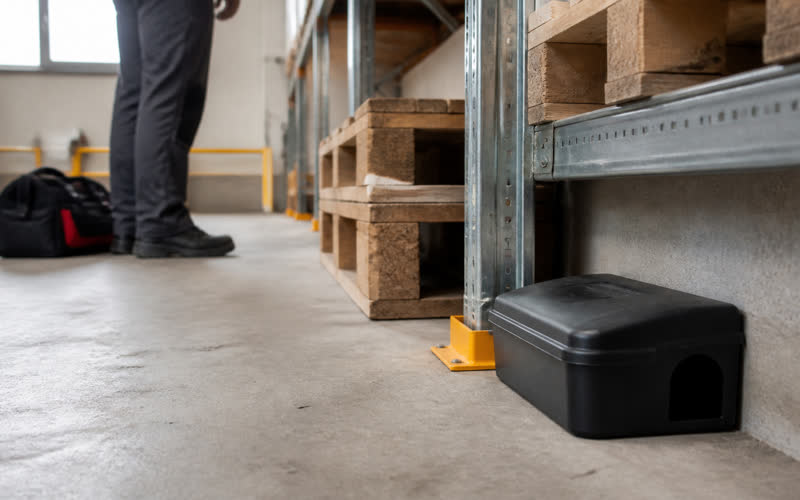
Regular servicing
Periodic checks, monitoring of the control points, replacement of used product and a written record of the work carried out. The frequency depends on the type of site and the level of activity.
Types of site
We serve warehouses, production facilities, food businesses, restaurants, cafés, shops, offices, hotels, educational establishments and farms.
How a control point map is actually drawn up on a commercial site
Rodent control in businesses starts not with bait but with a plan of the site. The specialist first walks the outer perimeter and marks the places where rodents can physically approach the building: cracks in the foundations, service entries, ventilation openings, the bin area and the edges of loading bays. Perimeter stations usually go about ten metres apart, more closely where there is vegetation or where the bins are. Only then does the interior begin — the bases of walls, the corners of plant rooms, the ends of racking, rooms holding food ingredients. Indoors the spacing between points is smaller, because a rodent moves along the wall indoors rather than across open floor. Every point gets a number, and the number is drawn onto the site plan. That plan stays with the client. It means that six months later any member of staff or any new specialist knows exactly where point thirteen is and why it is there.
What is recorded at each visit and why a written record matters
When inspecting a site, the specialist does not stop at a note saying "all in order". At each numbered point it is recorded whether the bait has been taken, how much of it, whether there are droppings in the station, and whether the unit is damaged or has been moved. Observations away from the points are noted separately: gnawed cardboard boxes, tracks in sand or dust along a wall, gnawed cable sheathing, doors left open that ought to be shut. These entries make up the written record of the work carried out, which is kept on site together with the control point layout plan. When a food safety or occupational safety inspector arrives, the business has to show not a promise that rodent control is happening, but a record of what was done and when. More practically still: the record shows a trend. If points 4, 5 and 6 by the warehouse doors show activity three times running, the problem is not the bait — the problem is the doors.
Goods-in as the main route by which rodents arrive
Some businesses look for the rodents' way in through the walls, when the rodent came in through the door — along with the goods. Wooden pallets stored outside by the fence, cardboard boxes of food products, consignments from other warehouses: all of these can bring in both animals and their droppings. The practical solutions are simple but require discipline. Pallets are inspected from underneath before being brought in. Pallets that have stood outside are not put next to food ingredients. Cardboard from deliveries is broken down and removed the same day rather than piling up in a corner for weeks. A separate group of control points is set up in the goods-in area and checked more often than the rest, because this is where the first signs appear soonest. If activity shows up only in goods-in and nowhere else, that is a strong signal that the source is in the supply chain rather than in the building itself.
What staff should report and what they should never do
The specialist comes to the site on a schedule. Staff are there every day, so it is the staff who most often notice something first. It is worth reporting gnawed packaging, black grain-like droppings on a shelf or the floor, an unusual smell in a plant room, noise in a suspended ceiling in the evening, and any station that is damaged or has been moved. What must not be done matters just as much. Control points must not be moved during cleaning or because they are "in the way". They must not be opened, washed out or shifted elsewhere, because the link to the plan and the earlier records is then lost. Staff must not add bait of their own next to a station. If a point is blocked by pallets, the answer is to clear it, not to move it. A simple briefing note in the company's internal procedures settles the matter for years.
Building work that reduces repeat costs
Rodent control for businesses gets cheaper once the building stops being easy to get into. Most of the solutions are not expensive. Sealing thresholds and the bottoms of doors removes the couple of centimetres of gap that mice come through every night. Metal mesh on ventilation openings and basement windows stops both mice and new attempts by rats. Brush seals on staff and waste exit doors only work if the doors are actually kept shut. Pipe and cable entries in walls are filled with metal material, not expanding foam — a rodent gnaws through foam in a few nights. Outside, simple hygiene helps: bins with lids, a clear strip along the foundations, vegetation cut back. We record these points during the inspection as recommendations to the site manager, because without them each treatment only holds the situation rather than changing it.
How visit frequency is set and what makes up the price
Rodent control for commercial sites is not sold as a fixed package that suits everyone equally. Frequency is set by the activity data. At the start, visits are more frequent, because it has to be established how widespread the problem is and which zones are active. Once several checks in a row show clean points, the interval is extended. If activity returns — for example in autumn, when rodents look for warmth, or after building work on a neighbouring site — the frequency goes up again. The price for commercial sites starts from €70, and the final figure is calculated individually according to the floor area and the type of site. It is affected by the number of control points, the nature of the premises, whether there is a waste area, and whether the work has to be done outside business hours. We serve sites in Riga around the clock, including emergency callouts. Describe your site in the form — we reply to enquiries within 5 minutes.
Frequently asked questions
Do you offer regular servicing?
Yes, with periodic checks and documentation.
How much does treating a commercial site cost?
From €70; the exact figure depends on the floor area and the type of site.
Do you work outside business hours?
Yes, including nights and weekends.
What happens if a control point on site goes missing or is damaged?
A missing or crushed point is recorded in the notes and reinstated in the same place according to the numbering on the plan. What matters is establishing why: most often a forklift has caught it or the cleaning staff have moved it. If the same location keeps suffering, we move the point a couple of metres and enter the change on the plan, so the documentation stays accurate.
Will rodent control disrupt the business?
Usually not. Checking the control points in a warehouse or a shop takes from half an hour to a couple of hours depending on the floor area, and the work is done along walls and in technical areas. On sites where customer flow or the production process demands it, we schedule the inspection outside business hours, including at night or at weekends. Times are agreed in advance by filling in the form.
What documentation does a business receive after servicing?
The control point layout plan with its numbering stays on site, together with a written record of the work carried out at each visit: the date, the points checked, the activity found, the actions taken and the recommendations to the site manager. The business can produce these records during an inspection as a record of what was done on the site and when.
Is one contract enough in a building with several tenants?
Rodents do not recognise tenancy boundaries — they move through the shared cable ducts, the ventilation and the basement. If only one unit is serviced, activity returns from the neighbouring zone. The most effective solution is a single control point system for the whole building, ordered by the manager or the owner. We do service individual units separately, but then the common areas remain a source of risk.