
At a glance
- Service
- Rodent control in a private house in Riga
- Area covered
- Riga and the surrounding region
- Price
- From €40 — the figure quoted is the final price
- Availability
- 24/7, weekends and nights included
- Reply time
- Within 5 minutes of the form being submitted
- How to book
- Through the enquiry form only
In a private house you own the whole property, so the problem can be solved completely. At the same time the perimeter is long: foundations, ventilation grilles, garage, shed, compost heap and heating line.
Perimeter inspection
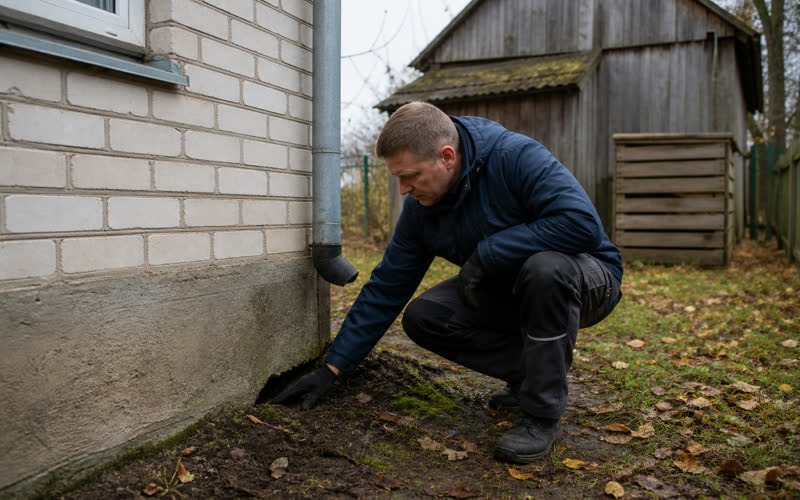
We walk the outside of the house looking for burrows along the foundations, gaps around pipe entries, damaged ventilation grilles and spaces under the decking. Outdoor bait stations go along the runways.
Food sources in the yard
Compost, bird feeders, animal feed in the shed and bins left without lids are the most common reasons rodents pick this particular house.
Autumn migration
In September and October field mice and rats look for warmth. Private houses are the first building on their route, so preventive treatment before the cold sets in costs less than treatment in midwinter.
Walk the house in a circle — the control point route
Rodent control in a private house starts with one full circuit of the building, clockwise, missing no corner. The first control point is the foundations: look at the horizontal joint between the foundation blocks and the wall, at cracks in the render, and at soft, washed-out ground where the rainwater downpipes discharge. The second is the ventilation grilles in the foundations — in timber houses they are often rusted through or missing altogether. The third is the pipe and cable entries: water supply, sewer, electrical conduit, heat pump lines. The fourth is the threshold of the garage door, where the rubber seal cracks over time and leaves a two-centimetre gap beneath it. The fifth is the decking and the zone under its base. Then move on to the outbuildings — shed, log store, compost heap, greenhouse. At each point note three things: is there a gap, is there food, are there fresh tracks. A circuit like this takes about forty minutes.
Where to put bait stations around the perimeter and why exactly there
Stations around a private house are not spaced evenly with a tape measure — they follow the rodents' actual runs. In practice the distance between points is roughly eight to twelve metres, but that figure is only a starting point. Each station is turned with its entrance facing a wall or a fence, because rodents move along vertical surfaces and only cross open ground when forced to. Places where a station always works: the outside corners of the building, the end of the log pile, the back of the compost bin, the shed wall, the run of the heating line, the fence and hedge line. Places where a station does not work: the middle of an open lawn, the edge of a path, a convenient spot by the door. A medium-sized house on a plot of 600–1,000 m² usually comes to eight to fourteen points. The first check is after seven to ten days — how consumption is spread across the stations shows which side the pressure is coming from.
Loft or basement — two different problems
The height the sound comes from tells you a great deal. If at night you hear light, quick footsteps across the ceiling, rolling sounds and rustling in the insulation, it is almost always mice that have got into the loft through the roof eaves. Mice climb well on rough render, timber cladding, downpipes and on trees whose branches reach the roof. In the basement and the foundation zone the noises are heavier, less frequent, with scratching and gnawing — there you more often have rats coming in at ground level, along the sewer line or through a washout under the foundations. The response differs. In the loft you work on entry points at roof level: eaves closures, ventilation openings, the chimney collar. In the basement you work at ground level: service entries, ventilation grilles, sewer inspection chambers. If the noises are in both places at once, the house has already been reached from two sides and the treatment has to cover the whole property.
What to seal and with what — materials that actually hold
Rodents' incisors grow throughout their lives, so they gnaw through most of the soft materials common in building work. Expanding foam is not a solution in any situation — a mouse chews a passage through it in a few nights, and behind the foam a hidden, invisible burrow remains. Silicone, plaster and tape are just as useless. Only two principles work: metal and mineral mass. For gaps up to about thirty millimetres use galvanised metal mesh with an aperture of up to five millimetres, packed in tightly and then rendered over with cement mortar. Larger holes in the foundations are filled with mortar reinforced with mesh. Ventilation grilles get stainless steel mesh fitted on the inside, keeping the airflow. The bottom of doors and gates gets a metal threshold or sheet edging screwed on. Timing matters too: sealing happens after bait consumption has stopped, not before, otherwise the animals are shut inside the building.
Garden and yard — what actually feeds the rodents
Most rodent problems at private houses start not in the house but within a fifteen-metre radius of it. A log pile pushed up against the wall is an ideal nesting site: dry, warm, with hundreds of hidden gaps. Move it at least a metre from the wall and lift it onto pallets twenty to thirty centimetres above the ground so you can see underneath. Compost is the second main source — an open heap with kitchen waste is a buffet at night, so switch to a closed compost bin with a lid and a metal mesh base, and do not put meat, fish or dairy in it. Fallen apples and plums under the trees need collecting, not leaving until spring. Bird feeders scatter seed straight onto the ground in winter — move them away from the building and put a tray underneath. Do not leave the dog's or cat's bowl in the yard overnight, and keep the feed sack in a metal or hard plastic container with a lid.
Outbuildings feed the house — shed, garage, greenhouse
At private houses the house itself is very often only the second stage. The population lives in the shed or the old garage, where there is bird feed, crates of vegetables, seed, dry grass and nobody looks for long stretches, and only when the temperature drops or the food runs out does part of the group move into the warmer building. That is why treatment covering only the dwelling gives a short-lived effect — a few weeks later the next group arrives from the outbuilding. The practical answer is to treat the whole property as one site: stations around the house perimeter and also inside and around the shed and garage. The owner is well advised to review storage too: vegetables and seed in metal or thick plastic containers, cardboard boxes out, a clear strip of floor along the walls for inspection. The old pile of furniture and building rubble in the corner of the shed has to go — there is nearly always a nest under it.
Why autumn decides the whole season
September, October and November are the months when a private house becomes a target. Natural food in the fields and gardens runs out, night temperatures drop, and rodents start looking for a warm, dry place to overwinter — the foundation zone, the loft, the heating duct, the shed. In this period one or two mice that get into the house can become dozens by January, because in the warmth breeding does not stop. The practical conclusion: perimeter stations should go in before the first frosts, not once you can already hear noises in the ceiling. Autumn treatment is usually simpler and cheaper, because the animals are still outside and get intercepted at the perimeter. By midwinter they are already inside the structure and the work becomes harder. If in autumn you notice fresh diggings by the foundations or droppings in the shed, fill in the form on the website — we reply to enquiries within 5 minutes, evenings and weekends included.
Frequently asked questions
Do you treat the yard as well?
Yes, perimeter treatment is part of rodent control at a private house.
How much does rodent control at a private house cost?
€90–110 depending on the floor area and the length of the perimeter.
Are the stations safe for dogs?
Yes, outdoor stations are lockable and fixed in place.
What is the difference between rodent control in a private house and in a flat?
In a private house you control the whole property — building, yard, outbuildings and perimeter — so the problem is fully solvable. In a flat the rodents come from communal areas and neighbouring flats, and treating a single flat often gives only a partial result. In a house the outside perimeter does the work, and in a flat that perimeter simply does not exist.
How many bait stations does a medium-sized private house need?
A plot of 600–1,000 m² with a house and one or two outbuildings usually comes to eight to fourteen points. The number depends on the length of the perimeter, how many outbuildings there are, and how many runs the inspection finds. Stations are placed along the actual runways, not evenly by the metre.
Is expanding foam any good for sealing rodent holes?
No. A mouse chews a passage through foam in a few nights, and behind it an invisible burrow remains, so the foam only hides the problem. Use galvanised metal mesh with an aperture of up to five millimetres, packed into the gap and rendered over with cement mortar. For ventilation grilles — stainless steel mesh on the inside.
The noises are in the loft, but the stations go around the house — will that help?
The perimeter intercepts the inflow from outside, but on its own it is not enough if the nest is already in the roof insulation. In that case you work on two levels: points in the loft by the nesting zone, and the perimeter around the building so that no new animals come in. After that the roof eaves and ventilation openings are sealed.
How long does it take to see a result at a private house?
The first changes are usually visible within seven to ten days — the noises decrease and bait consumption shifts. A full cycle with a follow-up check takes two to four weeks depending on the size of the population and the number of outbuildings. Treatment at a private house costs €90–110, with a minimum callout of €40.