
At a glance
- Service
- Rat extermination in Riga
- Area covered
- Riga and the surrounding region
- Price
- From €40 — the figure quoted is the final price
- Availability
- 24/7, weekends and nights included
- Reply time
- Within 5 minutes of the form being submitted
- How to book
- Through the enquiry form only
Rats are warier than mice. They avoid new objects in their territory — this behaviour is called neophobia — and that is exactly why traps set by householders often fail to work for several days. Professional treatment takes it into account at the planning stage.
Riga is dominated by the brown rat, which digs burrows, moves through the sewers and most often enters a building through the basement or pipe entries.
How rat extermination works
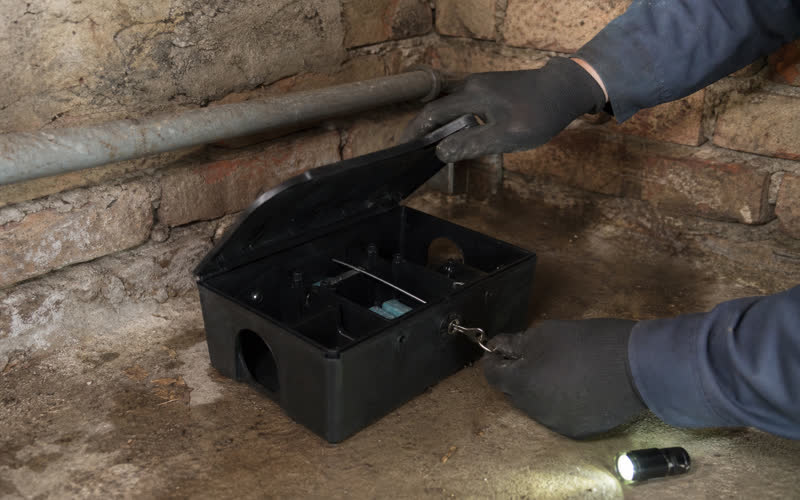
First we find the runs — grease marks along walls, droppings, burrows and gnawing. Bait stations go directly on these runs, not in the middle of the room. Rats need time to accept a new object, so the first check takes place a few days after the stations are set out.
Where rats most often appear in Riga
Most often in the basements of blocks of flats, where there is damp, a heating substation and pipework. From there they move upwards through ventilation shafts and pipe runs. In private houses rats usually arrive from outside: from the compost, the shed or a neighbouring property.
Why rats have to be dealt with quickly
Rats gnaw cable insulation, insulation material and packaging, contaminate food and carry diseases, including leptospirosis. A single pair can produce a substantial population within a year, so putting it off always costs more.
Neophobia: why bait stations stay untouched for the first few days
The brown rat avoids anything new in its territory. This trait is called neophobia, and it is the main reason rat extermination is never a one-day job. A bait station that has just been set out can stand completely untouched for the first three to seven days, even if there are dozens of animals in the basement. A rat gives it a wide berth, watches from a distance and only gradually accepts it as part of the landscape. For the black rat, more often found in Riga's lofts and upper floors, this period is longer still. That is why stations go on the runs along walls, not in the middle of a room, and why unpoisoned monitoring bait is often used at first to establish a feeding habit. If the client moves the stations somewhere else on day four, you are back to day one.
How to read rat traces and signs on site properly
A site inspection starts with measuring the signs, not guessing at them. Brown rat droppings are 15–20 mm long, spindle-shaped, with rounded ends; mice leave 3–6 mm grains, and that difference alone determines what technique is needed. A burrow entrance in soil or in a crack in a basement floor is usually 5–8 cm across, with a fan of excavated earth at the mouth. Grease marks form along walls 5–10 cm above the floor — where the animal's flank rubs the render every night; they are the most reliable sign of an active run. A gnawed hole in a wooden door or plasterboard bigger than 4 cm points to a rat, not a mouse. In addition we assess heating substation entries, sewer inspection chambers and the bottoms of ventilation shafts. These measurements build the map by which stations and traps are placed.
Riga's older housing stock and the sewer as a route upwards
A large share of Riga's buildings were built before 1940 or during the Soviet period, and it is their construction that shapes rat behaviour. Clay and cast-iron sewer stacks crack over time, openings form at basement level, and the brown rat gets inside the building through them completely unseen. In the timber houses of Āgenskalns and Grīziņkalns the way in is often voids washed out beneath the foundations; in Soviet-era apartment blocks it is the heating substation and water main entries, where the pipe sleeve was never sealed. From there the rat moves vertically through the bathroom and kitchen shafts, so a problem that started in the basement shows up a month later on the fourth floor. The practical order is simple: treat the basement and the service ducts first, the flats only afterwards — otherwise you are treating the symptom.
Why sealing holes before treatment works against you
It seems logical to seal everything first and then exterminate. In practice that ruins the result. If the access routes are closed while the population is still inside, the animals are shut into the voids of the structure, stop going out to their usual feeding places and start looking for new routes — often through the floors and partitions of flats. Bait stations placed in the basement are then outside the new runs. The second effect: a blocked hole concentrates the gnawing in one place, and a week later the damage at the opening is wider than it was at the start. The right order is treatment, then a drop in activity, and only then physical sealing with galvanised metal mesh, cement mortar or sheet-metal plates. Rats gnaw through expanding foam in a few nights, so it does not count as a seal.
Breeding rate: why delay changes the scale of the job
The brown rat becomes sexually mature at around three months, gestation lasts about three weeks, and a litter is usually 6–10 young. With steady food and warmth — that is, in a heated basement by the heating substation — breeding in Riga continues through the winter too. That means a month of waiting is not neutral: one animal seen in autumn can, by spring, be several family nests at different ends of a building. Both the number of points and visits and the extent of the damage grow — gnawed cables, insulation, stored materials. A small problem in a flat tends to fall within €40–80, a private house with a basement and grounds €90–110, a commercial site from €70; on a site left too long the work simply takes more visits.
When mechanical traps are the better solution than poison
Baiting rats is not the right choice everywhere. In food production, kitchens, shop sales floors and warehouses with open product we use mechanical traps in enclosed housings indoors — they let the result be monitored and rule out any contact between chemicals and goods. The second case is enclosed voids: suspended ceilings, partitions, the space under floorboards, places beneath fixed equipment. If a rat dies there after taking poison, the body is inaccessible and creates a serious smell for weeks afterwards. The third case is sites where pets or small children move about freely. A trap takes more work: it is set at right angles to the run along the wall, checked every day or two, and moved if there is no result after three days. Often the right scheme is a combination — bait stations outside the building and in the basement, traps indoors.
What exactly is checked at the follow-up inspection
A follow-up visit is not a formality and does not stop at asking whether you can still hear anything. The specialist opens every station and records bait consumption in grams or fractions — a completely empty station means one thing, gnawed corners something else entirely. Which stations are working and which are standing untouched is compared, and the inactive ones are moved closer to the grease marks and burrow entrances. We check whether new burrows have appeared, whether old ones have been reopened, and whether the droppings are fresh — fresh ones are dark and soft, old ones dry and grey. On the basis of this data we decide whether to continue the same scheme, change the type of bait or switch to traps. A full cycle on a site usually takes two to four visits over several weeks.
Frequently asked questions
How quickly can rats be got rid of?
Activity usually drops in the first week. Full control depends on the size of the population and on whether the entry points have been dealt with.
Is putting down poison enough?
No. Without sealing the entry points, new rats will take the vacated space. That is exactly why treatment always includes dealing with the cause.
Can a rat end up dead inside a wall?
Choosing the method and the placements correctly reduces that risk. In places where it is critical, we use mechanical traps.
Why do rats not touch the bait stations in the first week?
The reason is neophobia — the brown rat avoids new objects in its territory and watches them from a distance. Three to seven days without consumption is normal progress, not a mistake. The stations must not be moved or opened during this time, because human scent and a change of position extend the settling-in period all over again.
How do I tell a rat from a mouse by the traces they leave?
The simplest indicator is the droppings: a rat's are 15–20 mm long and spindle-shaped, a mouse's 3–6 mm and fine. A hole gnawed by a rat is over 4 cm across, and a burrow entrance in soil is 5–8 cm wide. Along walls a rat leaves grease marks 5–10 cm above the floor — a mouse leaves nothing so pronounced.
Shouldn't all the holes be sealed first?
No, sealing before treatment usually makes things worse. The population stays shut inside the structure, abandons its usual runs and starts looking for new ways through floors and partitions. The right order is treatment, a drop in activity, and only then sealing with galvanised mesh or cement mortar. A rat gnaws through expanding foam in a few nights.
Do rats breed in Riga in winter as well?
Yes, in a heated basement or by a heating substation breeding does not stop. The brown rat becomes sexually mature at around three months, gestation lasts about three weeks, and a litter is 6–10 young. That is why waiting increases the scale of the job. If the signs are fresh, fill in the form on the website — we reply within 5 minutes and work around the clock.