
At a glance
- Topic
- Rodents in insulation and facades
- Signs
- Droppings, grease marks, gnawing, noise
- Mouse gap
- From 6–7 mm
- Rat gap
- From 20 mm
- What fixes it
- Inspection, bait stations or traps, sealing entry points
- How to book
- Enquiry form only — we reply within 5 minutes
Insulation material is ideal for rodents: warm, soft, easy to gnaw through and completely safe from predators. This is one of the most common and least noticed problems in Latvian buildings.
How rodents get into the insulation
Through unsealed bottom edges of the facade, gaps in ventilated facades, pipe entries and the roof edge. A ventilated facade with no protective mesh along the bottom is an open door around the entire perimeter of the house.
How to spot it
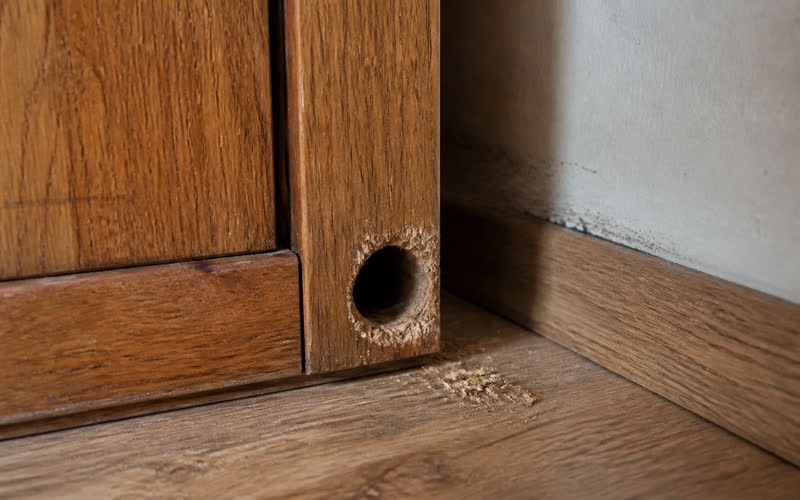
Noise in the wall that moves vertically, droppings at the bottom edge of the facade, visible openings in the insulation, and rising heating bills with no other explanation.
Why it is expensive
Gnawed insulation loses its thermal performance exactly where the runs are. On top of that, rodents in insulation often reach the electrical wiring — and gnawed cable insulation is a fire risk.
The solution
Treatment first, then sealing the bottom edge of the facade with a protective metal mesh. Replacing the insulation is only necessary if the extent of the damage is large.
The ventilated facade and its weak point at the bottom edge
A ventilated facade is built so that a two to four centimetre air gap remains between the thermal insulation and the cladding panel, through which air flows from the bottom upwards and carries moisture away. That same gap is also an ideal, dry, protected vertical corridor running the full height of the building. If the bottom edge at the plinth is not closed off with a perforated metal profile or mesh but left open, rodents have free entry from ground level. From there they travel along the gap, gnaw chambers into the mineral wool and connect them with runs. The right answer is not to close the gap — the facade would then start accumulating moisture — but to seal it with a perforated galvanised or stainless steel profile whose openings are up to five millimetres. That keeps the airflow and at the same time physically prevents entry.
Mineral wool and expanded polystyrene — which do rodents choose
Rodents use both materials, but differently. Expanded polystyrene, or EPS, is soft, easy to gnaw and produces no dust, so they make long, smooth runs and wide hollow chambers in it that can extend a metre and more. Extruded polystyrene is denser, and runs form more slowly in it, but just as surely. Mineral wool is fibrous, irritates the airways and is less comfortable to gnaw, but it is an excellent nesting material: the animals pull it apart, compress it and move it around, so the damage shows up as slumped, compacted wool and voids rather than as a tunnel. The practical conclusion is that none of the common insulation materials is protection in itself. What protects is the detailing — a metal profile at the bottom edge, mesh on ventilation and pipe outlets, and tightly sealed joint ends.
A thermal camera as a way of finding nests
Nests in a facade are out of sight, but they change the heat picture. With a thermal camera in cold weather, when the difference between the inside and outside temperature is at least ten to fifteen degrees, warmer, irregularly shaped patches show up from outside where the insulation is compressed or missing, along with linear streaks of heat along the runs. It is better to take the images early in the morning or after sunset, so that a sun-warmed facade does not distort the picture. It also reveals places where the panels are simply badly joined, so the survey serves a double purpose. A thermal camera does not prove that animals are there right now — that is confirmed only by sound, droppings at the plinth or gnawed openings — but it narrows down considerably the area of facade that has to be opened up.
How the damage shows up in the heating bill
Insulation with runs and nesting chambers in it loses part of its effectiveness, because compressed and empty zones form thermal bridges. In practice this shows up gradually: winter consumption rises compared with previous seasons in similar weather, and at the same time local signs appear — a cold wall in one room, condensation in a corner, a different wall temperature to the touch. If the house has been renovated and consumption was stable in the first years but then starts climbing with no other explanation, the facade is worth inspecting. In addition, the moisture created by urine and by disrupted ventilation in the gap reduces the insulating properties further still. So treatment and sealing here are not only a matter of comfort but also a way of stopping costs from rising.
Working with the facade contractor
If the facade has to be opened up, the order matters just as it does in a basement. First, bait points are placed at the plinth and along the route of the treatment, and consumption is monitored for two to three weeks. If the facade is opened and closed again straight away, the animals stay inside or move to the adjacent section, and a month later the whole thing repeats. Once movement has stopped, the builders take off the cladding panels in the damaged area, remove the contaminated insulation, clean and deodorise the surface, fit new material and only then reinstate the cladding. At the same time it makes sense to install the protective profile at the bottom edge and mesh on the ventilation outlets, since the scaffolding is already up. The work schedule is worth agreeing in advance, so that the inspection, the treatment and the repairs do not work against each other.
What to specify when planning a renovation
Prevention is simpler than repair, and most of the solutions cost little if they are allowed for at the design stage. The practical list: a perforated galvanised steel profile or mesh at the bottom edge of the facade with openings up to five millimetres; stainless steel mesh with an aperture of up to one centimetre on all ventilation and air outlets; all pipe, cable and ventilation entries tightly sealed with metal wool under mortar, not with foam alone; plinth insulation in a dense material with mechanical protection at ground level; at least thirty centimetres between the ground or gravel surface and the bottom edge of the insulation. A fifty-centimetre strip of gravel with no planting around the building is useful — it reduces concealed access to the wall. These requirements are worth writing into the scope of works rather than leaving them to the builder's judgement.
Frequently asked questions
Does all the insulation have to be replaced?
Not always — it depends on the extent of the damage.
How do you stop it happening again?
With a protective metal mesh at the bottom edge of the facade and sealed pipe entries.
Can it be spotted from outside?
Sometimes yes — from openings in the insulation and droppings at the facade.
Can facade damage be spotted without scaffolding?
Partly, yes. From the ground, use binoculars or a telephoto lens to look at the plinth line, the ventilation outlets, the window sills and the areas around pipes — look for gnawed edges, spilled wool and dark smears. It also helps to look for droppings along the plinth, bits of wool fallen on the ground, and a thermal image taken on a cold morning before sunrise.
Do rodents in the insulation threaten timber structures?
In timber-frame houses, yes. From the insulation layer the animals easily reach the vapour barrier, the electrical wiring and the timber studs, and damage there costs more than the wool itself. So in timber-frame buildings the inspection should start earlier, at the first sounds in the wall, and the entry points should be sealed as soon as the treatment is finished.
What does inspecting and treating a private house cost?
Treating a private house usually costs from ninety to a hundred and ten euros, and commercial premises from seventy euros; the minimum callout is forty euros. These are final prices. The exact sum depends on the size of the property and the length of the facade — describe the situation in the form on the website and we will reply within 5 minutes.