
At a glance
- Page topic
- How to get rid of mice
- Area covered
- Riga and the surrounding region
- Price
- From €40 — the figure quoted is the final price
- Availability
- 24/7, weekends and nights included
- What works
- Metal mesh with a 5 mm aperture and cement mortar; expanding foam does not
- How to book
- Enquiry form only — we reply within 5 minutes
You can catch mice, but if the gaps stay open, new ones will come in just as fast. That is exactly why sealing is the decisive step.
1. Remove the food
Dry goods — cereals, flour, pasta, pet food — into metal or hard plastic containers. Clean out the crumbs behind the cooker and the fridge.
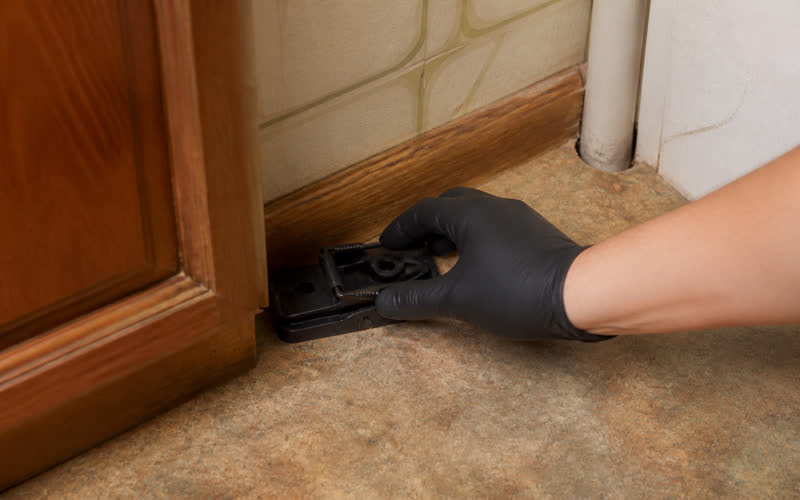
2. Set the traps
Along the walls, with the working end towards the wall, 2–3 m apart. At least 3–4 traps per room. Bait — peanut butter or chocolate.
3. Find and seal the gaps
Check around the pipework under the sink, ventilation grilles, gaps around radiator pipes and under doors. Anything bigger than 6–7 mm is a way in. Seal it with steel wool or mesh, not with foam.
4. Check the result
If no more droppings appear after 1–2 weeks, the problem is solved. If they still appear, the source is outside the flat.
The first 48 hours: what to get done in two evenings
Mice breed fast, so the first two days decide how long the whole process takes. On the first evening, move all open food stores — cereals, flour, pasta, pet food, nuts — into glass or thick plastic containers with tightly closing lids. Paper and thin film packaging is no obstacle to a mouse. Clean out behind the cooker and the space under the fridge, where crumbs collect. On the second evening, set the traps — not two, but six to ten, because with mice the number matters more than precision about placement. After each job, wash your hands and remove visible droppings with a damp wipe rather than sweeping them with a brush, which lifts dust into the air.
Finding gaps with a torch at night — from outside
A visual check in daylight misses most entry points, because they are narrow and in shadow. A far more precise method is to reverse the direction of the light. Once it is dark outside, ask someone to stay in the room with the light on and walk round the outside of the building with a powerful torch — or the other way round, stand inside in the dark while someone else lights the wall from outside. Every strip of light shining through is a gap a mouse can get in by. Check especially the places where pipes and cables cross the wall, the joint between the foundations and the finishes, the bottom edge of doors, ventilation outlets and basement window frames. An adult house mouse squeezes through a six-millimetre opening — less than the thickness of a pencil.
The order of steps that actually works
The order is not a matter of choice, and getting it wrong is the most common reason for failure. Food first: while there is freely available food in the kitchen, trap bait cannot compete with it. Second, the traps — and they must be left in one place for at least three nights before you draw any conclusions. Third, keeping score of the results: where you catch, where you do not, where new droppings appear. Fourth and only then — sealing the gaps. If you close the openings on day one, the animals stay inside and catching them afterwards is harder. Fifth, a monitoring period: seven to ten empty nights in a row with the traps set. Every step taken too early means going back to the start.
You caught two, and then it all stopped
This is the most common situation, and it almost never means the job is finished. There are three possible explanations. First — the remaining mice have learnt to avoid the traps after seeing one go off; changing the type of trap and the bait then helps, for example from a cereal product to a fatty one. Second — the other animals live in a different room or on a different floor and simply do not cross your line of traps; move some of the traps to where you find fresh droppings, rather than where access is easiest. Third — the problem really is solved. That is only proved by empty nights together with no new droppings appearing. Clean up all the old ones completely and watch for three mornings running; if nothing shows up, the situation is under control.
When a flat problem is really a building problem
There are signs that the source is outside your door. The mice appear from a ventilation grille or a stack shaft rather than from the outer wall. The activity is concentrated along the wall bordering the stairwell or the refuse chamber. The neighbours above or below you complain of the same. After a successful catch, it all starts again within a few weeks. In cases like this, work done in one flat is only protection, not a solution — there is no point repeating it for weeks. Your job is to seal the gaps around the shafts and submit a written report to the building manager with dates and photographs. If a professional assessment of the basement and the stairwell is needed, fill in the form; we reply within 5 minutes and work throughout Riga.
Frequently asked questions
How quickly can I get rid of them?
Usually in 1–2 weeks, if the gaps have been sealed.
Will the mice come back?
Only if the entry points are left open.
Does a cat solve the problem?
Partly, but it does not stop new mice coming in.
How many traps does one flat need?
Considerably more than it seems — six to ten for a two-room flat. Mice move around a small area, within a radius of a few metres of the nest, so two traps in the kitchen simply stay outside the routes of most of the animals. Setting them more densely along the walls shortens the process from weeks to days.
What should I seal a six-millimetre gap with so that it holds?
Expanding foam on its own will not do — mice gnaw through it in a few nights. Pack the opening tightly with stainless steel wool or fine metal mesh first, and only then apply foam or filler over the top. The metal is the barrier, the rest is finishing. Seal holes around pipes with a metal collar.
Should I use poison if the traps are not catching?
In living accommodation that is rarely the best next step. The animal can die inside a wall cavity or under the floor, and the smell lingers for weeks. First check where the traps are placed, what bait you are using and whether any food has been left freely available. If that does not help either, describe the situation in the form.