
At a glance
- Topic
- Autumn rodent control — prevention before the season
- Signs
- Droppings, grease marks, gnawing, noise
- Mouse gap
- From 6–7 mm
- Rat gap
- From 20 mm
- What fixes it
- Inspection, bait stations or traps, sealing entry points
- How to book
- Enquiry form only — we reply within 5 minutes
Autumn rodent control is planned work carried out before the seasonal peak, not a reaction to a problem that already exists. It is both the cheapest and the simplest form of treatment.
Why August and September
Rodents start moving indoors as the temperature falls. If the perimeter is already protected and the gaps are sealed, the migration stops at the outside wall rather than in the kitchen.
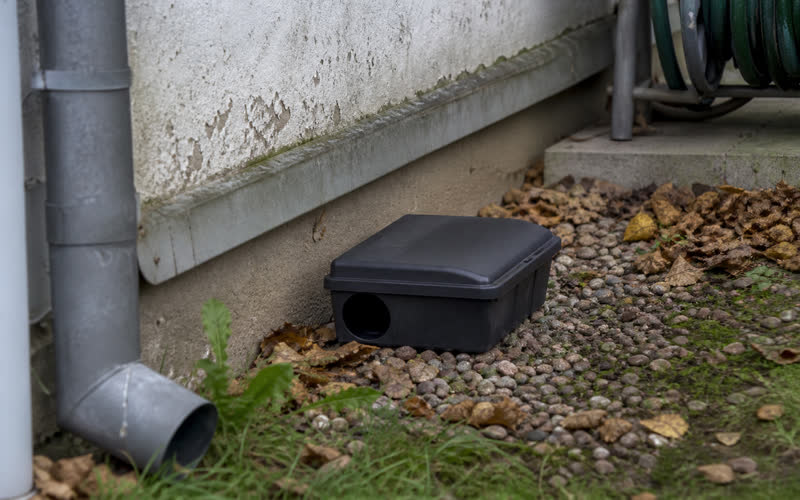
What an autumn treatment covers
A perimeter inspection, outdoor bait stations placed along the external walls, identification of entry points and advice on sealing them, plus an internal check of the basement, garage and loft.
Who it matters most for
Private houses with a garden, summer houses before winter, warehouses and food premises, and the basements of apartment blocks — anywhere the influx from outside is heavy.
The cost difference
A preventive treatment usually takes one visit. Treatment once rodents are already nesting in the structure or the insulation takes several checks and often repairs to the damage as well.
The August and September preparation list
Autumn jobs have to be done in a particular order, otherwise some of them are pointless. Week one: walk the perimeter of the building and note down every opening — cracks in the foundations, ventilation hatches, pipe and cable entries, gaps under doors, damaged mesh on basement windows. Week two: sort out the food sources — compost, fallen fruit, bird feeders, bin lids, pet food left outside. Week three: move firewood, boards and building materials away from the walls and lift them off the ground. Week four: close the openings from the largest down to the smallest, and only then set out external control points around the perimeter. This order matters because sealing up before dealing with the food sources achieves nothing — the animals stay in the yard and look for the next gap. Note your findings on paper or on your phone; in spring that list will save you half the work.
Compost, firewood and fallen fruit before autumn
Three things in the yard determine how many animals come up to the house in autumn. Compost: an open heap of kitchen waste is a source of food and warmth at once, since decomposition makes it warmer than its surroundings. Switching to a closed composter with a solid base and a lid, taking plant material only, removes that source. Fallen fruit: a crop of apples and pears left lying in the grass draws animals in every night through September and October; collecting it every couple of days changes the situation more than anything else you can do in the garden. Firewood: stacked against the wall on the ground, by October it becomes a nesting site one metre from the foundations of the house. A stack on pallets 30 cm above the ground and at least a metre from the wall, with clear access all round, is no longer attractive. These three jobs cost nothing and can be done in a single weekend.
Sealing entry points in order of priority
Closing everything at once is rarely possible, so start with what matters most. The first priority is openings at ground level and below: cracks in the foundations, basement windows, ventilation hatches, sewer and water mains entries — this is where rats get in, and this level gives the biggest effect. Second are the bottoms of doors: a gap over 6 mm is an open door to a mouse, and the answer is a metal threshold or a plate along the bottom. Third are pipe and cable runs through walls and floors — expanding foam on its own is no use there, because it gets gnawed out; you need metal mesh or cement mortar as the base layer. Fourth is the roof edge, the eaves and the ventilation outlets up top. The choice of material is simple: metal mesh with an aperture of up to 5 mm, galvanised sheet or mortar. Plastic, wood and unreinforced foam last a few weeks.
Why August costs less than November
The price difference is not a seasonal discount but a difference in the amount of work. In August the treatment is usually preventive: a small group, or only the approach routes, a few stations around the perimeter, one check. By November that same building often has a population nesting inside on several levels, with damaged insulation and contaminated rooms; it needs more points, more visits and longer to reach a stable result. In practical prices that is the difference between a minimum callout from €40 and a multi-visit programme for a private house in the €90–110 range, or from €70 for commercial premises. On top of that, autumn brings indirect costs that nobody budgets for in advance — spoiled stores, gnawed thermal insulation, wiring repairs. That is why work in August is in practice the cheapest option available.
Coordinating autumn work in an apartment block
In an apartment block, autumn treatment needs preparing several weeks in advance, because many people are involved. Start with the building manager: autumn rodent control is usually best planned as an annual job, and the decision on it should be taken in August rather than once the problem is already there. Access has to be sorted out before the day of treatment — basement, loft, bin room, heating substation, pump room; if any of these is not opened up, the treatment stays incomplete in exactly the place it is needed most. Residents should be informed at least a week ahead with a notice in the stairwell: when the work will take place, which rooms will be treated, that the points must not be touched, and that children and pets must not be let near them. At the same time, the autumn is when the bin area should be put in order — lids, cleanliness around the containers, the surface of the yard. This coordination is easiest to start with a description in the form, stating the number of floors and the type of basement.
What to check after the first cold nights
After the first nights when the temperature drops below zero, the inspection should be repeated, because the situation changes within days. Check the quiet places inside — basement corners, the space behind the boiler, the undersides of shelves, the plinth of fitted kitchen units — looking for fresh droppings. Fresh ones are dark and soft, old ones grey and crumbly; that difference tells you whether the activity is current. Second, listen at night: scratching in the ceiling or wall that appears right after the first frosts is typical. Third, look at the places you sealed earlier — a new hole next to an old patch means the animal is inside and looking for a way out, not the other way round. Fourth, check the outdoor stations: a rise in consumption once the cold arrives is normal and shows that the points are in the right places. If you find even one of these signs, fill in the form — we reply within 5 minutes, at night as well.
Frequently asked questions
When is the best time?
August and early September, before night temperatures fall.
Is prevention needed if there are no rodents?
On sites with a heavy influx from outside — yes, it is the cheapest form.
How often should it be repeated?
Usually once a year, before the season.
What should come first if there is only one free day for autumn jobs?
Start with the food sources and the firewood: close the compost, collect the fallen fruit, clear up under the bird feeder and move the woodpile away from the wall. These give the biggest effect per hour invested. Sealing gaps is the next step, and it can be spread over several weeks.
Isn't August too early if there are no signs at all?
It is not. The whole point of August is that there are no signs yet — the work happens before they get in, not after. Sealing the perimeter and setting outdoor points intercepts the animals on the way to the building. By the time signs appear in October the population is already inside, and the amount of work is several times greater.
How long does an autumn treatment usually take from start to result?
Inspecting the site and setting out the points usually happens in a single visit. A stable result is judged by the follow-up checks — the first normally within a few weeks, the rest as the situation dictates. There may be no consumption at all in the first nights; that is normal and does not mean the points are in the wrong places.