
At a glance
- Page topic
- How to get rid of rats
- Area covered
- Riga and the surrounding region
- Price
- From €40 — the figure quoted is the final price
- Availability
- 24/7, weekends and nights included
- What works
- Metal mesh with a 5 mm aperture and cement mortar; expanding foam does not
- How to book
- Enquiry form only — we reply within 5 minutes
Tackling rats without a system usually fails. With the right sequence you can get a result yourself — as long as the problem is still small.
1. Remove the food
Food in metal or hard plastic containers, bins with lids, compost closed, pet food not left outside overnight. Without this step the rest do not work.
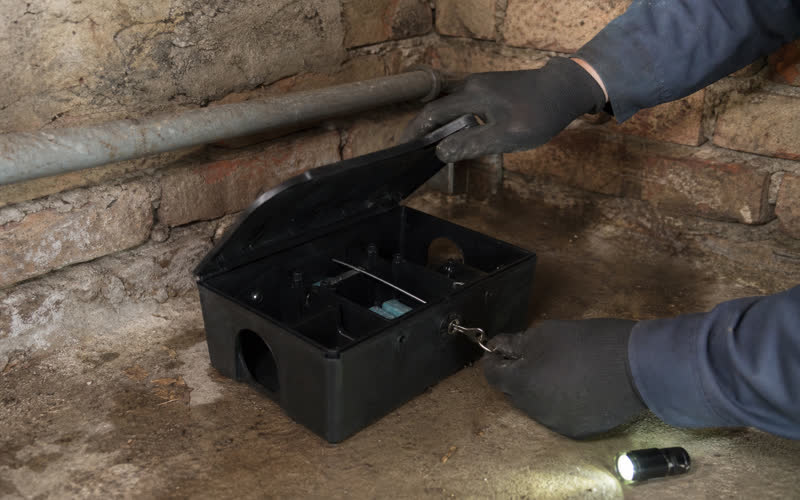
2. Find the runs
Look for grease marks along walls, droppings, burrows along the foundations and gnaw damage. These places determine where the traps go.
3. Set the traps correctly
Along walls, on the runs you have found, leaving them unset for 2–3 days first so the animals get used to them. Rats need heavy-duty traps, not mouse traps.
4. Seal the entry points
Metal mesh or cement mortar — a rat gnaws through wood, plastic and expanding foam. This step decides whether the problem comes back.
What does not work
Ultrasonic devices (rodents get used to them within days), scents as the only measure, filling in burrows before treatment, and poison put out in the open.
A realistic timeline: what doing it yourself looks like week by week
Expectations are usually out of proportion with reality, so it helps to know how the process actually goes. The first three days are reconnaissance: you set out the traps and stations, but the rats do not go near them. That is normal — rats show neophobia, that is, a fear of anything new in their territory. Days four to seven usually bring the first results, as the animals have got used to the new objects by then. In the second week activity should drop noticeably. In the third week the sealing work and the checks take place. If fresh signs are still appearing every night at the end of the third week, the do-it-yourself approach has not worked and carrying on will change nothing — only the time you spend.
How to tell progress from standing still
Judge by three measurable things, not by how it feels. First — the number of fresh droppings in one and the same place. Clear them all away every evening and count the new ones in the morning; a count that falls over the week is progress. Second — the amount of bait taken at the stations. Falling consumption means the population is shrinking; unchanged consumption two weeks running means the animals are being topped up from outside. Third — night noises and where they are coming from. If the sound moves from the kitchen to the basement, you have not solved the problem, only pushed it along. Write the dates down on paper or on your phone. Without notes you will not be able to say after two weeks whether things have improved.
The outdoor side that most people leave out
Rats almost never live in the building alone. They have outdoor burrows, travel routes and feeding places, and working only indoors means you are catching the animals that come in while the source stays untouched. Walk round the yard and look for round burrows roughly five to eight centimetres across at the foundations, under decking boards, at the edges of the compost heap and near the trench of the district heating line. The sign of a fresh burrow is a clean, worn entrance with no cobwebs and a fan of loose soil in front of it. Push a crumpled newspaper into the burrow; if it has been pushed out the next day, the burrow is active. Also deal with bird feeders, bins with damaged lids and fallen fruit — that is a steady food base that keeps a population going regardless of your traps.
Why with rats in particular the neighbours are part of the solution
Rats range over a considerably wider area than mice and will comfortably cover several hundred metres in a night. That means treating one private house or one flat solves the problem at one point while the colony lives in a neighbour's shed, on an empty plot or in a shared basement. If your work succeeds but a month later everything repeats, the cause is almost always beyond your boundary. The practical step is awkward but effective: talk to the immediate neighbours and find out whether they are seeing signs too. In an apartment block the basement and the service shafts are the building manager's responsibility — a written submission with dates and photographs works better than a verbal request. Work carried out in step across several properties gives a result that individual houses will never achieve.
Three mistakes that make the situation worse
The first — putting poison outside without a tamper-resistant station. It endangers neighbours' cats, dogs, birds and hedgehogs, and the bait itself breaks down in the rain within days and becomes useless. The second — sealing openings right at the start, while there are still animals in the building. You are not shutting the rats out, you are shutting them in, and they then look for a new way out through a plasterboard wall or a cable duct; an animal that dies in a sealed wall cavity becomes a separate and expensive problem. Sealing is the last step, not the first. The third — giving up on day three, when the traps are still empty. Days three and four are precisely the threshold beyond which neophobia fades and the mechanics start to work. Moving the traps every day simply restarts the process.
Frequently asked questions
How long does it take?
For a small problem, 1–2 weeks. If the activity continues, the source is most likely outside your control.
When should you call a specialist?
If rats are visible during the day, if they are in the basement, or if the problem keeps coming back.
Do home remedies help?
As an addition — partly. As the only measure — no.
How many burrows in the yard mean this is no longer one or two rats?
Three or more active burrows in one yard usually indicate a nesting group rather than occasional visitors. Check activity by plugging the entrance with crumpled paper and looking at it a day later. If several burrows have been cleared, catching them one by one will no longer help — a systematic approach across the whole site is needed.
Should the traps be moved if nothing has been caught in a week?
Not straight away. For the first three or four days rats go round new objects, so moving them before that simply restarts the process from scratch. If after seven days there is neither a catch nor a touch on the bait, shift the trap 30–50 cm along the same wall rather than into another room — the route is right, the position is wrong.
What do you do if the neighbours do nothing?
Carry on protecting your own property by sealing it physically — that works regardless of what the neighbours do. Close openings over six millimetres, fix ventilation grilles securely, sort out how the bins are stored. In an apartment block, write to the building manager, attaching dates and photographs. If the situation does not improve, fill in the form — we work around the clock in Riga.