
At a glance
- Topic
- Mouse droppings — how to recognise them
- Signs
- Droppings, grease marks, gnawing, noise
- Mouse gap
- From 6–7 mm
- Rat gap
- From 20 mm
- What fixes it
- Inspection, bait stations or traps, sealing entry points
- How to book
- Enquiry form only — we reply within 5 minutes
Mice leave droppings exactly where they travel and feed — in drawers, in cupboards, behind the cooker and along the skirting boards.
Appearance and size
3–6 mm long, dark, with pointed ends — similar to a grain of rice. Unlike rat droppings they are thin and much smaller.
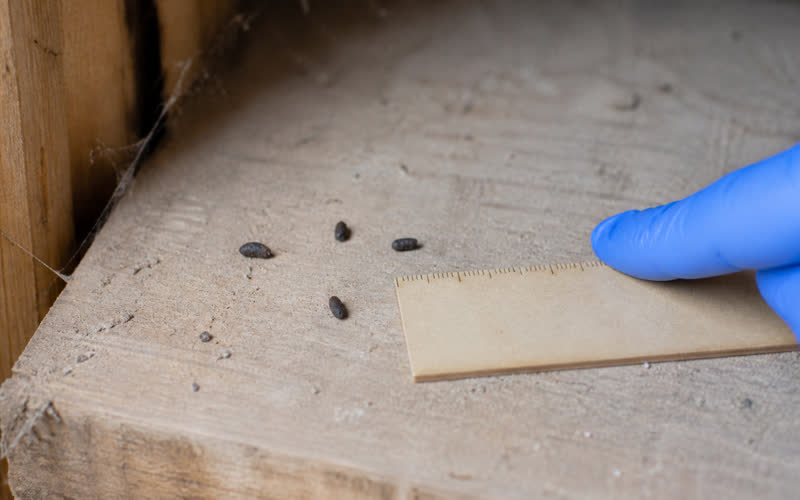
Where to look for them
In kitchen drawers and cupboards, behind and under the cooker and the fridge, along skirting boards, in the pantry and under the sink. Mice travel along walls, so finds are usually along the edges.
What they tell you
A lot of droppings in one place means a feeding site or a nest nearby. Scattered across several rooms — the population has already spread.
How to clear them up safely
Gloves, the wet method, a disinfectant. Under no circumstances dry sweeping or a vacuum cleaner — public health guidance points this out in connection with the risk of rodent-borne infections.
A find in a drawer or a cutlery tray
The kitchen cutlery drawer is one of the most common places where mouse droppings are first noticed, and it is exactly here that people most often do the wrong thing. Divide the contents into two groups. Hard, smooth, unscratched items — spoons, forks, knives, metal and glass dishes — do not need throwing away; wash them in the dishwasher on the hottest setting, or in hot water with detergent. What does need throwing away is the other group: wooden utensils with cracks, scratched plastic spatulas, straws, paper and cardboard packaging, and any open food that has been kept in the drawer. The plastic tray itself has to be taken out and washed separately, because the material usually ends up under it rather than on top. Put gloves on before you take anything out, and do not sweep the contents up dry.
Cleaning a kitchen cupboard in the right order
Cupboards are cleaned in a set order, otherwise the job has to be done twice. Step one — open a window and air the kitchen for at least 15 minutes. Step two — put on nitrile gloves and a mask that fits the face. Step three — empty the cupboard completely and put the contents on a surface you can wash afterwards. Step four, and the most important: dampen the droppings generously with soapy water and let it soak in for five minutes, and only then pick them up with damp paper towel. Dry sweeping with a brush or a vacuum cleaner sends the dust into the air and is exactly what has to be avoided. Step five — wash the shelves, the walls and the back of the cupboard, corners and screw holes included. Step six — waste into a double bag, gloves off last, hands with soap. Leave the cupboard open until it is completely dry.
An old dry find or a problem that is still active
Finding droppings does not automatically mean the mice are still in the house. Fresh material is dark, almost black, soft and wet-looking; it deforms easily under a wooden skewer. After a few days it turns greyish brown, matt and hard, and crumbles under pressure rather than giving. Very old material is dusty, pale and often has a layer of dust stuck on top — if there is an even layer of dust over it, it has been lying there for at least several weeks. Judge the surroundings too: an active mouse presence usually comes with fresh gnawing with lighter edges, thin rustling of paper or insulation, and a smell. If the find is only dry and old with nothing else alongside it, clean the spot completely and carry out the repeat check described below.
A systematic check behind and under appliances
Mice stay where there is warmth, darkness and food debris, so appliances have to be checked in every case. Work through them in order and skip none. Fridge: pull it out of its recess and look at the floor beneath it, the back panel and the heat exchanger grille, where nesting material often collects. Cooker: take the bottom drawer right out and look into the void under the oven with a torch — it is one of the most common places. Dishwasher and washing machine: check the pipe entries in the wall and the gap between the casing and the unit. Microwave and toaster base: turn them over and check underneath. In each place look for three things — droppings, shredded paper or fabric material, and greasy smeared marks along an edge. Write down what was found where.
When food packaging has to be thrown away
Here you go by the packaging material, not by whether you can see damage. Throw away everything packed in paper, cardboard, thin foil or a thin plastic bag if it has been in the affected cupboard — even if you cannot see a hole, because a mouse's chew point is often 3–5 mm and hidden in a seam or a fold. Also throw away open products in glass or plastic containers without a tight lid. You can keep: unopened tins, glass jars with an airtight metal lid, tightly sealed plastic boxes with a gasket, and vacuum packs that are completely intact. Before putting anything back in the cupboard, wash all the outer surfaces with a damp cloth. From now on keep cereals, flour and animal feed in rigid boxes with lids — it is the simplest step, and it removes the main food source.
The repeat test: clean, then check after 48 hours
This is the simplest way to find out whether the problem is active or already over. Clean the affected spot completely — not a single pellet may remain after cleaning. Photograph the clean surface with the date, so there is no doubt later. Move nothing in that spot for two days and leave the doors as they normally are. After 48 hours check with a torch, holding it almost parallel to the surface. If new 3–6 mm pellets have appeared, the presence is active and what is needed is treatment, not more cleaning. If the surface has stayed clean, repeat the check a week later, because mice can change their route for a while. Write down the results of both checks — that is the most concrete information you can give when you fill in the form.
Frequently asked questions
How many droppings does one mouse leave?
Up to 80 a day.
Are they dangerous?
They can contain disease organisms, so work with gloves on.
There are droppings, but I never see a mouse — is that possible?
Yes. Mice are active at night and are rarely seen during the day.
Does cutlery have to be thrown away if there were mouse droppings in the drawer?
Metal and glass items do not need throwing away — washing in the dishwasher on the hottest setting, or in hot water with detergent, is enough. What does need throwing away is wooden utensils with cracks, scratched plastic and any paper or cardboard packaging from the same drawer.
How do I tell whether a find is old and the problem is already over?
Clean the spot completely, photograph it and touch nothing for two days. If new 3–6 mm pellets appear after 48 hours, the mice are still there. If the surface stays clean, repeat the check a week later, because the route may change for a while.
Which products in the cupboard have to be thrown away and which can be kept?
Throw away everything in paper, cardboard, foil and thin bag packaging, even without a visible hole, because a chew point can be 3–5 mm and hidden in a seam. You can keep tins, airtight glass jars and intact vacuum packs, washing the outer surface with a damp cloth.