
At a glance
- Service
- Mouse extermination in Riga
- Area covered
- Riga and the surrounding region
- Price
- From €40 — the figure quoted is the final price
- Availability
- 24/7, weekends and nights included
- Reply time
- Within 5 minutes of the form being submitted
- How to book
- Through the enquiry form only
A mouse squeezes through a gap no wider than a pencil — roughly 6–7 mm. That is why a mouse problem is almost never solved with traps alone: if the gaps stay open, new mice will arrive.
Mice breed fast. One female can produce several litters a year, so a few weeks of waiting changes the scale of the treatment.
How mouse extermination works
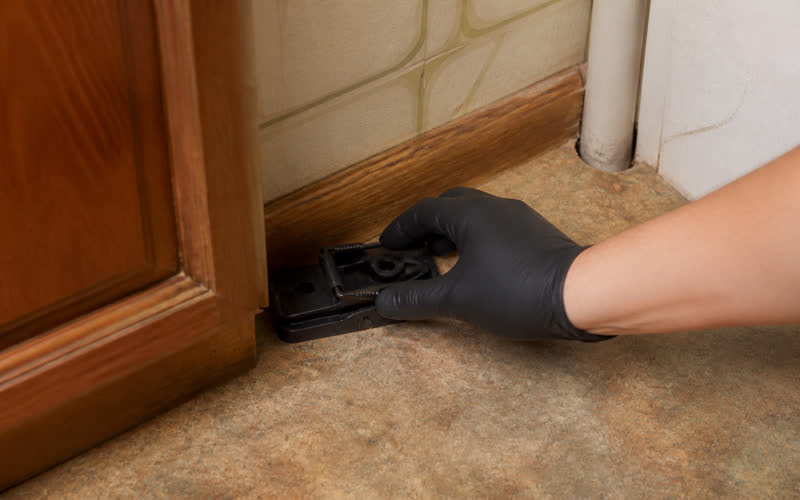
We inspect the kitchen, the pantry, skirting boards, pipe entries and ventilation. Mice travel along walls, so that is exactly where we place traps and stations. At the same time we note the gaps that need sealing.
Mice in a flat
In a flat, mice usually come in through the ventilation shaft, pipe runs or from the stairwell. If there is a food source in a neighbouring flat or in the basement, the problem will return until that place is treated too.
Mice in a private house or summer house
In private houses mice move in during autumn, as the temperature drops. The commonest places are gaps in the foundations, ventilation grilles, the garage and the loft. In summer houses the problem shows up after a period of nobody living there.
The six-millimetre rule: where mice actually get in
An adult house mouse squeezes through any gap wider than 6–7 mm — about the thickness of a pencil. The skull is flat, the collarbone flexible, and where the head goes the rest of the body follows. That is why dealing with mice starts not with bait but with crawling along the skirting board with a torch. Riga flats repeat the same list of gaps: pipe runs under the sink and bath, where the old packing has crumbled away; kitchen and bathroom ventilation grilles with broken louvres; holes around radiator pipes where the concrete has chipped; the gap under the front door if the threshold is worn; skirting-board joints in corners and the points where the electrical trunking enters the wall. In Soviet-era apartment blocks mice travel up the vertical shafts and come out on the floors where the runs are open. The sealing material matters — expanding foam is gnawed through by midnight. What works is stainless steel mesh or steel wool, packed in tight and covered with cement mortar or acrylic sealant.
The arithmetic of mouse breeding — why waiting is expensive
A house mouse is sexually mature at six weeks old. Gestation lasts 19–21 days, a litter is usually 4–8 young, and in favourable conditions — a warm, well-fed building — a female produces 5–10 litters a year. The practical meaning is simple: a pair that moves in during October is no longer a pair by Christmas. That is exactly why putting it off to watch for another couple of weeks costs more than mouse extermination done straight away. Another number worth knowing: a mouse eats only about 3 g of food a day, but gnaws and contaminates many times more, because it feeds in small portions 20–30 times in twenty-four hours, moving between several feeding points. That also explains the amount of droppings — 50–80 grain-shaped pellets a day from a single mouse. If, two days after clearing out the kitchen cupboard, there are fresh, dark, soft droppings again, the population is active rather than a leftover from last year.
Why different methods work on mice than on rats
A rat is neophobic — a new object in its territory is avoided for several days, which is why traps often fire only on the fourth or fifth night. A mouse is the opposite: curious and inquisitive, it will examine a new object on the very first night. In practice this means a well-placed mouse trap often fires on the first or second night, and the result can be judged quickly. The second difference is range. A mouse may spend its whole life within 3–10 metres of the nest, while a rat travels tens of metres. So in mouse control the points must be set densely and exactly where the signs are — not a few scattered around the flat on the off-chance. The third difference: a mouse needs practically no separate water source, it gets by on the moisture in its food. That means fixing water leaks will not drive mice out — what has to be dealt with is food and entry points.
Placing traps: mechanics, not guesswork
Mice travel along vertical surfaces, touching the wall with their flank, and rarely cross open floor. So a trap goes tight against the wall, not a few centimetres out from it, with the trigger side facing the wall — so that a mouse running along the wall passes straight over the mechanism rather than skirting round the far side of it. Space traps 2–3 metres apart; in a room with active signs use 3–4 traps, not one. The priority spots: behind the fridge and cooker, under the sink, on the bottom shelves of kitchen cupboards, along the skirting board behind furniture, in the pantry and by the basement door. If traps are going into a room used by children or pets, put them inside tamper-resistant stations. Before setting them, it is worth leaving an unset baited trap out for two nights so the mice get used to taking food from it — with mice this step is not essential as it is with rats, but it raises the strike rate considerably if traps have already stood empty for a couple of nights.
Bait that really works — and why cheese is not on the list
Cheese is folklore. The house mouse is by nature a seed and grain eater, and what draws it more strongly is a combination of fat and sugar with a pronounced smell. In practice the best things to use against mice in traps are peanut butter, chocolate, oat flakes, sunflower seeds and wild bird seed mix. Peanut butter is also convenient because it cannot be stolen quickly off the trigger — the mouse licks it, and that is what sets the mechanism off, whereas a hard piece is often carried away whole. The dose is small: pea-sized. A large blob of bait lets the mouse eat its fill without touching the trigger. Chocolate goes on as a thin shaving, oat flakes with a drop of peanut butter so they stick. If there is a lot of spare food in the house, the bait is competing with the whole kitchen, so storage has to be sorted out before the traps go down. Nesting material — a cotton thread or a scrap of wadding — works well in winter, when mice are actively collecting insulation for the nest.
The food and waste routine, without which it all comes back
Cardboard and thin plastic packaging are no obstacle to a mouse — it chews through in minutes. Cereals, flour, pasta, dry pet food and bird seed must be kept in metal or thick, rigid plastic containers with a tight lid. A sack of dry pet food on the basement floor is one of the commonest reasons mice in Riga private houses do not leave even after treatment. In the evening, wipe surfaces down, dry the sink, and keep the bin lidded and emptied before nightfall — mouse feeding activity starts at dusk and peaks in the first hours after dark. Outside: keep compost in a closed container, stack firewood at least 30 cm off the ground and 30 cm away from the wall, pick up fruit under trees, and site the bird feeder well away from the building or, in winter when there is a mouse problem, take it down for a while. These steps do not exterminate mice on their own, but without them any mouse extermination in a flat or house is only temporary.
How to be sure the problem really is solved
The result is measured by checking the signs, not by how it feels. Clear away all the droppings you find, so that new ones stand out clearly. Dust a thin layer of flour or talc over 20 × 20 cm patches along the skirting board behind the fridge, under the sink and by the basement entrance, and check for tracks three mornings running. Leave a few unset bait points and watch whether food is taken. Listen at night — scratching in the wall or above the ceiling after 10 pm is a sign of activity. If there are no fresh droppings, no tracks, no bait taken and no sounds for seven to ten days, the infestation has been stopped. Only then is there any point in removing the monitoring points, but the seals and the storage routine stay. If any of the signs come back, it usually means one of two things: an entry point left unsealed, or a food source nobody has spotted. Fill in the form and we reply within 5 minutes, at night and at weekends too.
Frequently asked questions
How quickly do mice die off?
Activity usually drops within a few days. The most important long-term step is sealing entry points.
Can mice be exterminated without poison?
Yes. On many premises — especially with children, pets or food present — we use mechanical traps.
Why do mice come back?
Almost always because entry points have not been sealed, or a food source is available nearby.
How big a gap has to be sealed to keep mice out?
Anything wider than 6–7 mm has to be sealed. In practice that includes gaps that look far too small. Use stainless steel mesh or steel wool, packed in tight and covered with mortar or sealant. Expanding foam and silicone alone will not do — a mouse chews through them in a few nights.
Why are the traps standing empty when there are definitely mice?
Usually the reason is placement rather than bait. The trap must go tight against the wall with the trigger facing the wall, along the mouse run, not in the middle of the room. The second reason is too much bait, enough to feed on without touching the mechanism. The third is too few traps: a room with active signs needs 3–4.
Can two mice become a serious problem within a few months?
Yes. A female is sexually mature at six weeks, gestation lasts about 20 days, a litter is 4–8 young, and in a warm building there are 5–10 litters a year. The first offspring start breeding before the female has finished the next litter. That is why waiting a couple of weeks genuinely changes the scale of the job and the cost.
How much does mouse extermination in Riga cost?
The minimum callout charge is €40. Treating a flat usually costs €40–80 depending on the floor area and the level of infestation, and €90–110 for a private house with a basement and outbuildings. These are final prices. We give an exact figure once we have a description of the premises — fill in the form and we will reply within 5 minutes.