
At a glance
- Page topic
- Rat poison — why it is not enough on its own
- Area covered
- Riga and the surrounding region
- Price
- From €40 — the figure quoted is the final price
- Availability
- 24/7, weekends and nights included
- What works
- Metal mesh with a 5 mm aperture and cement mortar; expanding foam does not
- How to book
- Enquiry form only — we reply within 5 minutes
Poison is not a bad product in itself — professionals use it every day. The difference lies in how and where it is placed.
Why poison alone does not solve the problem
Poison reduces the population, but it does not remove the cause. If the entry points stay open, new rodents from the surrounding area move into the space that has been cleared. That is why treatment without sealing entry points gives only a short-lived result.
A dead rodent inside the structure
This is the most common problem after do-it-yourself poisoning: the animal dies inside a wall or under the floor, where it cannot be reached. The smell lasts one to four weeks. It is exactly for this reason that professionals use mechanical traps in such places.
Secondary poisoning
If a poisoned rodent becomes food for a cat, a dog or a bird of prey, the poison passes into them as well. Cats and dogs are poisoned this way every year. Tamper-resistant stations reduce this risk considerably, because the animal dies closer to the station.
How professionals use it
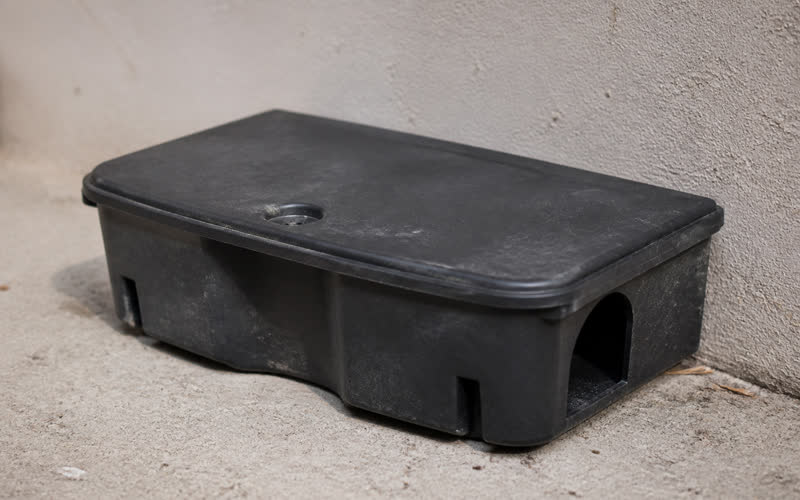
Only in tamper-resistant, lockable, fixed stations, placed along the runs, in set positions and rechecked afterwards. Never loose, and never anywhere a child or a pet can reach it.
How an anticoagulant rodenticide actually works
Modern rat poison is not a nerve agent that kills on the spot. Most professional products are anticoagulants — substances that block the way vitamin K circulates in the body and therefore the production of blood clotting factors. The rodent eats the bait, walks away and behaves completely normally for several more days. Only once the clotting factors already in the body have been used up does internal bleeding begin. Death comes on average between the third and the seventh day after the dose is taken. This delay is not a shortcoming of the product but a deliberate design. Rats are markedly wary of new food and are able to link feeling unwell to a particular product. If the poison killed within half an hour, the rest of the colony would see the result and would not touch the bait again. Slow action means the colony keeps feeding while the dose has already been taken.
Why that very delay puts a dead rodent inside your wall
The delay of several days that makes poison effective against a colony is also its main practical problem inside a home. The rodent does not eat the bait and stay put. It goes back to the nest — a ventilation shaft, a cavity in a partition wall, under the floor insulation, behind a fitted kitchen. In its last days a poisoned animal grows weak, looks for somewhere dark and warm, and burrows further into the structure rather than coming out into the open. That is why, after do-it-yourself poisoning, the smell often appears not where the bait was but a metre or two further along, behind the finish. In Riga's Soviet-era apartment blocks the most common spot is the sewer stack shaft and the cavity between the kitchen and bathroom walls. In professional work the bait layout is planned with exactly this in mind: as close as possible to an accessible area and as far as possible from closed cavities.
The vitamin K antidote, and why a vet visit must not wait
For anticoagulant poisoning there is a genuine antidote — vitamin K1, which a vet administers and then prescribes as a long course, often for several weeks. It works because it restores the production of the very clotting factors the poison has blocked. The critical factor is time. Treatment is safest when it is started before symptoms appear, because symptoms mean internal bleeding is already under way. If you see that a dog or cat has eaten bait, or even suspect it has, go to a vet the same day and do not wait to see whether anything happens. Take the packaging with you, or at least photograph the label — the active substance and its generation determine both the dose and the length of the course. What a person does in the first few hours matters here more than anything else.
Signs of poisoning in a pet and how to recognise them
Because the action is delayed, an owner usually sees no link at all between the event and the symptoms. One to three days can pass between the bait being eaten and the first signs, sometimes longer. The first thing noticed is unexplained tiredness and reluctance to move — the animal sleeps more than usual and refuses its normal activity. Then come pale or whitish gums, blood in the saliva, urine or droppings, bruise-like patches on the skin and belly, nosebleeds, and laboured or rapid breathing if blood collects in the chest cavity. Unsteadiness and weakness in the hind legs are also typical. None of these signs is specific to poison alone, but together with a suspicion about bait they are reason enough to see a vet immediately.
Open bait trays are the worst option in a home
Bait tipped out onto paper, a saucer or simply into a corner creates three problems at once. The first is direct access for a child or a pet — pellets and wax blocks are made to attract by smell and appearance, and that works on more than rodents. The second is bait being moved: rats and mice regularly carry pieces away and hide them in a store, so the product ends up in places nobody put it and nobody is checking. The third is damp and dust, which quickly make the bait unappealing so the animal stops touching it. Professional practice therefore uses tamper-resistant, fixed stations with a restricted opening, in which the bait is secured and cannot be pulled out. A station also makes it possible to see afterwards how much bait is being taken and at which point — without that, a treatment cannot be assessed at all.
Bait shyness and a partial dose: how poison stops working
Using poison irregularly or incorrectly produces the exact opposite of what people expect. If bait is put down for a couple of days, then taken away, then put down again a month later in a different place, part of the colony takes a dose that is not lethal. Those animals survive and go on breeding, while at the same time learning to avoid food of a similar smell and texture. The result is a population that will not touch bait any more, and a household convinced that poison does not work at all. The other mistake is changing product every week in the hope of finding a stronger one — to a rodent, every new thing is one more reason to be cautious. The correct approach is the opposite: one bait, in unchanging positions, continuously available, with regular checks on how much is being taken, until activity at the control points stops. Only then is the extermination finished rather than abandoned halfway.
Where poison is the right tool and where a trap is better
Poison is not a universal solution, and professionals use it at only some of the points. It is in the right place around the outside perimeter of a building, at gaps in the foundations, at sewer chambers, around compost and bin areas, in basements, in plant rooms and at control points on commercial premises, where stations are fixed, labelled and out of reach of anyone who has no business with them. A trap is the better choice wherever a dead animal has to be found straight away, or where the risk to people and pets is too high: in kitchens and food storage areas, in children's rooms, in rooms with a dog or a cat, and next to inaccessible cavities where a dead rodent would sit behind the finish for weeks. In most Riga flats the right answer is a combination: mechanical control inside and bait stations outside the living space — in the stairwell, in the basement or at the foot of the building.
What to do with leftover product
Unused rodent poison is not household waste. It must not go into the general bin, be flushed down the drain or be left in the basement for next time — it is precisely the forgotten packet on a basement shelf that later becomes the source of poisoning when a child or an animal finds it. The product should be kept in its original, labelled packaging, because only that carries the name of the active substance, which can decide what a vet does. A lockable cupboard or a high shelf in a room a pet never reaches is suitable for storage. Take surplus product to a hazardous waste collection point — in Riga the recycling yards accept it. If you are not sure what exactly is left over, or where bait was placed in the home in the past, describe the situation in the form, and during the inspection the specialist will also check the old points and collect what remains.
Frequently asked questions
Is poison dangerous to pets?
Yes, both directly and through a poisoned rodent.
Why is there a smell after poison has been used?
Because the animal dies somewhere that cannot be reached.
Can I use poison myself?
You can, but only in a tamper-resistant station and never anywhere children or animals can reach it.
How long after eating poison does a rat die?
Three to seven days on average. Anticoagulants act gradually, because they block blood clotting rather than killing outright. It is this delay that stops the colony linking the bait to danger and ensures several animals take a dose. So in the first days after treatment activity may even seem unchanged — that is the process running normally, not a sign that the product is not working.
My dog ate bait but looks fine. Should I wait for symptoms?
No. Symptoms appear only after one to three days, and their appearance means internal bleeding has already started. Go to a vet the same day and take the packaging or a photo of it with you. A vitamin K1 antidote exists, but it is most effective when treatment is started before any signs appear.
Does rat poison work on mice too?
Yes, the active substance works on both species, but that alone is not enough. The type of bait, the size of the dose and above all the placement differ: mice move within a smaller radius and need far more control points, closer together, while for rats the points are further apart but larger and nearer the main runs. The right poison in the wrong place does not work.
Why did the poison stop working when they were eating the bait at first?
The most common reason is bait shyness after a partial dose. If bait has been available irregularly or changed often, part of the colony takes a non-lethal amount, survives and then avoids similar food. The answer is not yet another new product but continuously available bait at unchanging points with regular checks on consumption. If things have reached that stage, describe it in the form — we reply within 5 minutes.