
At a glance
- Topic
- Rat tracks and grease marks
- Signs
- Droppings, grease marks, gnawing, noise
- Mouse gap
- From 6–7 mm
- Rat gap
- From 20 mm
- What fixes it
- Inspection, bait stations or traps, sealing entry points
- How to book
- Enquiry form only — we reply within 5 minutes
These tracks are the most valuable information an inspection can give: they show the exact route on which stations and traps need to go.
Grease marks
A rodent's coat is greasy, and rubbing repeatedly against a wall leaves a dark, shiny mark. The mark is usually 5–10 cm above the floor along the base of the wall, around holes and pipework. A bright, tacky mark means an active route.
Tracks in dust
Dusty surfaces hold prints: about 1 cm for a mouse, 2 cm and more for a rat. There is often a tail-drag line between the prints as well — a reliable sign of a rat.
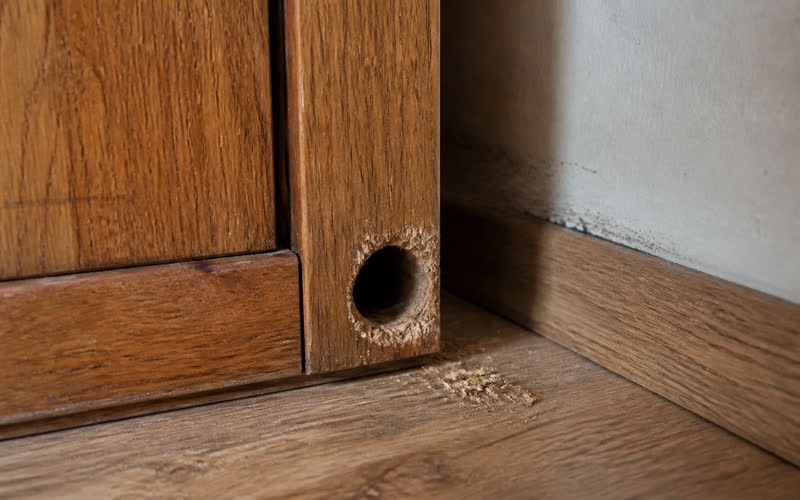
Gnaw marks
Round openings in wood or plastic: about 2 cm across with smooth edges for a mouse, 4 cm and more with rougher edges for a rat. Fresh gnaw marks are lighter than the surrounding surface.
How to use it
A simple method: dust the suspect spot with a thin layer of flour and check it in the morning. The tracks will show the direction and the approximate size.
The flour or talc test, done properly
This test gives physical proof in one night if it is done precisely. Choose two or three spots: along the wall close to the skirting board, by a possible opening, and at the bottom of a cupboard. Sift a very thin layer of flour or talc over an area of roughly 30 × 40 cm in each — the layer has to be thin enough that the colour of the floor still shows through. A thick layer does not work, because the animal goes round it. Leave the spot overnight, do not switch the light on in the room and do not move anything. In the morning, photograph it first, holding the torch almost parallel to the floor, because the prints are invisible in direct light, and only then go closer. A mouse print is about 1 cm or less with a narrow trail; rats reach about 2 cm with a wider stride and often an unbroken tail-drag line.
How to read the direction of travel
The direction is more valuable than the print itself, because it tells you where to look for the entry point. Look at the shape of the print: the toe impressions are deeper and more pointed on the side the animal was heading, while the heel end is shallower. The second clue is the throw of flour: at each footfall material is kicked backwards, so the light ridge of flour sits behind the print, on the opposite side to the direction of travel. Third, the tail-drag line sometimes ends in a small S-shaped curve nearer the starting point. Fourth, and the most practical: the density of prints increases closer to the entry hole, because that is where the animal slows and changes direction. If two test patches in different rooms both show a direction towards the same wall, that is where the opening or pipe entry will be.
The height of grease marks as a species indicator
The height of the marks is one of the most reliable indicators of species, because it depends on the animal's body size and on how it moves. The brown rat runs tight along the wall, so a dark greasy mark forms about 5–10 cm above the floor — even, roughly 2–3 cm wide, and brighter in corners and at pinch points. Mice leave far finer, fainter marks, usually at a height of 1–3 cm, and they are often only noticed on light-coloured or white skirting. The black rat, which climbs, leaves marks in quite different places — on the undersides of pipes, on beams and along the edges of high cupboards, rather than at floor level. Measure the height with a ruler and write the number down, not a description. That one number, together with the size of the droppings, almost always settles the question of species.
Marks on pipes and cables — the vertical routes
Horizontal routes at floor level are only half the picture. Rodents also travel vertically, and these routes go unnoticed because people look at eye level rather than shining a torch upwards. Check heating and water stacks along their whole length — a dark, slightly shiny coating forms on the underside and sides of the pipe, one that will not wipe off dry with a finger. Check cable bundles too, the inside of the ventilation shaft near the grille, pipe entries in the stairwell, and the points where a pipe passes through a floor slab. Very often there is a ring of smeared grime visible around that hole — this is the entry point between floors. In a private house, add rainwater downpipes, roof overhangs and trees whose branches reach the roof. Photograph every spot you find and note the floor.
Cleaning the marks off as an activity check
Old marks may be left over from a problem solved long ago, so finding them does not in itself mean the animals are still there. The check is simple. Clean a stretch of mark about half a metre long with hot soapy water until the surface is completely clean, and mark the ends with pieces of tape so you know the exact spot later. Photograph the cleaned stretch. After three to five days, look at the same place under raking light. If a new dark coating has appeared, the route is active, and this is exactly where the control points should go. If the surface is still clean, repeat the check after another week before concluding that the route is no longer in use. The same principle can be applied in several places at once, to work out which routes in the building are still in service.
Using the findings to decide where control points go
The whole point of mapping the signs is precise placement, because a point set in the wrong place stays untouched for weeks. Three basic principles. First, points go on the route, not in the middle of the room: along the wall, behind furniture, by the skirting board, exactly where the grease mark or the prints are. Second, close to the entry hole and between the opening and the food source — animals follow one and the same route and do not stray from it. Third, at a height that suits the species: floor level for brown rats and mice, and also on beams, shelves and by pipe crossings for climbers. If there are children or pets in the house, choose positions they cannot reach. Fill in the form and include the locations of the signs, the heights and photographs — we reply within 5 minutes and we work around the clock in Riga.
Frequently asked questions
How do you tell fresh tracks from old ones?
Fresh marks are shiny and tacky; old ones are dry and dull.
Do the tracks show how many there are?
No, but several prints of different sizes point to several individuals.
Where should you look for them first?
Along walls, behind furniture, by pipework and holes.
How thick should the layer of flour be for the test?
Very thin — thin enough that the colour of the floor still shows through, over an area of roughly 30 × 40 cm. A thick layer does not work, because the animal goes round it. Leave it overnight with no light on, and in the morning photograph it first with the torch almost parallel to the floor, only then going closer.
How do you tell from a grease mark whether it is a rat or a mouse?
Measure the height with a ruler. A brown rat's mark is 5–10 cm above the floor, roughly 2–3 cm wide and even. Mice leave far finer traces at a height of 1–3 cm. Marks on the undersides of pipes and along the edges of high cupboards point to a climber rather than a basement rat.
How do you tell whether a route is still in use?
Clean a half-metre stretch of the mark with hot soapy water, mark the ends with tape and photograph it. After three to five days, look at it under raking light. A new dark coating means the route is active. If the surface is still clean, repeat the check after another week.