
At a glance
- Service
- Rodent control in flats in Riga
- Area covered
- Riga and the surrounding region
- Price
- From €40 — the figure quoted is the final price
- Availability
- 24/7, weekends and nights included
- Reply time
- Within 5 minutes of the form being submitted
- How to book
- Through the enquiry form only
A flat differs from a house in one crucial respect: you do not control the whole building. Rodents move through ventilation shafts, pipe runs and partition walls, so the source is often outside your front door — in the basement or in a neighbour's flat.
Where to look in a flat
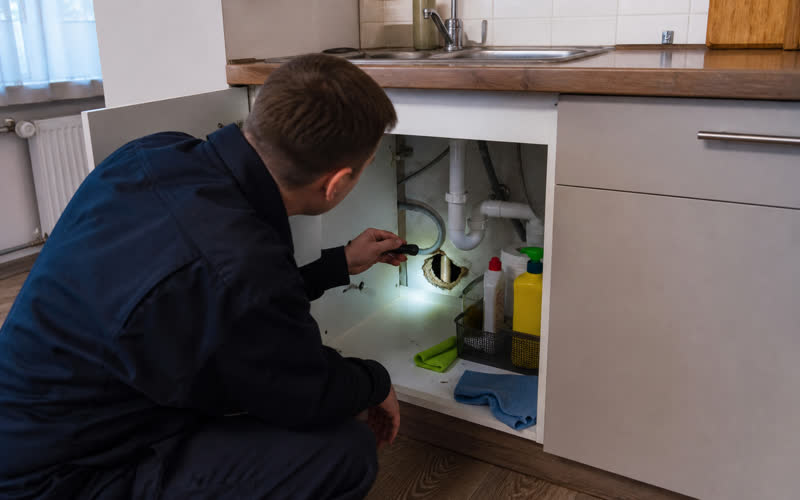
We check the backs of kitchen units, the pipe entries under the sink, ventilation grilles, skirting boards and the pantry. In a flat, rodents almost always travel along the walls rather than across the middle of a room.
When the problem is building-wide
If droppings reappear after treatment, or the neighbours are complaining of the same thing, the source is in the communal areas. In that case the most effective solution is to treat the basement and stairwell as well.
Discreet treatment
We arrive with no signage and no markings. Lockable bait stations are compact and leave no visible trace in the flat.
Room-by-room inspection: what to look for in each room
We start the inspection in the kitchen, because that is where the food and warmth are. We pull out the cooker and the fridge, look at the skirting behind fitted units and at the point where the pipe under the sink goes into the wall — an unsealed gap is often left there. In the pantry we check packets of grain, flour and pet food: a mouse chews through paper and thin plastic overnight, and from the side all you see is an irregular row of holes. In the bathroom we look at the riser shaft behind the inspection hatch — there is almost always a vertical gap there between the concrete slab and the pipe. On the balcony the risk spots are stored potatoes and old upholstered furniture used for nesting. In the hallway and by the front door we check the gap under the door and the electricity meter recess. Mouse droppings are 3–6 mm long, dark and pointed at the ends; rats leave 15–20 mm droppings, thicker in shape. Their distribution already tells you which side the rodents are coming in from.
Vertical routes in a Soviet-era apartment block
A question we hear often — how did mice get to the ninth floor when the basement is at the bottom. The answer is the building's own infrastructure. In Soviet-era apartment blocks the ventilation shaft runs through every floor, and its walls are not sealed: a 6–7 mm gap is all a mouse needs to squeeze through. The second route is the riser penetrations — the points where water and sewer pipes cross the floor slabs. When flats are renovated, these openings are rarely filled with cement mortar; usually there is expanding foam, which a rodent gnaws out in a few nights. The third route is the refuse chute, where a building still has one in use: the hopper seals are worn, and the chute gives rodents both a travel channel and a constant food supply. So when inspecting a flat we always record which vertical line of the building it sits on, and whether there are signs of activity in the nearest stairwells.
What a resident can do before the specialist arrives
The preparation takes about half an hour and speeds up the treatment considerably. Clear access to the underside and back of the kitchen units — at least pull out the bottom drawers and move boxes off the pantry floor. Put all open food, including dry pet food, into glass or rigid plastic containers with lids; that removes the rodents' alternative food and forces them onto the points we place. Do not wash away droppings or seal holes before the inspection: they are the only traces we have for working out the route. If you have already put down shop-bought poison, tell us exactly where and how long it has been there — that changes the active substance we choose. If there are children or pets in the home, say so in the form, so the team brings lockable bait stations and mechanical traps.
Treatment in an occupied flat with children and pets
People go on living in the flat, so leaving products out in the open is not acceptable. We work with two tools. The first is lockable bait stations with a key: a plastic casing with the bait fixed on a metal rod, so neither a child nor a cat can pull it out. We place these only where they cannot be reached — behind the fridge, under the plinth of a fitted kitchen, in a services recess, on the balcony behind a shelf unit. The second is mechanical traps, where a result is needed immediately or the household would rather no product were used at all: in the corners of the pantry, behind the washing machine. We write down the position of every station and leave the resident a list, so nothing is forgotten under the furniture. If there is a crawling infant in the flat, we drop the stations altogether and work mechanically only.
Why treating one flat on its own does not fix the problem for long
A mouse colony lives in the fabric of the building, not in the flat. Your rooms are a feeding point to it, not a nest. Once the bait has killed off the individuals that come in to you regularly, the vacancy is filled within 3–6 weeks by others from the same riser or stairwell — particularly in autumn, when the temperature outside drops below 8 degrees and the population moves indoors en masse. So we always pair a flat treatment with two things: mechanically sealing the entry points and a follow-up visit after 10–14 days. Gaps around pipes are filled with cement mortar and steel wool — expanding foam alone is no use. If activity continues even after sealing, that is a clear signal the source is the basement or a neighbour's flat, and the work has to move up to building level.
If the neighbour or the building manager does nothing
It is a common situation: the source of the problem is beyond your front door, but nobody is in a hurry. The practical sequence is this. First, record the facts: dates, photographs, the inspection report. Then submit a written request to the building manager — not a verbal message — and demand a reply within a set period; maintaining the communal areas, including the basement and stairwell, is their responsibility. If there is no reply, the matter can go onto the agenda of the flat owners' general meeting: building-wide rodent control including the basement and refuse chute costs less per flat than each household acting separately. In parallel, protect your own flat — close the ventilation openings with stainless steel mesh of up to 5 mm aperture and fill the holes. That does not solve the building's problem, but it will keep the rodents out of your rooms.
How long the treatment takes and what happens afterwards
In a one-room flat the inspection and placement usually take 30–45 minutes; in a three- or four-room flat up to an hour and a half if furniture has to be moved. There is no need to leave the flat, and the rooms can be used again as soon as the work is done. The first changes are usually noticeable within 2–4 days: activity drops at night and bait consumption in the stations falls. If a rodent has died inside a partition, the particular smell fades in 5–10 days; extra ventilation helps. Prices are final and depend on the number of rooms: one-room flat €40, two-room €55, three-room €70, four-room €80. A follow-up visit is arranged by prior agreement. We work in Riga around the clock, including emergency callouts; fill in the form and we reply within 5 minutes.
Frequently asked questions
Do I have to move out during the treatment?
No. Rodent control does not require the rooms to be cleared.
Will the neighbours find out?
No. We work without markings or signage.
What does rodent control in a flat cost?
From €40 for a one-room flat to €80 for a four-room flat.
How do rodents get to the upper floors?
Through the building's vertical services. The ventilation shaft, the riser penetrations through the floor slabs and the refuse chute connect the basement to every floor, and mice move along them freely. In a nine-storey block the top floor is no safer than the first — often the opposite, because the gaps around pipes left after renovations upstairs are rarely checked by anyone.
Should food be taken out of the kitchen before the treatment?
There is no need to clear it out completely, but open products and dry pet food should go into containers with lids. That removes the rodents' alternative food, and they take to the points we place sooner. Also clear access to the underside and back of the kitchen units — the main entry points are there, and the treatment then goes considerably faster.
Are bait stations safe if there is a cat or a dog in the house?
The lockable stations are closed with a key, and the bait inside is fixed on a metal rod, so an animal cannot pull it out. On top of that we place them only where a pet cannot get to them — behind the fridge, under the kitchen plinth, in a services recess. If you would rather rule out products entirely, we work with mechanical traps alone.
How long before the problem disappears completely?
Activity usually eases within 2–4 days, but for the situation to settle fully allow 10–14 days and a follow-up visit. If the source is the building's basement or a neighbour's flat, a flat treated on its own can face rodents coming back in — which is why we always pair the treatment with mechanically sealing the entry points.