
At a glance
- Service
- Rodent control in the attic
- Area covered
- Riga and the surrounding region
- Price
- From €40 — the figure quoted is the final price
- Availability
- 24/7, weekends and nights included
- Reply time
- Within 5 minutes of the form being submitted
- How to book
- Through the enquiry form only
An attic is quiet, dry and rarely visited — exactly what rodents look for when they nest. Unlike a basement, the animal here is more often the black rat, which climbs well.
How rodents get into an attic
Rodents reach an attic from above, not from the basement. During the inspection we start with the eaves line, unscreened ventilation openings and the joints in the roof covering around the chimney. If a tree grows next to the building and its branches reach the roof, that becomes a permanent route in.
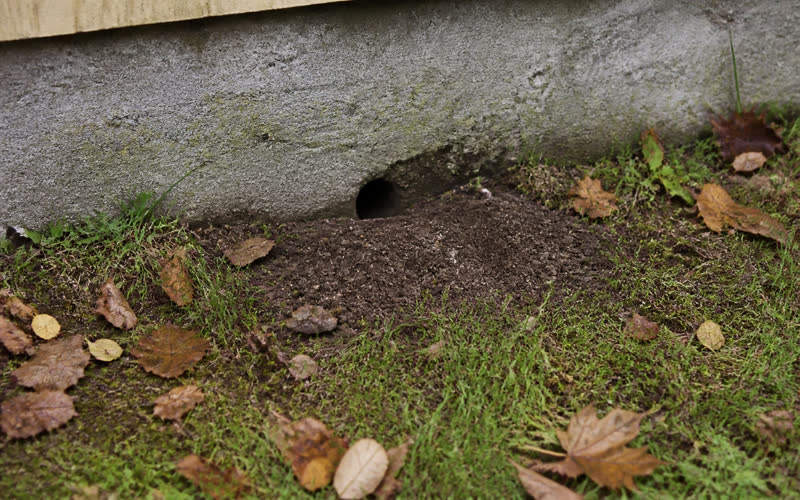
Damage to the insulation
Rodents tunnel through the insulation and gnaw through cable sheathing. The result is both heat loss and an electrical risk.
Treatment in the attic
We place bait stations and traps along the edges of the structure and on the runs the animals use. At the same time we point out the places in the roof structure that need sealing.
Inspecting an attic safely: light, joists, breathing protection
An attic is the place where a badly done inspection causes more damage than the rodents do. Three basic rules. First, lighting: you need a head torch that leaves both hands free, plus a hand torch for side light, because it is raking light that makes runs and footprints show up on the dust. Second, where to step: walk only on the joists or on boards laid across them; loose-fill insulation hides the void between joists, and a step beside a joist means a foot through the ceiling. If you have to work in the attic regularly, it is worth laying two wide boards as a permanent walkway. Third, breathing: years of accumulated dust, dry insulation fibre and droppings are not something to inhale, so a respirator-type mask, gloves and closed clothing are needed. Wash the clothes separately afterwards. Before you climb, make sure the ladder is stable and the hatch stays open.
How to read the evidence in loose-fill and board insulation
The two commonest types of insulation show activity in completely different ways. In loose material — cellulose, granules, crumbled mineral wool — the animals dig tunnels, and from above you see compacted, slightly sunken runs going straight from one point to another and ending at a round opening. The surface along these lines is smoother than the material around it, and droppings lie on it. In board or roll material laid between joists you cannot dig a tunnel, so the animals travel along the top of the joist and under the edge of the board; the signs are a rubbed, darkened band on the timber, a lifted board corner and droppings in a line along the joist. The third sign in both cases is smell — a concentrated note of ammonia in one particular spot means a nest nearby. Note which side of the roof the signs are on and how far from the hatch; that information determines where the control points go.
Stored belongings as nesting material
There is almost always something stored in an attic, and those belongings are often the main nesting base rather than the insulation itself. The riskiest items are cardboard boxes of papers, books and clothes; soft furniture, mattresses and pillows; blankets, curtains, old bags; offcuts of fabric and wadding; and boxes of decorations packed with artificial straw or shredded film. The sign that something has been used is shredded material in the corner of a box or under a piece of furniture, a gnawed 3–5 cm hole in the side of a box, and droppings inside it. The practical recommendation is simple: swap cardboard boxes in the attic for hard plastic containers with tight-fitting lids, take soft furniture out of the attic altogether, and keep everything stored on a shelf above floor level rather than on the insulation. After that the result of a treatment holds better, because the animals have fewer places left to rebuild a nest.
The roof edge and eaves gaps — the main entry point
Most attic infestations begin in one and the same place: where the roof covering meets the top of the wall. This junction typically has several weak points. A gap between the eaves boarding and the wall, opened up as the timber dries. Ventilation openings in the eaves or ridge with no mesh, or with rusted, gnawed mesh. A spot where the roof covering does not sit against the battens and leaves a 2–4 cm gap. A damaged or fallen section of bargeboard on the gable. A downpipe fixing that gives direct access to the edge. In practice, remember that a mouse needs only 6–7 mm and a rat about 20 mm, and that a timber edge gets widened with teeth. For sealing, use galvanised metal mesh with an aperture of up to 5 mm, sheet metal flashing or mortar; expanding foam without metal reinforcement will not hold here. Inspect both from inside and from outside in daylight.
Overhanging branches and trees by the roof
An attic differs from a basement in that the way in is through the air. A tree branch reaching closer than about two metres to the roof edge is a permanent bridge, used every night whatever the weather. Climbing plants on the wall, a tall hedge at the corner of the house and cables fixed to the façade work the same way. Autumn pruning is the simplest and cheapest measure: cut branches back to a safe distance, clear climbers off the bottom metre of wall, and pull in slack cable loops. Also look at neighbouring structures — a shed, a garage, a canopy — from whose roof an animal can step across onto the house. This work does not by itself remove animals already nesting in the attic, but without it sealing and treatment are cancelled out by fresh arrivals. The right order is to reduce the population, seal the edge, and only then expect a result.
Why noise in the attic often means a black rat
Sound is the first and often the only sign an owner notices. It is worth reading it accurately. Mice make a fine, quick rustling and small footfalls, usually in the evening and early morning. Heavier scratching, clearly audible dragging and a rolling noise — as though something were being rolled across the ceiling — point to a larger animal. If that comes with 10–14 mm, slightly curved droppings and grease marks on the joists rather than down at floor level, consider the black rat: this species prefers dry, high spaces, climbs well and nests in the roof structure itself. The distinction is not academic. It changes where the control points go — stations along the joists and the roof edge, not in the basement — and it shifts the sealing priorities to the eaves and the branches. Describe in the form what the sound is like, when it happens and which direction it comes from; that tells us more than a general description.
Cleaning and replacing contaminated insulation
Long occupation leaves droppings, urine and nesting material in the insulation, and that part cannot be put right by ventilating. The order of work is set. First the treatment, and confidence that activity has stopped — cleaning before that means doing the job again a month later. Then sealing the entry points, so the restored layer is not reoccupied. Only after that, cleaning: take out only the damaged and contaminated zones, not the whole layer, because the damage is usually local, around nests and runs. Work in a respirator, gloves and closed clothing, collect the material in sealed bags, and lightly dampen the dust first so it does not rise into the air. Clean the surfaces under the removed layer, let them dry, and only then lay new material at the correct thickness. If you want an estimate of the scale, describe the roof area and the type of insulation in the form; we reply within 5 minutes and work in Riga around the clock.
Frequently asked questions
How do I know there are rodents in the attic?
By noise at night, droppings on the insulation and runs through the insulating material.
Does the insulation have to be replaced?
Not always. It depends on how much damage there is.
Is the treatment safe?
Yes, we use tamper-resistant stations and mechanical traps.
Can I go up and look for myself?
You can, provided you observe three things: walk only on the joists or on boards laid over them, use a head torch so both hands are free, and wear a respirator-type mask with gloves. Years of accumulated dust together with insulation fibre and droppings are not something to inhale, and a step beside a joist means a foot through the ceiling.
How do I tell whether a nest in the attic is active or old?
By the droppings and the material. Fresh droppings are dark, soft and shiny; old ones are grey, dry and crumble when touched. In an active nest the shredded material is loose and shaped, with compacted runs visible in the insulation surface around it. An abandoned nest is flattened and covered with a layer of dust.
Does all the attic insulation always have to be replaced?
Usually not. The damage is local — around nests and along runs — so only the contaminated zones are taken out and replaced. Replacing the whole layer is only needed if the infestation has run for years and affected most of the area. Either way, cleaning comes after treatment and sealing, not before.