
At a glance
- Service
- Rodent control in a café
- Area covered
- Riga and the surrounding region
- Price
- From €40 — the figure quoted is the final price
- Availability
- 24/7, weekends and nights included
- Reply time
- Within 5 minutes of the form being submitted
- How to book
- Through the enquiry form only
A café has smaller premises than a restaurant, but the food source is just as constant. In a small floor area the presence of rodents becomes noticeable faster — and becomes a problem faster.
Waste storage
In small premises the waste is often kept by the back door. That is the commonest place for the problem to start.
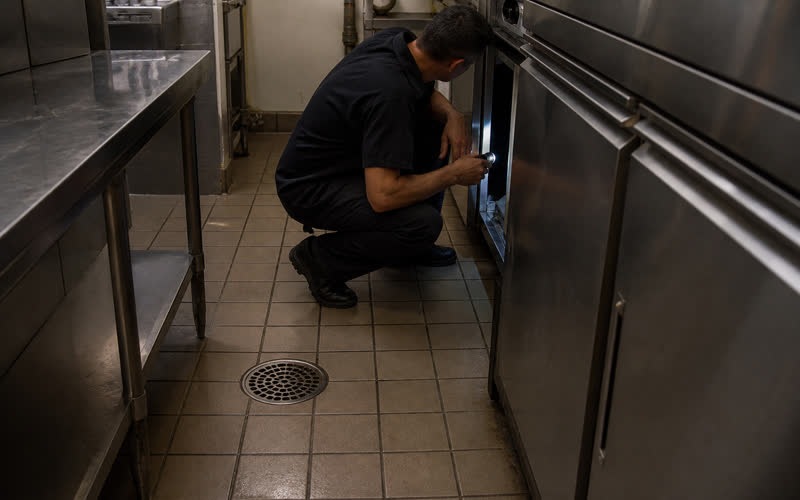
Behind the equipment
The backs of fridges, coffee machines and cookers are warm and hard to reach — that is where nests form and crumbs collect.
Quick treatment
In small floor areas the treatment usually takes less than an hour, so it can be carried out between trading days without any interruption to business.
Small premises: fewer hiding places, but also less room for stations
Cafés in central Riga often occupy sixty to a hundred square metres, and that changes the logic of the treatment. The good news is that a rodent has nowhere to disappear to: the kitchen area is easy to survey, the store is a single shelf, and tracks in flour dust are spotted at the very first inspection. The bad news is that we have nowhere to put bait points either. There can be no station in the seating area at customers' feet, in the kitchen working area it gets in the way, and what remains is the perimeter: along the back wall, in the recess behind the fridge compressor, under the sink unit, by the threshold of the service door. In practice that means four to six points rather than twelve. We compensate with precision — every point goes on a run that has actually been identified, not at an even spacing. In a small property, one badly placed point is a quarter of the whole plan.
Coffee grounds and pastry crumbs as a constant food source
In a café the food problem is not large waste but a continuous fine stream. Coffee grounds are rich in nutrients and smell strongly — in an open bucket under the counter they draw mice more reliably than any food scraps. Pastry crumbs fall behind the display cabinet, under the feet of the counter, into the gap between the floor tiles and the base of the machine. Sugar-sachet remnants, milk spills under the steamer, almond-flour dust — all of it accumulates in places the daily sweep never reaches. Our advice is specific: empty the grounds container into a sealed bag and take it out in the evening rather than leaving it until morning; once a week pull out the display cabinet and the counter and vacuum behind them; use a removable tray under the coffee machine. If those three things are happening, bait consumption after treatment drops considerably faster.
A shared waste area in a mixed-use building
Most cafés in Riga are on the ground floor of a residential building, and the bins stand in a shared courtyard or a basement recess where residents, the hairdresser and an office throw their bags too. You can dispose of your own waste impeccably, but the population feeds off the whole area together. That is why during an inspection we always go outside and look at the bin area: do the lids close, are there trodden runs in the grass under the bins, are bags dumped alongside when a bin is full. If the area is the source of the problem, treatment indoors alone gives a short-lived result. The practical solution is to place control points along the perimeter between the bins and the building wall as well, and to talk to the building manager about collection frequency. Fill in the form and we will assess the courtyard side during the inspection too.
The summer terrace and spilled drinks
The terrace is a separate problem that nobody notices in winter. Straws, sugar, drips of ice cream and pieces of food fall through the timber decking, and there they stay all season — sweeping underneath the deck is practically impossible. Beside it there are usually planters with damp soil and stacked folding furniture in the corner. As a result, by August a warm, sheltered zone with a constant food supply has formed under the terrace, right by the café door. From there it is one threshold to the inside. What we do: check the edges of the decking and whether the underside is closed off with mesh, place points along the building wall at the ends of the terrace, and recommend lifting and washing the deck at the end of the season. If the terrace sits on asphalt with a gap at the wall, that gap needs filling before the next season.
A morning opening check the staff can carry out
The best early warning system in a café is the barista who opens up. There are five minutes before the first customer, and that is enough. The checklist is short: are there any black, rice-grain-like droppings on the counter or shelf surfaces; are there footprints or drag marks in a layer of flour, sugar or dust; are the corners of bread and pastry packaging chewed through; are there fresh timber or plastic shavings under the sink; have small objects been moved overnight. It is worth recording what you find in a dated note rather than relying on memory — two entries in two weeks in the same corner are a precise indication of where to look for the nest. A check like this does not replace treatment, but it lets you start weeks rather than months earlier.
Why neighbouring premises in the same building matter
In an old Riga masonry building or a 1970s panel block, the ground-floor premises are linked by a shared basement, shared ventilation shafts and shared pipe runs. For a rodent there is no boundary between your café, the food shop next door and the basement store. If only one unit is treated, the population retreats to the neighbouring zone and comes back a few weeks later — that is not a shortcoming of the treatment, it is pressure from outside. So during an inspection we always ask what is behind the wall, above the ceiling and in the basement below the floor, and we check the pipe entries. If the source is the neighbouring unit or the shared basement, we say so honestly and recommend a solution worked out together with the building manager. Treatment of commercial premises starts from €70, and a plan at building level almost always costs less than repeat callouts to a single unit.
Frequently asked questions
How long does the treatment take?
Usually less than an hour.
Does the café have to close?
No, if the treatment takes place outside trading hours.
Is a night callout available?
Yes, we work 24/7.
Is it enough to treat just the kitchen?
Rarely. The kitchen is the food source, but the nests are more often in the seating area under the counter, in the recess behind the fridge, in the basement store or under the terrace decking. Treating only the kitchen puts the points away from the actual runs. During the inspection we check the whole premises, including the service entrance and the waste area.
The café is trading and the seating area is small — where will the points go?
Only in places a customer will not touch: along the back walls, behind equipment, under the structure of the counter, in service recesses and by the service door. The stations are tamper-resistant and fixed in place. If the premises are very small, we put some of the points in the basement and by the waste area.
The neighbouring unit in the same building has rodents. Is it worth us treating?
It is, but with realistic expectations. Treating your premises reduces the population and protects the stock, but as long as the source next door remains, the pressure continues. The most effective option is treatment together with the shared basement or the neighbouring unit. Fill in the form and we will propose a solution at building level.