
At a glance
- Service
- Rodent control on farms
- Area covered
- Riga and the surrounding region
- Price
- From €40 — the figure quoted is the final price
- Availability
- 24/7, weekends and nights included
- Reply time
- Within 5 minutes of the form being submitted
- How to book
- Through the enquiry form only
On a farm the influx of rodents from the surrounding area never stops. The aim here is not complete extermination but keeping the population at a low level.
Feed stores
Grain and animal feed are the strongest attractant. Control points need to be closer together here and checked more often.
Livestock buildings and animal housing
Placing bait near animals calls for particular care — stations are positioned so that livestock cannot reach them.
Perimeter protection
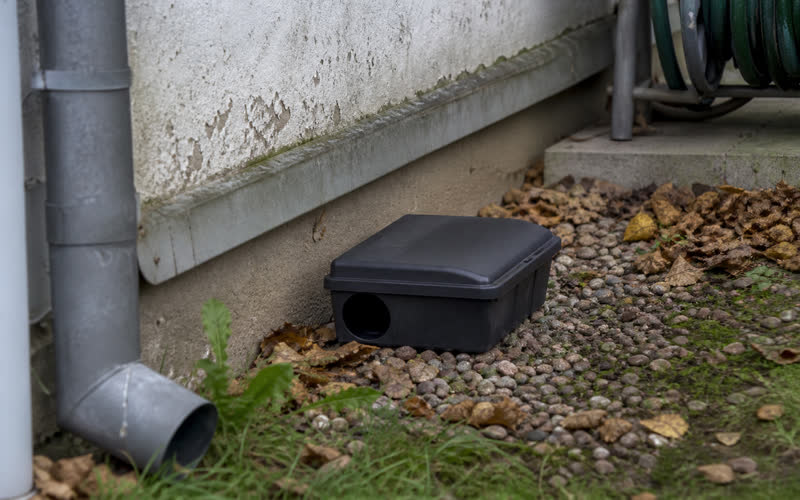
The main work is on the perimeter: stations along the outside walls intercept rodents before they get inside.
Grain stores — the strongest attractant on a Latvian farm
Nothing on a farm competes with grain. A loose heap in a barn, a bin with an imperfectly closed hatch, sacks of feed on pallets or a dryer with grain residues in its channels are a food source that works all year, does not change with the season and is practically inexhaustible. Against that background, any bait is competing with tonnes of freely available, high-value food, and that is exactly why treatment in a grain store calls for a different approach than in a house. The first step is always to reduce the availability of food: hatches closed, bin joints repaired, grain residues swept up along the walls and under the conveyors, sacks at least half a metre from the wall and on pallets. Only then does a network of points around the perimeter start to work. In the reverse order the result will be weak no matter how many points are put out.
Straw and hay bales as a nesting environment
A stack of bales is almost the perfect rodent home: warmth, dryness, complete darkness, nesting material and dozens of runs between the bales that neither a dog nor a person can get into. If the stack stands next to the feed store or the livestock building, you effectively have a nesting zone right beside a food source. In practice we recommend several things. Stack bales on a hard base or on pallets rather than directly on the ground, and not against the wall of a building — at least a metre of clearance lets you check and place points on both sides. Use the oldest season's bales first rather than leaving them at the bottom of the stack for years. We place protected stations around the perimeter of the stack, because the stack itself cannot be treated — you can only work it from the edge, which is why its size and position matter.
Why the aim is limiting the population, not wiping it out
An honest conversation about results on a farm looks like this: in an open rural setting with a food base, neighbouring fields, ditches and other farms nearby, the complete disappearance of rodents is not a realistic goal. The population is topped up from outside continuously. The real and achievable task is to hold the numbers low enough that there is no damage to feed, cables and insulation and no rodents getting into the animal housing. That is achieved with a permanent network of perimeter points, regular checks and good order around the buildings, not with one intensive treatment. In practice it means moving from callouts to a schedule. On farms where the checks happen regularly, the winter usually passes without any acute situations, even though the rodents remain in the surrounding area.
The influx at harvest time
At the end of August and September comes a shift that every farm feels each year: the fields are harvested, and a wide zone of food and cover suddenly disappears. The population that spent the summer in the fields and along the ditches moves within a few weeks to the nearest buildings — straight to the new grain heaps and the warm livestock buildings. So a treatment started at the end of October is already working against considerably greater numbers than the same treatment in mid-August. The practical conclusion is simple: the perimeter network of points needs to be prepared and filled before the harvest ends, not after the grain is already in the barn and tracks are appearing in the dust. Autumn is also the time to check the service entries to the buildings — door thresholds, ventilation openings, pipe penetrations — before the first cold nights.
Farm cats and why they are not enough
Cats on a farm are useful, but they do not solve the problem, and the reasons are practical. A cat hunts where it is convenient — the yard, the front of the livestock building, the edge of the hay shed — but does not get into a grain bin, or the middle of a stack of bales, or the burrows under a concrete floor where the nests are. Two or three cats have no effect on a population that breeds faster than it is caught, and most cats do not hunt adult rats at all. On top of that, the cat's food bowl in the yard is itself a steady food source that draws rodents in at night. If there are cats on the farm, that is taken into account in the treatment plan: we use tamper-resistant, fixed stations with an entry sized for rodents only, and we recommend feeding the cats at set times and not leaving a full bowl out overnight.
Protecting stations from livestock and the weather
On a farm a station is not simply a box put down — it has to survive rain, snow, wind and the presence of livestock. In a shed or a pen, a cow, a pig or a horse will tip a station over or move it within days if it is not fixed down. So we put the points out of the animals' reach — behind a barrier, in a wall recess, under a protective structure at the bottom edge of a wall — and physically fix them to the wall or the base. External perimeter points are placed on a hard base along the building walls and shielded from direct rainfall, because sodden contents lose their effectiveness fast. In winter, snow cover has to be allowed for: a point that is under the snow is effectively not working. Every point is numbered and marked on the plan so that none is forgotten or lost during the regular check.
Frequently asked questions
Is the treatment safe for livestock?
Yes, provided the stations are placed correctly and are lockable.
How often does it need checking?
On farms, usually more often than on urban sites.
Is a regular service possible?
Yes.
Why do rodents appear again the following season after a treatment?
A farm sits in an open environment where the population is constantly topped up from the fields, the ditches and neighbouring land. A single treatment reduces the numbers at that moment but does not stop the influx. The real answer is a permanent network of perimeter points with regular checks, not individual callouts.
When is the best time to start treatment on a farm?
Ideally before the harvest ends, in August or early September, while the population is still out in the fields. The perimeter network is then already working at the point when the rodents move to the buildings. Starting in November means working against considerably greater numbers and takes more time.
Can you work on a large farm with several buildings?
Yes. During the inspection we draw up a plan with numbered points for all the buildings and the perimeter, including the grain store, the livestock buildings and the bale stacks. The work can be organised as a regular service with a set schedule of checks. Fill in the form with the number of buildings and the area — we reply within 5 minutes.