
At a glance
- Service
- Rodent control in gardens and yards
- Area covered
- Riga and the surrounding region
- Price
- From €40 — the figure quoted is the final price
- Availability
- 24/7, weekends and nights included
- Reply time
- Within 5 minutes of the form being submitted
- How to book
- Through the enquiry form only
In a garden, rodents are only partly a problem in themselves — the main risk is that they move from the garden into the house as soon as it turns cold.
Burrows and travel routes
The brown rat digs burrows under sheds, compost heaps, decking and greenhouses. Where the burrows are tells you where to put the stations.
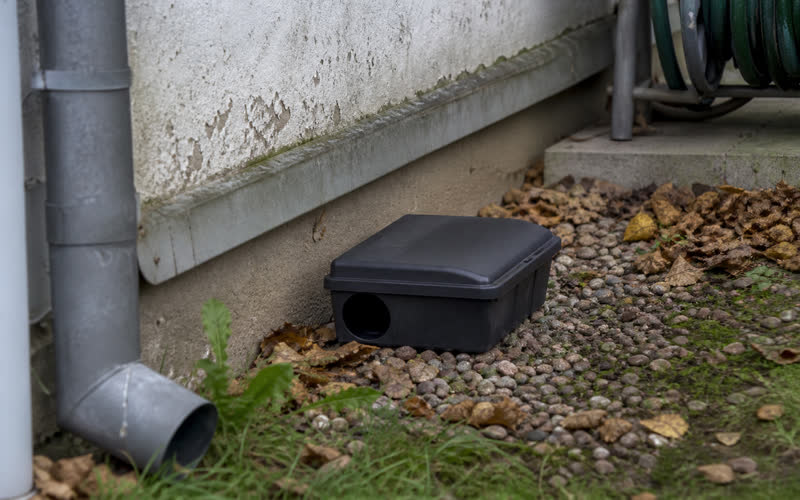
Compost and food sources
An open compost heap with food waste is the strongest rodent attractant in a yard. Bird feeders and pet food in a shed work the same way.
Outdoor bait stations
Outdoors we use lockable, fixed-down stations that stand up to damp and cannot be opened by pets or children.
Composting in a way that does not feed rodents
Compost is not a problem in itself — the problem is how it is set up. An open heap on the ground with kitchen scraps gives three things at once: food, warmth and cover, and it is exactly that combination that makes it the most attractive point in the whole yard. The answer is a closed composter with solid sides, a tightly fitting lid and either metal mesh in the base or a hard standing that prevents digging in from below. The second condition is the contents: plant material only — vegetable peelings, fruit waste, grass, leaves. Cooked food, meat, fish, cheese and dairy, and oil must not go into the compost, because those are precisely what attract rats. The third is management: turning it over every couple of weeks raises the temperature, speeds up decomposition and destroys any chance of nesting in the dry middle. If round openings 6–9 cm across appear in the sides of the heap, it is already a home rather than a compost.
Bird feeders and spilled seed
Feeding birds in winter is one of the most common reasons rodents turn up in a well-kept garden. The mechanism is simple: birds scatter a fair proportion of the seed, it collects under the feeder, and a mouse or a rat arrives there at night. Within two months a permanent feeding site with a run to the nearest cover can establish itself under a feeder. Three practical measures prevent it. First, the feeder goes at least a metre above the ground on a smooth metal pole, not hung on a tree branch over a shrub. Second, put a tray or a hard surface underneath that can be swept, and clear the seed residue every two or three days. Third, put out only as much food as the birds eat in a day — not a week's supply. If you find small 3–6 mm droppings or a flattened run in the grass under the feeder, you have found the source.
Damage in greenhouses and raised beds
A greenhouse is the warmest and most sheltered place in a garden, so it gets occupied before any other structure. The way in is almost always the bottom edge: a gap of a few centimetres is left between the polycarbonate sheet or glazing frame and the ground, and both mice and rats get through it. The protection is metal mesh with an aperture of up to 5 mm buried around the perimeter, 20–30 cm deep and turned outwards at the bottom. Inside, the damage is characteristic: seedlings cut off at the base, tomatoes and cucumbers gnawed in the lowest row, freshly sown seed drills dug up. Raised beds with a timber frame and a warm layer of mulch create a similar problem — a dry, hidden run forms under the board and the mulch. The practical answer is mesh in the base of the bed at the point of building it, and pulling the mulch back from the frame edge in autumn. Seed and planting stock in a greenhouse should be kept only in a metal container with a lid.
Ponds, water butts and damp in the yard
As well as food, the brown rat needs free water — roughly 25–30 ml a day — and it is often the water source that determines which part of a yard a burrow appears in. A garden pond, water butts, a leak in the irrigation system, a dripping outside tap and a pet's water bowl are the points around which the ground needs looking at during an inspection. The typical picture is a burrow 1–3 m from the water's edge, hidden under a stone, a timber edging or a dense shrub. A stony pond edge with a geotextile layer gives both a route and cover. What to do: repair leaks, put lids on water butts, bring the animals' water indoors overnight, and keep a metre around the pond edge low and open to view. Eliminating the water source in a garden altogether is not possible, but the cover around it can be removed, and that is usually enough to stop the spot being worth a burrow.
Where to put the log pile and how to stack it
The log pile is the most common nesting site in a Latvian yard, and the reason is how it is built: between the logs are thousands of dry, warm, dark niches that nobody ever looks into. If the pile also stands right against the house wall and on the ground, it is a perfect starting point for a route to the foundations. The right configuration comes down to three conditions. The pile on bearers or a metal frame at least 30 cm above the ground, so the underside can be seen and nothing can dig in there. At least a metre from any wall, with a clear walkway all the way round. And stacked so that the pile is used up within the year rather than standing untouched for three. The same goes for boards, bricks, tarpaulins and building materials: anything that lies on the ground against a wall for a year becomes a hiding place. This reorganisation takes a day, and it changes the situation on a site more than many other measures.
Storing onions and root vegetables in a basement or shed
The autumn harvest is a concentrated food store, and protecting it is part of garden rodent control. Potatoes, carrots, beetroot and onions kept in wooden crates or wicker baskets on a basement floor are gnawed from below — where the produce touches the side of the crate — and the damage only comes to light months later. The practical measures: crates raised at least 20–30 cm off the floor on a shelf or a bearer; a clear strip around the store so the floor is visible and droppings can be spotted; rotten specimens sorted out immediately, because the smell attracts. Flower bulbs — tulips, narcissi, garlic — should be kept in a metal or thick plastic container with a lid and ventilation holes smaller than 6 mm. Check the crates once a month. If you find fine parallel incisions on the surface of a bulb, the activity is current and the stations belong by the store, not out in the yard.
Hedgehogs and other wildlife: how the stations stay out of their reach
Treatment in a garden always has to be planned alongside the question of non-target animals — hedgehogs, frogs, birds, the neighbour's cat. The answer is design, not hope. A lockable bait station with a solid casing and an entry hole sized for a rodent is physically impassable to a hedgehog; the entry is formed as a bend, so a bird cannot get at the contents either. The station is fixed to the ground or to a heavy base so it cannot be tipped over or dragged away. Placement is the second factor: points go along walls, the fence line and at burrow entrances, not out on open lawn where other animals walk. The third is record-keeping — every point is written down and collected at the end of the programme, not left in the garden for years. If you regularly see hedgehogs in the yard, say so in the form and we will plan the layout of the points so their routes and the stations do not cross.
Frequently asked questions
Will the treatment affect the vegetables?
No. The stations are enclosed, and the product does not get into the soil or the plants.
Are the stations safe for a dog?
Yes, they are lockable and fixed down to the ground.
When is the best time to treat?
Late summer and autumn, before the rodents move into the house.
If rats have appeared in the yard, does the compost have to go altogether?
No, but it has to be reworked. A closed composter with a lid and either a solid base or one reinforced with mesh, taking plant material only and turned regularly, is no longer a feeding site. The problem is almost always an open heap with kitchen scraps, not the idea of composting itself.
Are outdoor stations dangerous to hedgehogs?
A properly chosen and positioned station is not accessible to a hedgehog — a closed casing, a rodent-sized entry hole with a bend in it, and a fixing to the base keep any other animal away from the contents. On top of that, the points go along walls and fences rather than out on open lawn. If there are hedgehogs in the yard, say so in the form when the work is being planned.
Where in a yard is a rat burrow most often found?
In three places: at the edge of the compost, under a log or board pile stacked on the ground, and close to a water source — a pond, a butt or a leak. The entrance is round, 6–9 cm across, with a smoothly worn rim. If a plug of leaves pushed into the entrance has been shoved out by the next day, the burrow is active.