
At a glance
- Page topic
- Rodent control products
- Area covered
- Riga and the surrounding region
- Price
- From €40 — the figure quoted is the final price
- Availability
- 24/7, weekends and nights included
- What works
- Metal mesh with a 5 mm aperture and cement mortar; expanding foam does not
- How to book
- Enquiry form only — we reply within 5 minutes
The product itself is rarely the deciding factor. Where and how it is placed matters far more.
Mechanical products
Spring traps, enclosed traps and live traps. The advantage is that the animal does not stay inside the structure and there are no chemicals involved. The drawback is that they need regular checking and correct placement.
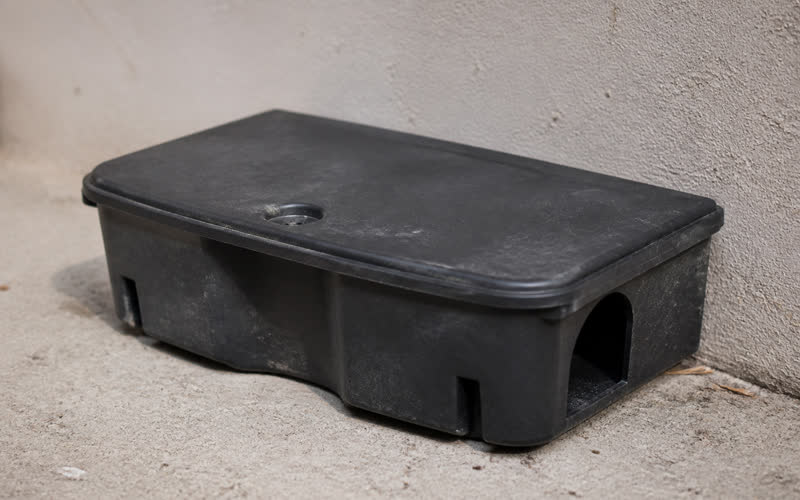
Baits and stations
Rodenticides in tamper-resistant stations. The advantage is that they work continuously and cover a large area. The drawback is that the animal may die somewhere inaccessible, and there is a risk of secondary poisoning if the station is not sealed.
Repellents
Ultrasound and scent products. The evidence for their effectiveness is weak, and rodents get used to them. They do not work as the only solution.
What sets the professional approach apart
Not so much the product itself as the inspection that comes before choosing it, placement on real runways, tamper-resistant stations that are fixed down, a follow-up check and sealing entry points.
How to read the label and what matters most on it
The front of the pack sells; the information is on the back and in the instructions for use. Look for four things. First, the active ingredient and its percentage content; that, not the product name, determines how the product works and for how long. Second, the places it may be used: some products are for indoor use only, others only for tamper-resistant stations, and this restriction is not a suggestion. Third, the warning phrases about danger to children, pets and watercourses. Fourth, the antidote or what to do in case of poisoning, which is worth reading before use rather than after. If the label text is in a foreign language with no translation, or the active ingredient is not stated at all, it is better not to use the product. Specific doses are set by the manufacturer's instructions for each product individually.
Storage and disposal of leftovers
This is the part people think about least, even though it is where most domestic accidents happen. Keep both unopened and opened product in its original packaging with a legible label — decanting it into an empty food container is a direct route to trouble. Location: a locked cupboard or box that children and pets cannot get into, dry, cool, separate from food, animal feed and household chemicals. Never store it under the kitchen sink. Unused product, used packaging and leftover uneaten bait must not go into household waste, must not be composted and definitely must not be flushed down the drain — they go to a hazardous waste collection point. A dead animal is picked up with gloves, put into a double bag and disposed of; it is not left outdoors where birds or cats can eat it.
Why the same substance behaves differently in a station and out in the open
The active ingredient is only half the story; the other half is the environment the bait sits in. Inside a sealed station the bait stays dry, keeps its shape and its smell, and only a rodent-sized animal can reach it. Bait put down loose in a yard or a basement soaks up moisture, grows mould and loses its appeal within a few days; the animal simply stops touching it. More importantly, loose bait is accessible to a cat, a dog, a bird, a hedgehog and a child, and an animal can also carry it off and drop it elsewhere, moving the risk to a place you do not control. A station also lets you record consumption and always know where every gram put out is. The same substance in a sealed point is both safer and more effective.
Monitoring products with no active ingredient
Not every product has to act — some have to show. Neutral bait with no active ingredient, put out in a station, serves one purpose only: establishing whether there is any activity at that point and how much. Powder markers work the same way, applied in a thin layer on the floor along a wall so that in the morning you can see the tracks and the direction of travel, and so do paper or cardboard indicators that hold gnaw marks. This approach is valuable at two moments: before treatment, to put points where they are genuinely needed, and after treatment, to confirm objectively that the activity has stopped. Monitoring is also the only correct solution in places where a permanent presence of an active ingredient is undesirable — rooms with food in them, for example, or children's facilities.
More does not mean better
A frequent mistake is assuming that a double portion of bait doubles the result. In practice the opposite happens. A large quantity of bait at one point sits uneaten for a long time, spoils and loses its appeal, and the animals then start avoiding the spot. An excessive quantity also raises the risk to other animals and makes record-keeping harder — you no longer know how much has actually been consumed. With traps the principle is reversed: number helps, size does not. Ten correctly placed traps with a pea-sized portion of bait work better than two with a thick layer of it. The general rule is simple: plenty of control points, little material in each, regular checking. It is regularity, not volume, that decides the result.
A short guide to choosing: which tool for which situation
A few mice in a flat with activity in one room — mechanical traps and sealing entry points; chemicals are not needed here and create a risk of odour inside the wall. A private house with burrows in the yard — tamper-resistant stations around the perimeter, never loose bait. A basement or plant room with no food in it — tamper-resistant stations along the walls plus monitoring points. A room with food in it, a kitchen, a store — mechanical products and monitoring, because the presence of active ingredients there is undesirable. An unknown situation where it is not clear whether there is any activity at all — monitoring points first for two weeks, and only then a choice. If the site is large or the rodents are inside the structure, fill in the form describing the situation: we reply within 5 minutes and work around the clock in Riga.
Frequently asked questions
Are the products sold in shops worse?
Not always worse, but they are usually put out without an inspection.
Which product is the safest?
Mechanical traps and tamper-resistant bait stations.
Can I use them myself?
Yes, as long as you follow the safety instructions and do not put them out in the open.
How long does bait stay effective once it is out?
That depends on the environment. In a dry, sealed station it lasts longer; in a damp basement or outdoors it loses its appeal much faster. The practical approach is a visual check every few days: if the bait is damp, collapsed, showing signs of mould or has lost its smell, it needs replacing regardless of any timescale.
Can several different products be combined in one room?
Mechanical products and monitoring points can be combined, and often it is useful to do so. Using different active ingredients at the same time in one zone is not advisable — recording consumption becomes impossible and you no longer know what produced the result. Choose one approach for one zone and write down what has been put where.
What should I do if a pet has got at a product?
Contact a vet immediately and take the product packaging with you, or at least photograph the label with the name of the active ingredient — that is the main thing the vet needs. Do not wait for symptoms, as they can appear with a delay. From then on, use only tamper-resistant stations the animal cannot get into.