
At a glance
- Service
- Rodent control in shops
- Area covered
- Riga and the surrounding region
- Price
- From €40 — the figure quoted is the final price
- Availability
- 24/7, weekends and nights included
- Reply time
- Within 5 minutes of the form being submitted
- How to book
- Through the enquiry form only
In a shop, rodents most often start in the stockroom and only later appear on the sales floor. By the time a customer notices them, the problem has already been there a while.
The stockroom and goods-in
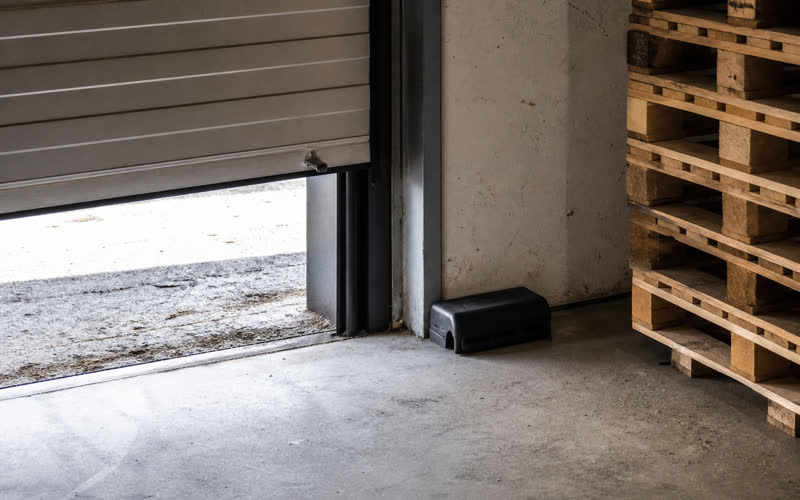
The goods-in area is the main entry point — rodents arrive on the premises from the supplier along with pallets and cardboard packaging.
Stock losses
Gnawed packaging means written-off stock. In food shops the losses mount quickly and often exceed the cost of treatment.
Treatment that is not seen
We place stations in the stockroom and plant rooms, and on the sales floor only in discreet locations. We work before opening or after closing.
Signs at shelf level that the first sales assistant notices
On the sales floor, rodent presence is almost always given away by the packaging rather than the animal itself. The typical signs are a gnawed cardboard corner with tooth grooves about 3–4 mm wide, a torn polypropylene bag of dry pet food or nuts, spilled grain under a shelf, and black droppings the size of a grain of sand along the back edge of a shelf. It happens most often on the lower shelves, because they are closer to the floor and the darkest. The second group of signs is under the shelving units: accumulated dust with paw prints, shreds of packaging paper and a distinct ammonia smell in an enclosed corner. Staff are worth telling that gnawed packaging means a nest nearby — rodents do not feed ten metres from home. So we log every find with the shelf row number, and that map effectively points to the sector of the floor where the search has to start.
Back of house and sales floor need different approaches
A shop has two distinct working environments, and they must not be treated the same way. At the back — the goods-in dock, the stockroom, the packaging and waste room, the service corridors — we can work with a full network of lockable control points along the wall lines, because there are no customers and no open product on shelves. On the sales floor the approach is different: there we use discreet monitoring points and mechanical measures, placed under shelving plinths, behind the till-area panels and in service recesses, where they are out of sight and where neither a customer nor a child can reach them. More active measures are not used on the sales floor or near open food. The boundary between the zones is marked on the site plan, and every point is numbered so that nothing goes unchecked or gets lost during servicing.
Fridges and display cases: the warm compressor compartments
Refrigeration equipment is the most contradictory place in a shop — it is plus two degrees at the front, but in the compressor and condenser compartment at the back the temperature holds steadily around twenty-five. It is warm there all year, it is sheltered, and dust collects there along with spilled food debris. In practice it is in these compartments, and under the plinths of display cases and near the condensate drains, that we find nests made of shredded cardboard and packaging film. There is an additional risk of cable damage: gnawed insulation in a refrigeration unit means a breakdown and potentially the loss of everything in the case. So during an inspection we always open the accessible service panels, check the wiring insulation and recommend that these compartments go into the regular cleaning schedule at least quarterly, rather than being remembered only when something is repaired.
Stock rotation and controlling spillages
Rodent pressure in a shop is determined less by how often it is treated than by how long product stands and how quickly spillages are cleared. Where rotation is poor, the bottom shelves and the corners of the stockroom go years without being emptied, and a completely undisturbed zone forms behind the rows of stock. The practical solution is specific: rotate dry goods on the principle that the oldest batch goes first, empty and wash out one shelf block completely once a month, and store nothing directly on the floor — in the stockroom a clear strip of floor at least 30–40 cm wide should be left along the wall under the pallets or the bottom level of the racking. Spilled grain, sugar or flour must be swept up immediately, not at the end of the shift. Damaged stock has to come off the floor and be kept in a sealed container until it is written off.
What staff should check every morning
The most effective monitoring in a shop is a short morning walk-round that takes five to seven minutes before opening. Six points to check: whether the back door and dock shutters were closed overnight and whether their seals are intact; whether the lids are closed on the containers in the waste room; whether there are fresh spillages or gnawed packaging under the bottom shelves; whether there are new droppings under the chilled cases; whether the control points are in their places and have not been moved during cleaning; and whether any newly damaged sacks have appeared in the stockroom. It is worth noting findings in a simple log with the date and location. That record is later the most valuable material for an inspection, because it shows the trend over time — whether activity is rising, whether it is concentrating in one sector — and the main effort is then directed at that sector.
A small shop and a supermarket are different jobs
The problems of a small street shop and a large retail centre unit are not the same. A small shop of up to a hundred square metres usually has one back room, one external door line and a limited number of points — there the deciding factors are the surroundings and the neighbours, because the rodents come from a shared basement, a food outlet next door or the bin area in the courtyard. In a supermarket you have to reckon with a long delivery flow, several dock shutters standing open for hours a day, a separate packaging and waste compactor, and a plant floor above the sales area. Without zoning and a numbered plan of points it is impossible there to work out where the pressure is coming from. The price differs accordingly: for commercial premises it starts at €70, but we work out the final sum from the floor area and the type of site. Fill in the form and we reply within 5 minutes.
Frequently asked questions
Will the treatment happen during opening hours?
Not necessarily — we can work before opening or after closing.
Will the stations be visible to customers?
No, we place them discreetly.
Do you service premises regularly?
Yes, regular servicing is advisable for shops.
How do you tell that rodents are on the sales floor and not just in the stockroom?
On the sales floor the signs show on the lower shelves: gnawed cardboard corners with 3–4 mm tooth grooves, torn bags, spilled grain and black droppings at the back of the shelf. Damaged packaging means a nest nearby, so the location of the find effectively points to the sector to search.
Do the backs of the chilled cases need checking too?
Without fail. In the compressor compartment the temperature holds around twenty-five degrees all year, and dust with food debris collects there. It is one of the most common nesting sites in a shop, and gnawed cable insulation can also cause equipment failure.
What can staff check every morning?
Five minutes before opening: the back door seals, the lids on the waste containers, spillages under the bottom shelves, droppings under the display cases, whether the control points are where they should be, and damaged sacks in the stockroom. Note findings with the date — that shows the trend.