
At a glance
- Location
- Ādaži
- Service
- Rodent control — rat and mouse extermination
- Price
- From €40 — the figure quoted is the final price
- Availability
- 24/7, weekends and nights included
- Getting there
- We travel from Riga; arrival time agreed per address
- How to book
- Enquiry form only — we reply within 5 minutes
Rodent control in Ādaži: a fast-growing suburb and what follows from it
Ādaži is a town and district centre that has grown in recent years as a residential area on the edge of Riga — detached houses, terraced houses, new residential developments, retail, service premises and light industry. The buildings are new, but that changes nothing for rodents: the brown rat and the house mouse use exactly the same service runs, however recently they were laid. So rodent control in Ādaži starts not with bait but with an inspection — we walk the perimeter looking for droppings, grease marks, gnawing and entry holes. Until it is known where the rodent gets in, a bait station only sustains the population instead of reducing it. First we find the route, then we plan the treatment and the sealing of entry points. In the buildings of Ādaži that almost always means two parallel pieces of work: control points indoors and perimeter protection outside, along the plinth and the outbuildings.
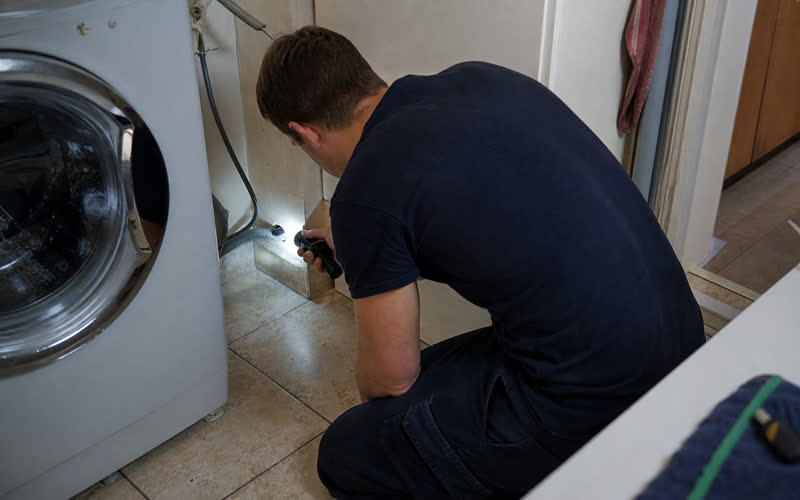
A new building is not a sealed building
In the new developments of Ādaži the most common find is unsealed service entries. Water and drainage pipes, electrical conduit, heat pump lines, ventilation outlets and cable ducts are often left with an open gap or filled with expanding foam. Foam does not stop a rodent — a mouse or a rat chews it through in a few nights. What works is metal mesh with a 5 mm aperture bedded in cement mortar. Keep the scale in mind: a house mouse gets through a 6–7 mm gap and a rat needs only 20 mm, so a careful look from two metres away tells you nothing. Inspecting a private house, we go along the whole plinth: joints, ventilation grilles, the bottom of the garage door, the base of the deck and every pipe entry. That check usually achieves more than an extra bait point, because it removes the possibility of getting in at all. Treating a private house costs €90–110, the minimum callout €40.
Sandy ground and the Gauja floodplains: where a rat digs its burrows
The area around Ādaži is sandy, set among river and lake floodplains and close to the Gauja. Light, well-drained ground is exactly what a brown rat needs for digging — the resistance is low and an underground run holds its shape. A burrow entrance can be recognised by an opening 5–8 cm across, usually on a slope, under shrubs, along a fence line, by a compost heap or a greenhouse. From the burrow the rat travels along fixed runs beside cover — a wall, a fence, a kerb — not across the open garden. So we put the external control points directly on those runs, not in the middle of the garden. In floodplain areas the rise and fall of the water in spring and autumn pushes rodents up onto drier ground, and enquiries from private houses then increase. That is why we review the external points seasonally rather than placing them once and leaving them unchecked.
Woodland and river edge: the autumn wave of mice
Ādaži is surrounded by wooded land, and many houses border pine woods or scrub. As the nights get colder, the field mouse looks for warmth in the nearest structure: a shed, a garage, the space under a deck, roof insulation or the plant room of a house. So in autumn rodent control in Ādaži is more a matter of the perimeter than of interior treatment — if the entry points stay open, every week brings in new animals. The signs are small: 3–6 mm droppings on the pantry shelves, chewed insulation around cables, a scratching sound in a partition or the ceiling at night. If 15–20 mm droppings appear in the crawl space or the basement, this is already a rat, and then the treatment plan is a different one, with a longer observation period, because a brown rat treats a new object in its territory with caution for 3–7 days.
Terraced houses and a problem shared with the neighbours
There are many terraced houses and adjoining units in Ādaži, and there a rodent problem is never one owner's business. The units are joined by a shared slab, crawl space, roof void and service runs, so a house mouse moves between households through the structure, not across the garden. If only one unit is treated, the population moves next door and comes back a few weeks later. In practice that means we inspect at least the adjoining units and seal the shared service entries — riser surrounds, ventilation ducts, roof overhangs. In flats and terraced house units treatment costs €40–80. Often the decisive part is not the bait but sealing entry points where the structure meets the neighbour's space. In practice inspecting several units at once costs less than repeated callouts one at a time, and the result lasts longer, because the population has nowhere left to move to.
How we work in Ādaži and how to book
Ādaži is roughly 20 km from Riga, with Carnikava, Saulkrasti and Sigulda nearby, so we plan callouts as part of the work north of Riga. In many households the residents are at work in Riga during the day, so inspections are often arranged for the evening or at the weekend — the arrival time is agreed separately for each address. For commercial properties, shops and production premises we usually plan the work outside visiting hours; there prices start from €70, depending on the floor area and the number of control points. We work 24/7, and emergency callouts are available. Fill in the form, saying what kind of property it is, the floor area and what you have noticed — we reply within 5 minutes and tell you how much inspection is needed. If the signs are fresh, we try to arrange the inspection within the next few days, so the treatment does not end up larger than it needs to be.
What rodent control in Ādaži covers
Rodent control in Ādaži means a full cycle, not a single treatment. Rat extermination and mouse extermination start with an inspection: we identify the species, find the runs and the entry points, and only then choose the method. Rodent control includes placing tamper-resistant bait stations or mechanical traps on the runs actually in use, a repeat check, and specific advice on what needs sealing so the problem does not come back. The price depends on the type of property and its floor area: treatment starts at €40, and the figure quoted is the final price. Describe the property in the form — we reply within 5 minutes.
Frequently asked questions
How much does rodent control in Ādaži cost?
The minimum callout is €40. Treating a flat or a terraced house unit usually costs €40–80, inspection and treatment of a private house €90–110, and for commercial properties prices start from €70 depending on the floor area and the number of control points. We set the exact figure once the property has been described. Fill in the form and say what kind of property it is and its floor area.
The house was built a couple of years ago — why does it have mice?
A new building does not mean a sealed building. In the new-builds of Ādaži we regularly find open water, drainage, electrical and heat pump entries, or openings filled with foam. Expanding foam does not stop a rodent — it gets gnawed through. A mouse gets through 6–7 mm, a rat through 20 mm. What helps is metal mesh with a 5 mm aperture in cement mortar.
How do I tell whether the house has a mouse or a rat?
The simplest indicator is the droppings: mouse 3–6 mm, rat 15–20 mm. A rat is also shown by grease marks 5–10 cm above the floor along the base of a wall and by a burrow entrance 5–8 cm across in the garden or along the fence. Mice are more often found in the pantry and plant rooms. We confirm it during the inspection.
Is it enough to treat only my own terraced house unit?
Usually not. The units are joined by a shared crawl space, roof void and service runs, so a house mouse travels through the structure to the neighbouring household and comes back. It is advisable to inspect at least the adjoining units and to seal the shared service entries — riser surrounds, ventilation ducts and roof overhangs. Fill in the form and say how many units are affected.