
At a glance
- Location
- Jugla
- Service
- Rodent control — rat and mouse extermination
- Price
- From €40 — the figure quoted is the final price
- Availability
- 24/7, weekends and nights included
- Getting there
- We travel from Riga; arrival time agreed per address
- How to book
- Enquiry form only — we reply within 5 minutes
Rodent control in Jugla: the lake shore and constant outside pressure
Jugla is a large neighbourhood in eastern Riga by Lake Jugla and Brīvības gatve. A body of water with a belt of reeds, damp meadows and shoreline scrub is the brown rat's natural habitat — there is water, cover and food all year round. That means rodent control in Jugla is different from the work in the inner neighbourhoods: there is no one-off introduction here, there is constant outside pressure from the shore towards the buildings. There are two practical consequences. First, we start the inspection from the outside of the building, working out which side the runs come from. Second, external control points are not an addition but the basis of the work — without them, treating the interior only clears space for the next animals. For properties closer to the shore we plan a shorter interval between checks than further into the neighbourhood.
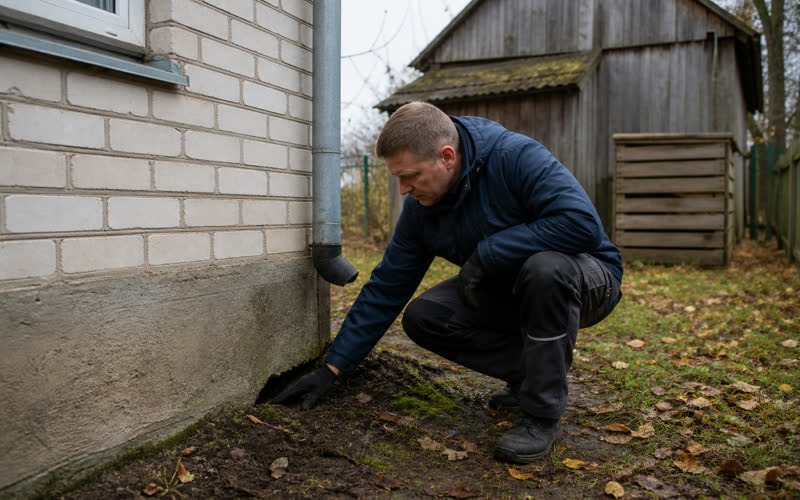
Damp ground: where the brown rat digs its burrows
The nearby lake and the low ground mean damp, soft soil, and that is exactly what suits burrowing — little resistance, the tunnel holds its shape, and underground the temperature is stable. You recognise a burrow entrance by the 5–8 cm opening, usually on a slope, under a shrub, along a fence line, by a compost heap, at the edge of a garage or on the kerb of a bin area. From the burrow the rat moves along fixed runs beside cover — a wall, a kerb, a fence — rather than across open ground, so outdoors we put the bait stations directly on those runs. In spring and after heavy rain, changes in water level flood the lower burrows and push the animals upwards to drier places: basements, sheds, heating substation rooms. That is usually when the number of enquiries from Jugla rises, and the external points need reviewing rather than leaving unchecked.
The woodland edge and the field mouse in autumn
Jugla is also bordered by wooded areas towards Berģi and Bukulti, and that brings a second, different problem — not rats from the water side, but the field mouse and the house mouse from the trees. When the nights turn colder, small rodents look for warmth in the nearest structure: a shed, a garage, the crawl space under a terrace, roof insulation, a service room in the basement. The signs are fine ones — droppings of 3–6 mm on pantry shelves, gnawed cable insulation, rustling in a partition wall at night. The difference from a rat is clear: rat droppings are 15–20 mm, and along the base of the wall there are grease marks 5–10 cm above the floor. Mouse extermination in a situation like that is more perimeter work than indoor treatment — if the entries stay open, every week brings new animals in.
Apartment blocks: basement, heating substation, ventilation shaft
The housing stock in Jugla is mainly Soviet-era apartment blocks with a through basement, a shared heating substation and vertical ventilation shafts. In a damp setting the basements are often cooler and wetter than elsewhere, and there a rat finds exactly what it needs. That is why rodent control in a flat on its own rarely gives a lasting result here — we inspect the basement window openings, the pipe inlets, the heating substation room and the surrounds of the stack at every level. We number the control points in the basement so that at the follow-up check we can see at which end of the building consumption is continuing. Entry points around pipes are sealed with metal mesh of 5 mm aperture in cement mortar; expanding foam does not stop rodents. Treating a flat costs €40–80, the minimum callout is €40, and the basement part is arranged by the building manager.
Private houses and garden streets near the water: perimeter protection
Jugla also has streets of detached houses and garden plots, some of them close to the water and the damp meadows. Here the task is perimeter protection. We walk round the building and check every inlet — water, drainage, electrical conduit, ventilation grilles, the underside of the garage door, the base of the terrace and the basement hatches. The house mouse gets through a 6–7 mm gap and a rat needs only 20 mm, so the check has to be done with a light and close up. Outside we remove the cover that creates runs: stacked firewood against the wall, dense scrub along the plinth, compost heaps right by the house. Bait stations go along the wall and the fence line, not in the middle of the garden. Inspecting and treating a private house costs €90–110.
How we work in Jugla and how to get in touch
In Jugla we always start with an inspection and identifying the species, because the solution differs: a brown rat from the water and the burrow zone calls for external control points and treatment of the burrows, while the house mouse and field mouse from the woodland side call for sealing the perimeter. We then draw up a treatment plan with the layout of the control points and a date for the follow-up check. You have to allow for the brown rat's neophobia: it avoids a new object for 3–7 days, so there may be no consumption in the first few days. For commercial premises prices start from €70 depending on the floor area and the number of points. We work 24/7 and emergency callouts are available. Fill in the form and state the type of property, its size and the signs you have noticed — we reply within 5 minutes.
What rodent control in Jugla includes
Rodent control in Jugla means a full cycle, not a single treatment. Rat extermination and mouse extermination start with an inspection: we identify the species, find the runs and the entry points, and only then choose the method. Rodent control includes placing tamper-resistant bait stations or mechanical traps on the actual runs, a follow-up check and specific advice on what needs sealing so the problem does not come back. The price depends on the type and size of the property: treatment starts at €40, and the figure quoted is the final price. Describe the property in the form — we reply within 5 minutes.
Frequently asked questions
How much does rodent control in Jugla cost?
The minimum callout is €40. Treating a flat usually costs €40–80, inspecting and treating a private house €90–110, and for commercial premises prices start from €70 depending on the floor area and the number of control points. We set the exact figure once we have a description of the property. Fill in the form and state the type and size of the property.
Why do rats come back in Jugla after treatment?
The lake shore, the reed beds and the damp meadows are a natural habitat with a permanent population, so the pressure on the buildings never stops. If only the interior is treated, the space that has been cleared is taken by new animals from the shore side. External control points on the runs and sealing the gaps along the plinth are both needed.
There are holes in the ground in the yard — is that a rat burrow?
It may well be. A brown rat's burrow entrance is roughly 5–8 cm across, usually on a slope, under a shrub, along a fence or by a compost heap, with a worn run leading away from it beside cover. In damp ground burrows like that form easily. During the inspection we map them and place the external points directly on the runs.
Mice appear in the house in autumn — where from?
From the woodland and meadow side. On colder nights the field mouse and the house mouse look for warmth in the nearest structure — a shed, the crawl space under a terrace, roof insulation. The sign is droppings of 3–6 mm and gnawed insulation. The solution is perimeter protection: openings around inlets are sealed with metal mesh of 5 mm aperture and cement mortar.