
At a glance
- Location
- Sarkandaugava
- Service
- Rodent control — rat and mouse extermination
- Price
- From €40 — the figure quoted is the final price
- Availability
- 24/7, weekends and nights included
- Getting there
- We travel from Riga; arrival time agreed per address
- How to book
- Enquiry form only — we reply within 5 minutes
Rodent control in Sarkandaugava: the railway cuts the neighbourhood into pieces
Sarkandaugava is a historic northern neighbourhood where housing, the port, industrial sites and the railway have grown into a single fabric. Tracks, branches and access lines cross the area in several places, and it is these that determine how rodent control in Sarkandaugava has to be planned. A railway embankment with its ballast layer, ditches and overgrown verge is a permanent movement route: covered, continuous, with food along its whole length. Along a corridor like that the brown rat moves at night from an industrial site to a residential block and back. So we start the inspection not in the flat but at the track strip: we look for runs along the foot of the embankment, burrow entrances in the slope and droppings under structures. Once we know where the corridor touches the property, we put the control points directly on that stretch rather than in the middle of the yard, and only then move on to the inside of the building.
Rail branches, loading bays and goods-in
The old access lines and loading bays are where food enters the neighbourhood. Spillage, torn packaging and pallets are left on the branch lines and by the transhipment areas; the rubber seal at the edge of a bay stops sitting flush over time, and a gap forms under the door — and a rat needs only 20 mm. Rodent extermination at business premises here therefore always starts at goods-in: we check the undersides of doors, the bay channels, the cable ducts and the waste area. Bait stations are placed in a closed line around the perimeter at an even spacing, with more of them at doors and bays where the pressure is greatest. Every point has a number on the plan, so that changes in consumption between visits show which direction the population is coming from. For commercial premises prices start from €70 depending on the floor area and the number of points.
Derelict and partly used industrial buildings as a reservoir
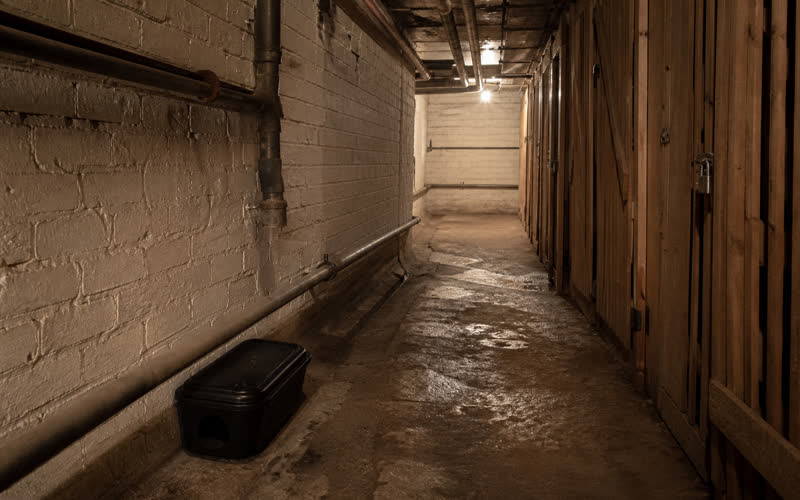
The neighbourhood has old production and warehouse buildings that are only partly used or stand empty — with broken windows, open basements, service tunnels and collapsed partitions. A building like that has neither an owner on site nor any maintenance, but it does have warmth, dryness and voids in the structure. It works as a population reservoir: however carefully the residential building next door is treated, the flow from there renews itself. In practice that means it is worth the owner or building manager assessing the situation at the scale of the block rather than a single building. If access to the neighbouring site is not possible, we build denser perimeter protection on the side facing the derelict building and reinforce the sealing of entry points at plinth level. In cases like these we check the points more often, because the pressure from the reservoir does not go away and consumption stays higher than at an ordinary property.
Housing of mixed ages between the factories
Between the industrial sites stand pre-war masonry and wooden houses, later apartment blocks and a few newer buildings. Each type has its own weak point. In the old houses it is the crumbling joints in the masonry plinth, basement windows without mesh, ventilation openings and the joints in timber structures; in Soviet-era apartment blocks it is the heating substation, the surrounds of the stacks and the ventilation shaft. The scale of an entry stays the same: the house mouse gets through 6–7 mm, a rat through 20 mm. Expanding foam does not solve the problem, since it is gnawed out in a few nights. What works is metal mesh of 5 mm aperture in cement mortar and metal collars around pipe inlets. Treating a flat costs €40–80, inspecting and treating a private house €90–110, and the minimum callout is €40. In older buildings an inspection usually takes longer than in a Soviet-era block, because there are more openings to check.
The signs that tell us how deep the problem goes
During the inspection we assess not only whether there is a rodent but also how long it has been there. The size of the droppings identifies the species: mice 3–6 mm, rats 15–20 mm. Grease marks along the base of a wall 5–10 cm above the floor mean a regularly used run, not a chance visit. A burrow entrance 5–8 cm across in the yard or on the embankment slope points to nesting right there rather than an animal passing through. In older buildings we also check gnawing in the timber structure and the level of the basement floor, because unrecorded entries are often left there. Everything found is marked on a plan of the property along with the layout of the control points, and we prepare a written record of the work carried out so that a comparison is possible at the next visit. Without a record like that you cannot say whether the population is shrinking or merely moving to another part of the building.
How we work in Sarkandaugava and how to get in touch
The work happens in two stages. In the first — the inspection, recording the entry points and placing bait stations along the lines where the railway and the industrial sites touch the property. In the second — assessing consumption, adjusting the points and sealing the entry points. There has to be enough time between the stages: the brown rat is characteristically neophobic and avoids new stations for 3–7 days, so a check the next day shows nothing. In apartment blocks we agree a single plan for the whole building and the courtyard with the building manager — separate treatments of individual flats in different months do not produce a result. After treatment it is advisable to review the external points seasonally, because the pressure from the railway verge does not disappear. We work 24/7 and take emergency callouts. Fill in the form, describe the property and the signs you have noticed — we reply within 5 minutes and tell you what scope of inspection is needed and how to arrange it with the building manager.
What rodent control in Sarkandaugava includes
Rodent control in Sarkandaugava means a full cycle, not a single treatment. Rat extermination and mouse extermination start with an inspection: we identify the species, find the runs and the entry points, and only then choose the method. Rodent control includes placing tamper-resistant bait stations or mechanical traps on the actual runs, a follow-up check and specific advice on what needs sealing so the problem does not come back. The price depends on the type and size of the property: treatment starts at €40, and the figure quoted is the final price. Describe the property in the form — we reply within 5 minutes.
Frequently asked questions
How much does rodent control in Sarkandaugava cost?
The minimum callout is €40. Treating a flat usually costs €40–80, inspecting and treating a private house €90–110, and for commercial premises — warehouses, production sites and retail units — prices start from €70 depending on the floor area and the number of control points. Fill in the form and state the type and size of the property.
There is a railway embankment next to the house. Can it be screened off somehow?
The embankment itself cannot be treated, but the point where it touches the property can be broken. We place external control points at the foot of the embankment and along the fence line, sort out the bin area and seal all the plinth inlets. In practice it is this boundary line, not the work in the flat, that decides the result. We put the points on the visible runs beside cover and adjust their spacing after the first check.
There is a derelict industrial building next door — is it worth doing anything at all?
It is. If there is no access to the neighbouring site, we build denser perimeter protection on that side and seal the plinth level more carefully. The result calls for more regular servicing of the points, since the pressure from the reservoir remains, but the building itself stays protected. We also close the basement windows and service inlets with metal mesh of 5 mm aperture in cement mortar.
In an old masonry building the basement has no floor covering. Can it still be worked on?
It can. In a basement like that two jobs matter most: covering the windows and ventilation openings with metal mesh of 5 mm aperture in cement mortar, and control points along the base of the walls where the runs and grease marks 5–10 cm above the floor are visible. We record the burrow entrances in the floor, close them and check again after two weeks.