
At a glance
- Location
- Vecmīlgrāvis
- Service
- Rodent control — rat and mouse extermination
- Price
- From €40 — the figure quoted is the final price
- Availability
- 24/7, weekends and nights included
- Getting there
- We travel from Riga; arrival time agreed per address
- How to book
- Enquiry form only — we reply within 5 minutes
Rodent control in Vecmīlgrāvis: the canal bank as a movement route
Vecmīlgrāvis is a large northern residential and port district beside the Mīlgrāvis canal. The banks of the waterway run through the whole neighbourhood and link port and warehouse sites to the apartment blocks. For rodents that is a ready-made route. The brown rat moves along linear, sheltered paths — beside bank reinforcements, along fences, over pipe and cable gantries — and at night it will cover hundreds of metres between a feeding place and a nest. Rodent control in Vecmīlgrāvis is therefore not spot work in a single building but the breaking of a route. During the inspection we walk the shoreline looking for runs, burrow entrances in the slope and droppings under structures. Once we know where the route touches the particular building, the bait stations and control points go on exactly that stretch rather than being scattered around the yard.
The brown rat and water: swimming is no obstacle
A stretch of water does not isolate a local problem. The brown rat swims well and crosses the width of the canal without difficulty, or enters a site from the water side using pontoons, boat landings, outfall pipes and old jetty structures. In practice that means a waterside site has a second, often unguarded side: on the land side the fence and gates are in order, while on the bank side an open ramp or ungrilled outfall pipe ends are left. When inspecting waterside sites we always check every pipe running to the water and fit its end with metal mesh. External control points go both along the fence line and along the bank edge, because otherwise the protection is one-sided and the population simply walks around the side that is being serviced. The same applies to boat landings and pontoon fixing points, where there is often a dry void under the decking.
Old jetties and damp bank soil as shelter
The canal edge has crumbling concrete lips, timber piles, voids under mole and jetty structures, old reinforced concrete slabs and overgrown banks. It is close to ideal shelter: dry inside, covered from above, with a direct exit onto a feeding route. Soft, well-drained bank soil allows burrowing — an entrance 5–8 cm across, usually halfway down the slope, under cover of shrubs. These places are the reservoir for the population: while they go unserviced, treatment in the stairwell is outweighed within a week. Rodent control here therefore starts outdoors. If the bank strip belongs to another owner, we talk to the building manager about a joint plan — at the very least a line of control points along the side of the building that faces the water. Without that work, any indoor treatment is short-lived, because the nests are left untouched.
Apartment blocks: the heating substation and the ventilation shaft
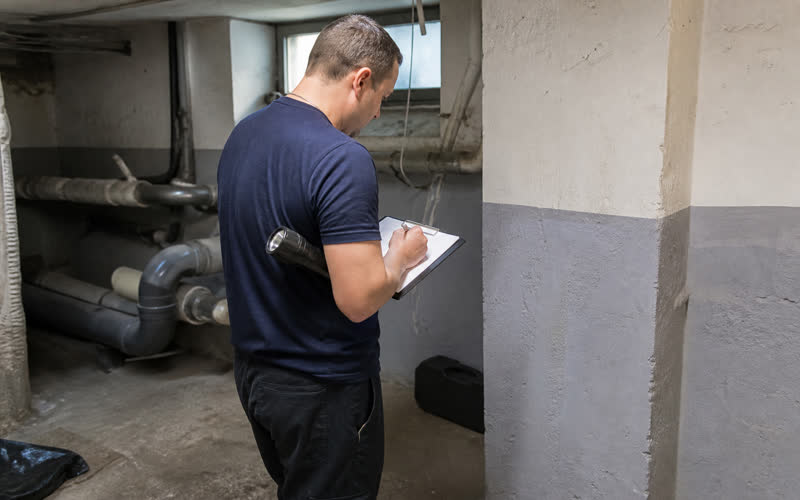
An animal that has come in from the canal finds warmth in the building. In the apartment blocks of Vecmīlgrāvis the typical points are the heating substation, the basement services corridor, the surrounds of the stacks, and the ventilation shaft the house mouse uses to climb to the upper floors. Basement windows without mesh and open pipe entries are the most common find. Keep the scale in mind: a mouse only needs a 6–7 mm gap, a rat 20 mm. Expanding foam does nothing here — it is gnawed straight through. We seal entry points with metal mesh of 5 mm aperture, bedded in cement mortar, and with metal collars around pipes. Treating a flat costs €40–80, minimum callout €40. For private houses in the low-rise part the price is €90–110. We cover basement windows with mesh across the whole opening, not only where marks are visible.
Port and warehouse sites: the food base and bait stations
Port and production sites at the canal edge maintain a food base that is not seasonal. Goods intake, spillage, open waste containers and pallet stacks against the wall provide a steady supply, and the distance to the nearest residential building is often a few hundred metres — one night for a rodent. Rodent extermination at commercial sites in Vecmīlgrāvis therefore rests on a line of sealed bait stations around the perimeter at an even spacing, with extra points at gates, ramps and the waste area, plus internal control points in the service corridors. Every point has a number and a place on the plan, so that consumption can be compared between visits and the direction the pressure comes from becomes visible. For commercial sites prices start from €70. We prepare a written record of the work carried out, with the point plan, the signs found and recommendations on storage practice.
Inspection, neophobia and the second visit
We start with an inspection, not with bait. We record droppings — mouse 3–6 mm, rat 15–20 mm — grease marks 5–10 cm above the floor along the base of the wall, gnawing, runs and burrow entrances. Only then do we place control points. It is important to understand the pace: the brown rat shows neophobia and will avoid a new bait station for 3–7 days. If the site is checked the next morning and nothing has been taken, that means nothing. On the second visit we assess consumption, move points onto the runs that are actually used, and finish sealing entry points, because that is what decides whether the canal route stays open. We work 24/7 and take emergency callouts. Fill in the form, describe the property and the signs you have seen — we reply within 5 minutes and tell you how much inspection is needed and whether the bank side should be looked at as well.
What rodent control in Vecmīlgrāvis includes
Rodent control in Vecmīlgrāvis means a full cycle, not a single treatment. Rat extermination and mouse extermination start with an inspection: we identify the species, find the movement routes and the entry points, and only then choose the method. Rodent control involves placing tamper-resistant bait stations or mechanical traps on the runs that are actually used, rechecking them, and giving specific advice on what needs sealing so the problem does not come back. The price depends on the type and size of the property: treatment starts at €40, and the figure quoted is the final price. Describe the property in the form — we reply within 5 minutes.
Frequently asked questions
How much does rodent control in Vecmīlgrāvis cost?
The minimum callout is €40. Treating a flat is usually €40–80, inspection and treatment of a private house €90–110, and commercial sites — warehouses and port premises — from €70 depending on the area and the number of control points. We set the exact figure once we have a description of the property. Fill in the form and state the type and size of the premises.
Do rats really swim across the canal?
Yes. The brown rat swims well and uses waterside infrastructure — pontoons, jetties, outfall pipes. That is why a site beside the canal has two sides to protect. We fit metal mesh to the ends of pipes running out to the water, and we put external control points along the bank edge as well, not only along the fence.
Why did the rats come back after the basement was treated?
Most often because the external route was never broken. Burrows left on the canal bank, voids under old jetties and an overgrown slope work as a reservoir from which the population renews itself. The answer is external control points along the water side, plus sealing every service entry with metal mesh in cement mortar, and mesh on the pipe ends on the water side.
Mice are coming through the ventilation shaft — what can be done in a flat?
We cover the shaft openings in the flat with metal mesh of 5 mm aperture and seal the surrounds of the stacks, since a mouse only needs a 6–7 mm gap. The source, though, is usually in the basement or the heating substation, so it is worth agreeing an inspection of the communal areas with the building manager as well. Fill in the form and describe the situation.