
At a glance
- Page topic
- The brown rat
- Mouse droppings
- 3–6 mm
- Rat droppings
- 15–20 mm
- Grease marks
- Rat 5–10 cm, mouse 2–5 cm above the floor
- Burrow entrance
- 5–8 cm
- Treatment
- Book through the form — we reply within 5 minutes
When people in Riga talk about rats, they are almost always talking about the brown rat. Its behaviour — digging, swimming and living at the lower levels — determines where the bait stations have to go.
How to recognise it
Body 20–27 cm, tail shorter than the body, blunt snout, small ears, greyish-brown coat with a paler belly. Weight 300–500 g. Droppings 15–20 mm with blunt ends.
Where it lives
In basements, sewers, under decking, in compost heaps and in burrows along foundations. The brown rat chooses the lower levels — unlike the black rat, it is rarely found in lofts.
Behaviour that shapes the treatment
Marked neophobia: it will avoid a new object in its territory for several days. That is why bait stations often stay untouched in the first few days — this is normal and does not mean the method is failing. It swims and can hold its breath for several minutes, which makes the sewer a travel route.
Breeding
One female can produce 5–6 litters a year with 6–10 young in each. The population grows very fast, so putting the work off always increases the scale of it.
How a burrow system is built and how to read it during an inspection
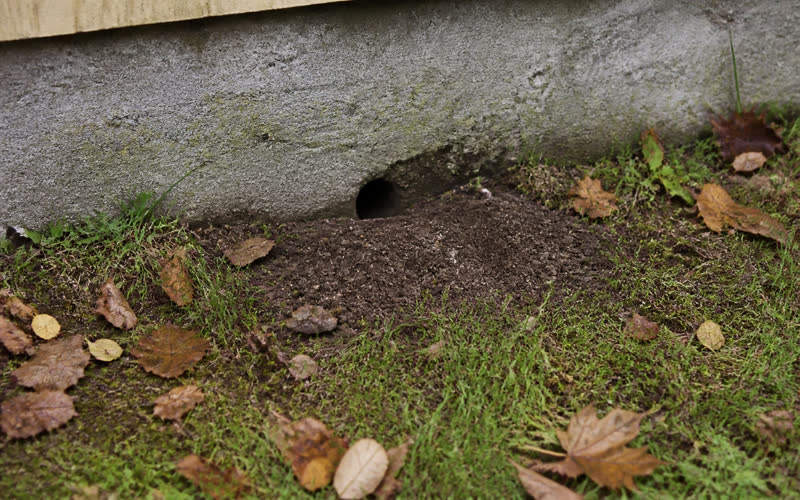
The brown rat digs, and that is exactly what sets it apart from other species when you plan a treatment. A typical burrow starts with a main entrance 5–8 cm across, usually at the foundations, under decking boards, at the edge of a compost heap or along the concrete strip of a fence. Behind it runs a tunnel leading to a nest chamber lined with shredded material — insulation, paper, fabric. Alongside there is often a separate food store where dry material is stockpiled. What matters most to a practitioner is not the main entrance but the hidden bolt holes: lightly disguised, covered with soil or grass, they open only at a moment of danger. If a treatment covers only the visible entrance, the animals simply keep using the rest. An active burrow is recognised by the smoothly worn arc of the entrance, freshly kicked-out soil, and by the fact that a plug of paper or leaves pushed into the entrance has been shoved out by the next day. In an inactive burrow the plug stays put and cobwebs cover the entrance. This simple test, done before and after treatment, is the most accurate indicator of whether the colony is still working.
The senses, and why they dictate where stations go
The brown rat has poor eyesight — it makes out shapes badly and is effectively colour-blind, though it reacts to movement at the edge of its vision. It compensates with very sharp hearing that reaches into the ultrasonic range, and a fine sense of smell it uses to read its own and other animals' urine trails. The vibrissae — the long facial whiskers — together with the guard hairs along its flanks let it navigate in complete darkness by touch. Thigmotaxis follows from this: a rat moves pressed against a vertical surface, because contact along its side gives it a sense of safety and a reliable route. In practice this means a bait station placed in the middle of a room, or even 30 cm out from the wall, will be ignored for weeks. The station has to sit hard against the wall, with its entrances parallel to the direction of travel, ideally in a corner, behind pipework or under shelving, where a route already exists. Grease marks low on the plaster show the exact line the animal walks every night. A station placed there works; anywhere else, it does not.
Swimming, diving and the sewer route in Riga's older housing stock
The brown rat is a strong swimmer. It can stay in water for long periods and moves through flooded services without difficulty, and it will dive to get through a trap. It is precisely this ability that makes the sewer the main entry route in Riga's older buildings. In the Centre and Klusais centrs, in buildings with cast-iron sewer stacks, the joints corrode over the years, gaps open at inspection hatches and connections, and the animal climbs up the inside wall of the pipe several floors. In basements where the floor gully has no water seal, or the seal has dried out, the way in is completely open. The practical signs are wet footprints around the gully, a suspicious smell in a corner of the basement, and noises heard in the toilet pan at night. Treating a building like this does not start in the flat — it starts in the basement and at the outlets of the stacks. If the sewer route stays open, new rats take over the vacated territory within a few weeks. In the form, describe the age of the building and whether the basement is dry — that determines the order of the inspection.
Night activity, and what it means to see a rat in daylight
The brown rat is strongly nocturnal. Activity peaks in the first hours after dusk and again before dawn, when the feeding routes are walked in full. During the day the animals stay in the burrow or in cover and come out only if they have a reason to. So a rat seen in daylight out in the open is almost always bad news: it usually means the population is large enough that the weaker animals are being pushed out of the safe harbourages and away from the food at night. The second possible explanation is disturbance — building work, a basement being pumped out, a compost heap moved — that has suddenly destroyed a nesting site. The third, and least common, is a sick or weakened animal. In practice a daytime sighting changes the scale of the treatment: one station is no longer enough, and the inspection has to widen to the whole building perimeter and the edge of the neighbouring plot. If you see a rat during the day, describe the exact place and time in the form — it gives a real sense of the size of the colony.
Social hierarchy, and why results do not come in the first few days
Brown rats live in structured groups with a clear order of dominance. At a new food source the adult dominant animals feed first; young animals and females with young wait and get access later, often only after several nights. Add neophobia to that — wariness of anything new on the route. A new object by the wall is walked around for days even when there is attractive food in it. Together these two factors set the rhythm of the treatment. In the first nights there may be no take at all, then a small and uneven take appears, and only after that does steady feeding start at all the points. That is why stations are not moved after two days — doing so puts the process back to the start. It is also why a single visit is not enough: on the follow-up visits the points where take is rising are replenished, and those left completely untouched for a week are relocated. A quiet site in the first week is not a sign of failure but an expected consequence of how the species behaves.
Diet and how it shifts with the season
The brown rat is an omnivore with a strong preference for cereals, seeds and protein-rich food. Unlike the black rat it will readily eat meat scraps, fish, pet food and food waste. Daily intake for an adult animal is roughly 20–30 g of food and, unlike mice, it also needs free water — around 25–30 ml a day. It is that need for water that makes a dripping tap, condensation on pipework or a puddle in the basement a place worth attention during an inspection. Seasonality shifts the emphasis. In summer and autumn there is food available outdoors — garden waste, compost, bird feeders, waste bins — and bait indoors competes with it. In late autumn and winter, when the outdoor sources disappear and the cold sets in, the animals concentrate in buildings and take rises sharply. That is why treatments from October to December usually produce a faster result, while a summer treatment starts by reducing the competing food sources.
Brown rat and black rat: the differences that change tactics
The brown rat (Rattus norvegicus), also known as the common or sewer rat, dominates in Riga, but the black rat (Rattus rattus) does turn up on some sites, and confusing the two costs time. The brown rat is heavier built, with a blunt snout, small ears and a tail shorter than its body. The black rat is slimmer, with a more pointed snout, large thin ears and a tail longer than its body. The key difference is vertical: the brown rat lives lower down — basements, burrows, sewers, ground floors; the black rat prefers height and nests in lofts, roof structures and tree canopies. The treatment plan follows from that. If the signs are burrows at the foundations, grease marks low down near the floor and droppings 15–20 mm long with blunt ends, you are dealing with a brown rat, and points go at floor level and around the outside perimeter. If the droppings are thinner with pointed ends and the tracks are in the roof insulation, the treatment moves to the upper levels.
Frequently asked questions
Does the brown rat climb?
It can, but it prefers the lower levels.
How far does it travel?
Usually within a 30–50 m radius of the nest.
Why do the stations stay untouched?
Because of neophobia — for the first few days rats avoid anything new.
How deep are brown rat burrows, and can they simply be filled in?
The burrow system is usually fairly shallow — often within half a metre of the surface — but the tunnels can run several metres and surface in more than one place. Filling them in without treatment rarely helps: the animals dig the tunnel out again or use the bolt holes within hours. The right order is to reduce the colony first, then close the entrances.
Why does a rat walk along the wall rather than across the middle of a room?
This is thigmotaxis — the need for constant contact along one side. With poor eyesight the animal navigates by its whiskers and flanks, so open space feels risky and awkward. The practical consequence: control points must sit hard against the wall or in a corner, on the route that already exists, marked by grease marks low down near the floor.
Can a brown rat really come up through the toilet?
It is rare, but possible. The species swims well and can dive briefly, so the water trap in the pan is not an absolute barrier if there is damage or open connections in the drainage. More often the way in is through basement gullies with no water seal and through gaps around the sewer stacks. In Riga's older buildings these are the points to check first.
How do you tell rat droppings from mouse droppings?
Brown rat droppings are 15–20 mm long, thick, with blunt ends, and they are usually found in groups along walls or near a food source. Mice leave thin 3–6 mm pellets with pointed ends, scattered more widely. Fresh droppings are dark and soft, older ones grey and crumbly, which lets you judge how recent the activity is.