
At a glance
- Page topic
- Rat traps — why they don't work straight away
- Area covered
- Riga and the surrounding region
- Price
- From €40 — the figure quoted is the final price
- Availability
- 24/7, weekends and nights included
- What works
- Metal mesh with a 5 mm aperture and cement mortar; expanding foam does not
- How to book
- Enquiry form only — we reply within 5 minutes
This behaviour is called neophobia, and it is the main difference between dealing with rats and dealing with mice. Not knowing about it, people conclude the method doesn't work — and stop exactly when it would have started working.
Neophobia — what it is
A rat notices any new object in its territory and gives it a wide berth for a few days. Mice do the opposite — they are curious. That is why rat treatment always takes longer.
How to get around it
Set the trap unset, with bait on it, for 2–3 days and let the rat get used to it. Only then arm it. This one step raises the success rate considerably.
Placement
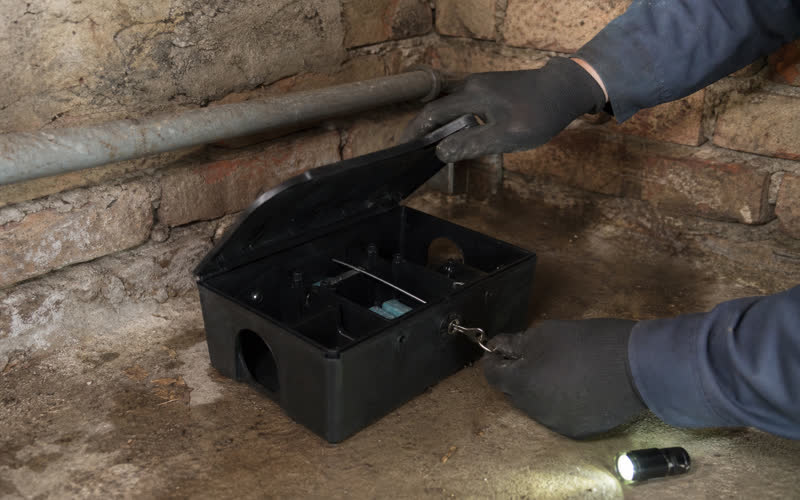
Along walls, at burrow entrances, on grease marks and on movement routes. A rat trap has to be solid and strong enough — a mouse trap does not kill a rat, it injures it.
When traps beat bait
In places where a rodent must not die inside an inaccessible structure, near food, and in rooms with children or pets.
Pre-baiting step by step — and what you lose by skipping it
With rats, pre-baiting is not a suggestion but a compulsory part of the method. The protocol looks like this. On day one, put the traps in the chosen spots unset, with bait on the trigger and a little of the same bait beside it on the base. On days two and three, refresh the bait, still leaving the trap unset, and note which points the bait disappears from. On the fourth evening, set only those traps where the bait vanished at least two nights running. The logic is simple: the animal has time to build a habit of approaching the object without consequences, and its wariness of the new item fades. Skip this stage and set the trap on the first evening, and one of two things happens — either the rat stays away for a week, or the first contact fails, the animal escapes and then avoids the whole set-up for months. The three days you save usually cost two weeks.
Why a mouse trap injures a rat rather than killing it
A mouse snap trap is designed for an animal weighing twenty to thirty grams. A brown rat weighs between two hundred and six hundred grams, its skull and neck muscles are on a different scale altogether, and the energy in the wire simply isn't enough for a clean strike. In practice the outcome is always the same: the trap catches the muzzle, a paw or skin, the animal tears free or drags the trap off, and you are left with an empty spot, traces of blood and a population that is now distinctly wary. It isn't just ineffective — it is prolonged suffering for the animal with nothing to show for it. A trap made for rats has a wider base, a stronger spring and a bigger trigger plate the animal steps onto with its full body weight. The only acceptable criterion for trap size is the target species, not whatever happens to be in the cupboard.
Securing the trap: why you tie it to something solid
A trap that has fired but not killed outright is, with a rat attached, a heavy object the animal can drag several metres. If it disappears into a wall cavity, a ceiling void, behind a fitted unit or down a ventilation shaft, you lose both the trap and any chance of retrieving anything — and a few days later a smell appears somewhere you cannot reach. So every rat trap needs to be tethered. Run wire or thin cord through the hole in the trap base and fix it to a pipe, a stair rail, a heavy shelf upright or a hook driven into the wall. Keep the cord no longer than thirty to forty centimetres. If the trap sits on a joist, a shelf or under the floor, tethering matters even more, because there a fall into a cavity is all but guaranteed. A tethered trap is also easier to find in a dark basement, where marks on the floor are invisible.
Bait for a rat: what works, and how it differs from mouse bait
A mouse is satisfied by seeds and scent; a rat responds to bulk, fat and protein. In practice the best performers are a piece of sausage or cured meat, hard-boiled egg, the rind of a cheese, nut butter and wet pet food. The important difference is how the bait is fixed. Mouse bait needs pressing into the recess on the trigger; for a rat it is often worth tying it on with thread or skewering it, because a rat can tear a piece off the edge without putting its body in the strike zone. The second difference is the contrast with the food already available. If there is an open bag of dog food in the basement or accessible waste in the kitchen, any bait in a trap is a worse option than what is already there risk-free — seal off the food sources first, then set traps. Change the bait every two or three days; meat that has hardened and dried out gives off no scent and no longer does its job.
How many traps a real problem needs
Two traps against a rat population is a symbolic gesture. Rats move along a handful of fixed routes, and covering even one of them properly takes several points on that route. A practical estimate: a small private house with a basement — six to eight traps; a garage or shed — four to six; a commercial storeroom — ten or more, spaced every three to five metres along the walls. The second reason for a high number is time. The fewer traps, the longer the process drags on, and the greater the chance that some of the animals learn from a failed contact. It is more effective to set many traps on one night and get several results at once than to work with two for a month. Traps should be placed densely exactly where the bait disappeared during pre-baiting, not spread evenly around the room.
Safety in a house with children and pets
A rat snap trap hits hard enough to cause a serious injury to a child's finger or a dog's nose. An open rat trap must never be left in a room a child or a pet can get into. There are three acceptable solutions. First, an enclosed unit with a housing that holds the trap inside, with access only through a rat-sized opening. Second, placing traps behind locked doors: in the basement, a plant room or a boiler room the household does not enter. Third, siting them under heavy, immovable structures with a minimal gap. Tell children plainly that the room is out of bounds rather than relying on them not going in. When setting a trap, put the bait on before arming the mechanism, hold the trap by the edge of the base and set it down with both hands, drawing your fingers away sideways.
Hygiene after a catch, and when traps stop being the right tool
Handling a caught rat matters far more than handling a mouse, because the animal is bigger and the amount of contamination is correspondingly greater. Work in disposable gloves. Put the trap with the animal into a thick bag, tie it shut, place it inside a second bag and take it out to an outdoor waste bin. Wipe the spot under the trap with a damp disposable cloth and soapy water — never with a vacuum cleaner or a dry broom, as those lift particles from droppings and urine into the air. Wash your hands with soap for at least twenty seconds, gloves or no gloves. Traps are not, however, a universal answer. If the site has a large population, if the pressure is coming from outside — a neighbouring property, the sewers, a bin area or a building excavation — if the animals live in wall cavities where there is nowhere to put a trap, or if the site is a shop, a café or a warehouse, then a systematic layout of control points and regular monitoring is what is needed. Fill in the form, describing the type of property, where the signs are and how many animals you have already caught. Prices are final: minimum callout from €40, flats €40–80, private house €90–110, commercial premises from €70. We reply within 5 minutes, and we work around the clock in Riga, including urgent callouts.
Frequently asked questions
How long do I have to wait?
With a period of getting them used to it — usually 3–7 days.
Will a mouse trap do for rats?
No, it is too weak.
Why does a rat walk around the trap?
Because of neophobia — it avoids anything new.
What does a rat trap that has fired but is empty mean?
Usually that the animal touched the trigger from the wrong angle, or pulled off loosely placed bait while standing outside the strike zone. Press the bait in or tie it to the trigger, set the trap at right angles to the wall with the trigger facing the wall, and check that the mechanism is not adjusted too stiffly. If it keeps happening, move the trap half a metre along the same route.
Can several traps go side by side in one place?
Not only can they — they should. Two or three traps a few dozen centimetres apart along one wall work far better than one, because an animal that skirts the first walks into the second. This approach is especially useful in narrow passages, along pipes and beside holes, where the route is known and fixed.
Should the trap be washed after a catch so other rats aren't put off?
The smell of blood does not make a trap unusable, and scrubbing it with strong cleaning products does more harm than good, because a chemical smell repels more than a previous catch does. Remove the old bait remains and the coarser dirt, and carry on using the trap. If you do wash it, use plain soapy water and dry it fully before setting it again.
Overall, how long should I expect trapping to take with rats?
A realistic timeline is two to three weeks: three days of pre-baiting, then an active catching phase, and finally seven to ten consecutive empty nights counted from the last catch. If catches are still coming at the same rate after three weeks, the source is outside the premises and the problem has to be tackled at property level rather than with traps.