
At a glance
- Topic
- Rats or mice — how to tell them apart
- Signs
- Droppings, grease marks, gnawing, noise
- Mouse gap
- From 6–7 mm
- Rat gap
- From 20 mm
- What fixes it
- Inspection, bait stations or traps, sealing entry points
- How to book
- Enquiry form only — we reply within 5 minutes
This is the first question in every inspection. Get the species wrong and the stations go in the wrong places, and the time is lost.
Droppings — the most reliable sign
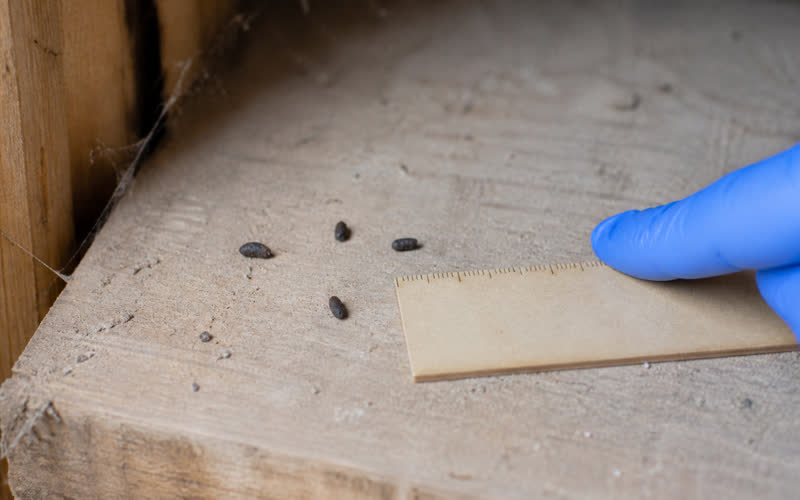
Mouse: 3–6 mm, thin, with pointed ends. Rat: 15–20 mm, thick, with rounded or blunt ends. The difference is so pronounced that confusing the two is practically impossible.
Gnaw marks and holes
A hole gnawed in timber by a mouse is around 2 cm across with smooth edges. A rat's is 4 cm and more, with rough, irregular edges.
Behaviour
Mice are curious and investigate new objects — traps work quickly. Rats avoid anything new in their territory (neophobia), so stations can sit untouched for the first few days. That does not mean the method is failing.
Why it affects the price
Rat work usually takes more time and a repeat check, precisely because of neophobia. A mouse problem is often resolved faster, but it demands more thorough sealing of entry points.
A ten-minute procedure for identifying the species tonight
You can settle the species in a single evening if you work through the steps in order. First, take a bright torch and check three zones: behind the cooker and the fridge, the bottom shelf of the food cupboard, and the point where pipes enter the wall. Step two — collect droppings onto a sheet of white paper and measure them with a ruler; 3–6 mm long means a mouse, 15–20 mm means a rat, and there is practically nothing in between. Step three is measuring the holes: a hole of roughly 2 cm in a wall or in packaging is a mouse's work, while 4 cm and larger with roughly chewed edges points to a rat. Step four — quieten the house and listen for five minutes. Step five is the dust test described below. After these five steps the answer is clear in most properties in Riga, with no specialist present. Write down the result of each step, because it is this information that then determines the treatment method and the price.
A young rat or a grown mouse — where people go wrong most often
This is the commonest mistake, because a young brown rat and an adult house mouse are almost the same body length. The difference lies in the proportions, not the size. On a young rat the head and feet are disproportionately large for the body — it looks like an animal that has not yet grown into its own limbs. A mouse has a small head, a pointed snout and large, distinctly protruding eyes. The tail is the second reliable sign: on a mouse it is thin as a string, covered with fine hairs and longer than the body; on a rat it is thick, bare, ringed, and shorter than the body. A mouse's ears are large in relation to the head and thinly translucent; a rat's are smaller, thicker and held close. If you only see the animal for a fraction of a second, look at the tail, not the overall size.
Sounds: light rustling against heavy thumps
Night-time sounds are one of the most informative signs, and you can assess them without seeing the animal at all. Mice move quickly and lightly — it sounds like fine rustling, tiny steps across a ceiling panel or a cardboard box, often with short pauses and sudden starts. The sound usually comes from a single plane: a wall cavity, the back of a kitchen cupboard, a partition. A rat makes a completely different noise. It is heavier, so you hear separate thumps, a dragging sound as a piece of food or insulation is moved, and sometimes distinct clattering in the sewer stack. A rat's gnawing is lower and more sustained, a mouse's higher and broken up. If heavy steps and a dragging noise come from the loft at night, it is almost certainly not a mouse. Note which floor and which wall the sound comes from — it saves inspection time later.
The flour test and the size of the footprints
The dust or flour test is the simplest home method, and it gives you physical proof. On a hard floor along a wall, by a suspected hole or at the bottom of a cupboard, scatter a thin layer of flour or talc over an area of roughly 30 × 30 cm. Leave it overnight and do not switch on the lights. In the morning look at the prints under side lighting, because in direct light they are invisible. A mouse footprint is about 1 cm or less, the feet fall close together and the trail is narrow. A rat print reaches about 2 cm, the stride is wider, and between the prints you often see a continuous line — a tail drag mark, which mice practically never leave. If there is a long unbroken streak between the pairs of prints in the flour, the species question is answered. You can run the test in several places at once, which also shows the direction of travel.
Where each species hides in Riga buildings
The location within the building is a strong indicator of species. Mice stay as close as possible to the food source and can be on any floor — a mouse in a fifth-floor flat is completely normal, because it nests behind a kitchen cupboard or in a ventilation shaft a few metres from the bread bin. The brown rat is a low-level animal: basements, the sewer system, cracks in the foundations, the bin area and the floor structure of the ground floor. In Riga's older buildings it comes in through damaged sewer stacks and basement hatches. The black rat chooses the opposite — lofts, roof structures, upper floors and places it can climb to along pipes and trees. So if the sounds come from the loft, the basement-rat theory is misleading. Note the floor, the type of room and the distance to food — these three pieces of information often point to the species more precisely than a brief glimpse of the animal.
Why the wrong species identification delays the solution by weeks
Getting the species wrong is not a theoretical error — it changes the whole plan of work. If the property actually has rats but the treatment is planned for mice, the control points go in at the wrong level: in kitchen cupboards and behind the cooker, while the animals move around the basement and the foundation zone. The result is two weeks in which nothing happens, the bait stays untouched, and the problem keeps growing. The opposite case is just as costly: solutions intended for rats in a large space never reach the mice living a few metres from the fridge. The rate of breeding differs too — a mouse population grows quickly and invisibly, while rat damage is heavier but less widely spread. That is why the first step of an inspection is always confirming the species from droppings and holes, not from the client's assumption. The exact species determines the product, the height of the points and the rhythm of the visits.
What to photograph and note down before filling in the form
For an enquiry to be usable, a few specific things are enough. Photograph the droppings with a coin or a ruler beside them for scale — without a scale the photo is almost worthless. Second shot: the hole in the wall, the skirting board or the packaging, again with a scale. Third: the grease mark or the flour-test prints under side lighting. Note which floor and which room the signs were found in, what time of night the sounds are audible, and whether the property has an accessible basement and loft. Say too whether there are pets and small children, because that affects the choice of solution. Fill in the form with this information and we reply within 5 minutes. We work around the clock in Riga, including emergency callouts, and a description prepared in advance shortens the on-site inspection by several hours.
Frequently asked questions
Can both species be in the same property?
Yes, especially in large properties with a basement.
Can I identify the species myself?
From the size of the droppings — almost always, yes.
Does the method really differ?
Yes — the placement, the type of bait and the frequency of checks all differ.
How do I tell a young rat from an adult mouse when the size is similar?
Look at the proportions, not the length. On a young rat the head and feet are disproportionately large for the body, and the tail is thick, bare and ringed. A mouse has a small head with a pointed snout, large thin ears, and a tail as fine as string that is longer than the body. The tail is the most reliable sign in a few seconds of observation.
Do footprints in flour really allow you to identify the species?
Yes, if you measure the prints. A mouse footprint is about 1 cm or less and the trail is narrow. A rat footprint reaches about 2 cm, the stride is wider, and between the prints you often see a continuous tail drag line. That streak is the clearest difference, and mice practically never leave one.
What does it mean if the sounds come from the loft rather than the basement?
Heavy steps and a dragging noise in the loft usually point to a black rat living at the upper levels, not a brown rat in the basement. Mice do occur in lofts too, but their sound is a light rustling rather than separate thumps. Knowing the exact floor and the side of the wall shortens the inspection considerably.
What do dark grease marks on the wall mean?
They are left by the animal's coat along a regular route. Mouse marks are fine and sit 2–5 cm above the floor; rat marks are wider, darker and 5–10 cm up. Wash one mark off and check again after three days: if it comes back, the activity is current rather than historic.