
At a glance
- Topic
- Rats in a private house — what to do
- Signs
- Droppings, grease marks, gnawing, noise
- Mouse gap
- From 6–7 mm
- Rat gap
- From 20 mm
- What fixes it
- Inspection, bait stations or traps, sealing entry points
- How to book
- Enquiry form only — we reply within 5 minutes
Unlike in a flat, in a private house you control the whole property — so the problem can be solved completely, provided you also remove the reason the rats chose this particular house.
Where the rats come from
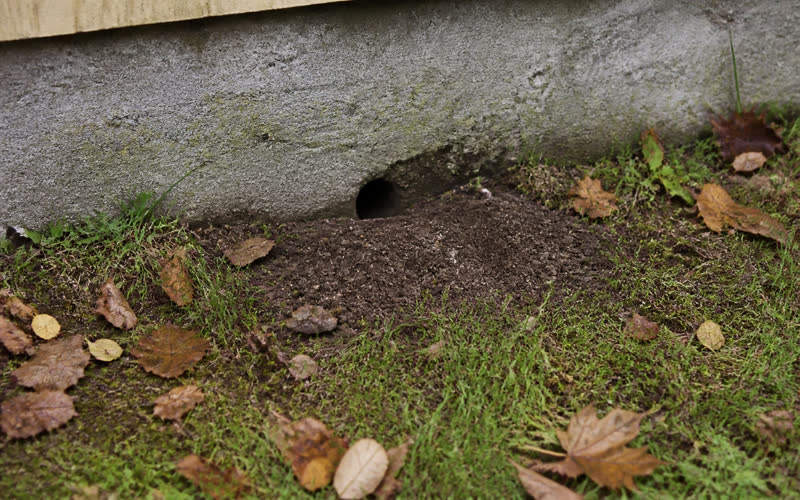
Walking around the house, look for burrows along the foundations, under the decking, by the shed and the compost heap. A burrow 5–8 cm across with a packed-down entrance means an active run.
What attracts rats
An open compost heap with food waste, bird feeders, animal feed in the shed, fallen fruit and bins left without lids. One of these sources usually explains the whole situation.
How rats get into the building
Through gaps around pipe entries in the foundations, damaged ventilation grilles, gaps under the garage door threshold, and along the heating line. A rat gnaws through timber and plastic, so sealing is done with metal mesh or cement mortar.
Autumn is the critical period
In September and October, as the temperature drops, rodents look for warmth. This is exactly when private houses take the biggest influx.
How to tell from a burrow whether it is live
A hole found in the yard does not yet mean anything lives in it. An active rat burrow has an entrance about six to eight centimetres across, and the edges of the entrance are smooth and pressed down, with no grass growing — the animal passes through several times a night and polishes the soil with its fur. Beside the entrance there is nearly always freshly dug, darker earth in a fan-shaped mound. An abandoned burrow looks different: cobwebs across the entrance, fallen leaves, dry grass stems, edges collapsed and irregular. The simplest test is to plug the entrance with crumpled newspaper or a thin layer of sand and look at it after twenty-four hours. If the plug has been pushed out or there are tracks in the sand, the burrow is live. If it stays untouched three nights running, the burrow can be treated as abandoned.
When the source is on a neighbour's property
The situation is often this: your yard is tidy, the bins are closed, the composter is closed, but rats turn up every autumn. That nearly always means the nest is behind the fence. Check where the tracks end at the boundary — rats use the same route along the base of a fence, and a narrow, trodden strip with no grass forms there. If the run leads towards the neighbour's side, treating only your own plot will give a short-lived result, because the population will be replenished from the source. The practical answer is a conversation, not a confrontation: show photographs, offer to treat both yards at the same time and split the cost. Treating two adjoining houses on one day is far more effective than two separate treatments a month apart. If the conversation is not possible, the boundary line is what remains on your side: bait stations along the fence and food sources sealed off completely.
Chickens and rabbits — the most commonly forgotten reason
Nothing else in the yard of a private house draws rats as strongly as a poultry or rabbit hutch. There are three reasons at once: grain feed left on the ground, a warm layer of bedding to nest in, and a constant supply of water. Rats usually dig in directly under the floor of the hutch and come out at night when the birds are asleep. What to do in practice: feed in daily rations so that nothing is left in the trough by evening, and store feed sacks in metal drums with lids, not in paper sacks in the shed. It is worth lining the hutch floor with metal mesh of up to one centimetre aperture, laid under the bedding and turned up along the walls to a height of at least thirty centimetres. Collect the eggs every evening — gnawed eggshells mean the rats are already inside, not just in the surroundings.
Water matters as much as food
Everyone thinks of food; almost nobody thinks of water. A rat needs about 25–30 ml of water a day, and in a yard where the food is locked away but water is freely available the population holds on regardless. Look at the yard with exactly that in mind: rainwater butts without lids, a dripping tap at the corner of the house, animal drinkers left out all night, a puddle under the end of a downpipe, upturned plant pot saucers holding water, a paddling pool standing full all summer. Run the downpipe outlets away from the foundations — that reduces damp at the base and takes away a drinking place at the same time. Cover butts with a tight-fitting lid or mesh. In winter any place where the water does not freeze matters, such as a sewer chamber or a warm corner of the foundations.
Why a cat rarely solves a rat problem
An adult brown rat weighs three hundred to five hundred grams, is aggressive and physically able to fight back — most house cats will not go for one at all, but hunt mice and young rats instead. The result is that the core of the colony stays untouched and keeps breeding. A second, less often mentioned effect: a cat's or dog's food bowl standing outside or on the porch is itself a steady food source and at night feeds the rats. A third — a pet can carry ticks and disease organisms if it hunts rodents. That does not make a cat pointless: its presence stops mice and deters new animals from settling in the shed. But as the only measure against rats it does not work, and it should not be relied on while the population is growing.
A burrow under the shed or an outbuilding
A shed on a concrete slab with a void underneath is one of the most convenient nesting sites there is — dry, dark, sheltered from the rain and from the dog. Simply filling the entrance with soil or stones achieves nothing: the animal digs a new passage within twenty-four hours, often on the other side where you will not see it. The correct order is this. First we place lockable bait stations around the building, along the line of travel rather than in the burrow itself, and follow consumption for two to three weeks. Once consumption stops and the plug test stays untouched three nights running, we move on to physical sealing. The recommended solution is metal mesh with an aperture of up to one centimetre, dug in along the perimeter of the building to a depth of at least thirty centimetres and turned outwards at the bottom, away from the building, in an L shape about twenty centimetres wide. A rat digs vertically down at an obstacle and stops at the turned-out edge.
Frequently asked questions
Do rats in the yard mean they are in the house too?
Not necessarily, but the risk is high — particularly in autumn.
How do I seal the burrows?
Filling in a burrow without treatment gives no result — the rats dig new ones. Treatment first, then sealing.
Does the compost heap have to go?
No, but it has to be closed, and no food waste should go into it.
How far from the house will a rat travel for food?
A brown rat usually moves within a radius of fifty to a hundred metres of the nest, provided there is enough food. That means the source is nearly always on your property or the nearest neighbour's, not a kilometre away. When you inspect, look within that distance — the compost heap, a poultry hutch, a waste bin or a log pile.
Does the ground around the foundations have to be dug up to find all the runs?
No, that is almost never necessary and it is expensive. The runs are found on the surface: by entrance holes, trodden paths along walls and fences, and small mounds of freshly dug earth. Digging is done only locally — where a barrier mesh is buried along a particular side of the building or around the perimeter of a shed.
Is treatment worthwhile in winter, with snow in the yard?
Yes, and in winter the result is often quicker. Snow shows the tracks and the exact runs that are invisible in summer, while the lack of natural food makes bait more attractive. Stations are placed against building walls and under canopies, where the snow does not reach them. We work across Riga all year round, including urgent callouts around the clock.