
At a glance
- Service
- Rodent control in a production facility
- Area covered
- Riga and the surrounding region
- Price
- From €40 — the figure quoted is the final price
- Availability
- 24/7, weekends and nights included
- Reply time
- Within 5 minutes of the form being submitted
- How to book
- Through the enquiry form only
In a production facility rodent control is a continuous process. Large floor areas, constant movement of goods and stored raw materials mean the influx from outside never stops entirely.
Raw material stores
Grain, flour, packaging materials and empty containers are both food and nesting material. Control points need to be denser here.
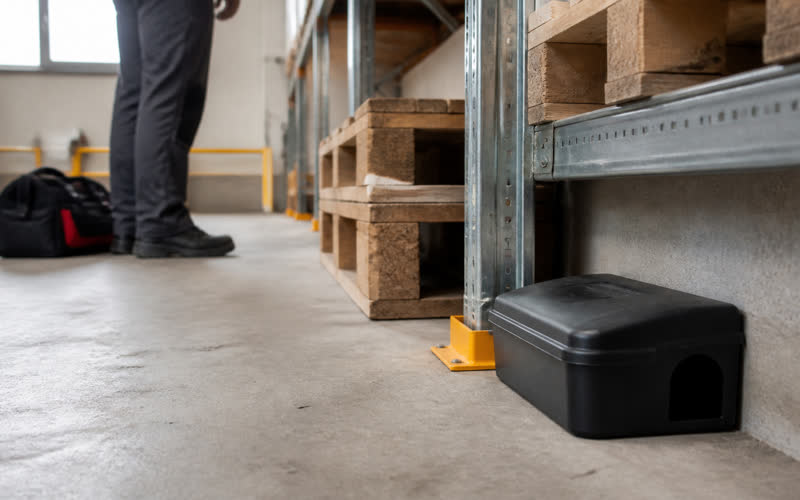
Process areas
In production rooms bait is often not permissible, so we use mechanical traps and monitoring points with no product in them.
Monitoring the control points
Every point has a number and a place on the plan. At regular checks we record activity, replace used products and prepare a written record of the work carried out.
Dividing a large site into zones
In a facility of several thousand square metres, a single uniform treatment gives no measurable result — zoning is needed. In practice we divide the site into four rings. The first is the outer perimeter along the site fence and the access roads, where monitoring points are placed roughly twenty to thirty metres apart. The second is the outer wall of the building — points at every door, gate, ventilation intake and services entry. The third is the internal technical ring: corridors, ancillary rooms, boiler house, compressor room, cable tunnels. The fourth is the process area, where we work only with mechanical and inert monitoring devices. Each point is given a number and a place on the site plan. That makes it possible to say precisely, a month later, that activity is concentrated in the outer ring by the container yard, rather than to note in general terms that the site has rodents.
Equipment voids and cable runs
Industrial equipment creates spaces that no maintenance schedule ever looks into. Conveyor frame sections, motor and gearbox plinths, the kickplates of electrical cabinets, insulated pipe runs and cable trays high up the wall — all of them offer warmth, cover and often spilt raw material too. Cable runs in a production facility also act as a horizontal road network connecting every part of the building above eye level; droppings and grease marks survive well on their edges. During the inspection these places have to be checked with a torch and a mirror, in places by removing a plinth panel. The long-term answer is structural: close the gaps in equipment plinths, seal cable entries between rooms with a material that cannot be gnawed through, and fit removable panels wherever a void needs cleaning out regularly.
The production shutdown window as the main opportunity for work
On a running line it is impossible to inspect the undersides and voids of equipment properly — some places are hot, some are moving, and safety requirements do not allow it. So in production facilities the main work is planned around shutdown windows: scheduled maintenance days, sanitary shifts, weekends or the annual overhaul period. During that time you can look at conveyor frames in full, remove kickplates, clean out the accumulations under equipment, place or move control points and carry out the sealing of entry points. In practical terms that means the servicing schedule is worth tying to the production schedule at the start of the year, rather than hunting for a window once a problem has appeared. Between shutdown windows we carry out the regular point checks in the technical and perimeter zones, which do not require the line to be stopped. In urgent cases we come out around the clock, at night and at weekends included.
Dust and spillage as a permanent food base
In a production facility what sustains rodents is not the product on the shelf but what falls past it. Flour, grain dust, sugar, pellets, raw material residues under conveyor transfer points and at sack-emptying stations — even a thin layer on the floor or on horizontal surfaces of the structure provides a complete food source. Particularly problematic are the places where dust builds up at height: on pipe runs, on the top surfaces of equipment frames and on cable trays, because these are almost never cleaned. That is why the cleaning schedule has a more direct effect on the result than the frequency of treatment. The practical task is to define specific high-level cleaning positions at a set interval, to clear spillage at transfer points immediately, and not to store raw materials in open sacks on the floor. Without that the population recovers regardless of how many points there are.
Delivery traffic and open doors
At a production facility the gates stand open for hours during the day, and that is one of the biggest risks of bringing rodents in. Delivery vehicles, outside maintenance firms, builders and repair crews open doors that would normally be shut, prop them with a brick for convenience, and bring in materials on pallets that have spent the night outside. On top of that, construction work on the site or on a neighbouring one shifts populations: when ground is excavated or an old building demolished, rodents relocate to the nearest warmer place within a week. In practice that means three things — agreeing a door regime with contractors, fitting the gates with automatic closers or at least PVC strip curtains, and stepping up perimeter monitoring during the periods when construction work is under way on site or demolition begins next door.
How activity data shows where to tighten up
Numbered points in a production facility give you data, not a tick to say the work was done. At each inspection we record which points show movement, how intense it is and how it has changed since the previous visit. Once that data is laid over the site plan, the picture becomes unambiguous. If activity is concentrated at the east gate and the container yard three months running, the problem is not the whole facility — it is one delivery point, and the work there is on door seals, the order of container storage and the density of the nearest external points. If movement appears in the internal technical ring, an internal nest and food source need finding. If activity rises across the whole perimeter at once, the pressure is coming from outside the site. Each situation calls for a different response. Fill in the form with the floor area and type of your site, and we reply within 5 minutes.
Frequently asked questions
Can you work while production is running?
Yes, with the zones and times agreed in advance.
Do you provide documentation?
Yes, with the layout of the control points and a written record of the work carried out.
How often should checks be carried out?
In production facilities usually more often than at other sites — it depends on the activity.
How is treatment planned at a large production facility?
We divide the site into four rings: the outer site perimeter, the building's outer wall, the internal technical ring and the process area. Each control point is given a number and a place on the plan. That makes it possible to see exactly which zone the activity is concentrated in, rather than noting a problem across the whole site in general terms.
Can the work be done without stopping production?
Checking the points in the perimeter and technical zones is done without stopping the line. But a proper inspection of equipment voids, conveyor frames and kickplates needs a shutdown window — scheduled maintenance, a sanitary shift or a weekend. It is worth building this work into the production schedule in advance.
Why does the problem keep recurring even though the points are serviced?
The reason is most often the food base: spilt raw material under conveyor transfer points and a layer of dust on pipe runs and equipment frames. Until the cleaning schedule covers the high-level positions and the spillage points, the population recovers regardless of how many points there are.