
At a glance
- Topic
- Rats under decking and under the house
- Signs
- Droppings, grease marks, gnawing, noise
- Mouse gap
- From 6–7 mm
- Rat gap
- From 20 mm
- What fixes it
- Inspection, bait stations or traps, sealing entry points
- How to book
- Enquiry form only — we reply within 5 minutes
Under timber decking it is dry, dark and out of human reach. If there is a food source nearby, rats set up a nest there and then look for a way into the building.
How to spot it
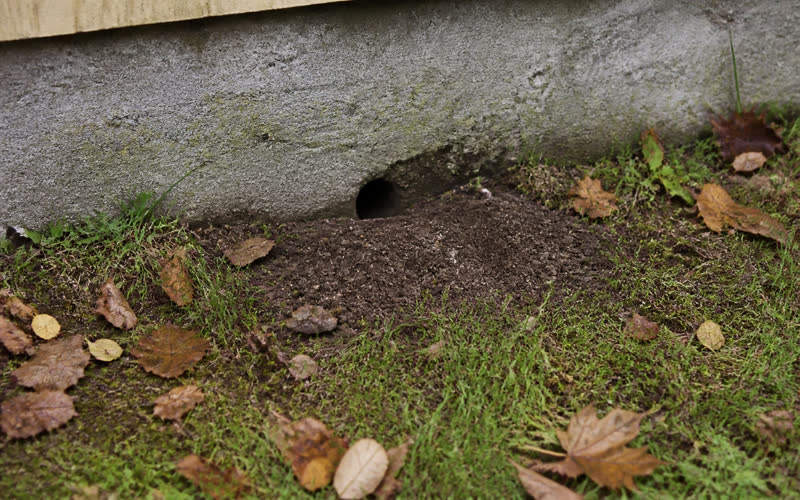
Burrow entrances at the edge of the decking with a compacted, smooth opening, excavated sand or soil by the foundations, and noise under the boards in the evening.
Why it is a risky spot
From under the decking to the house foundations is a matter of a few tens of centimetres. If there is a gap or a pipe entry in the foundations, the route inside is short.
How we treat it
We place outdoor bait stations at the burrow entrances and along the decking perimeter, lockable and fixed down. We do not fill the burrows in before treatment — that only makes the rats dig new ones.
The long-term solution
Closing off the decking perimeter with metal mesh, buried at least 30 cm deep, stops them settling again.
The structure of decking and the void that suits rodents best
Most timber and composite decks are built on joists resting on concrete pads or block paving, leaving a void ten to forty centimetres high between the ground and the boards. That range is exactly what suits rats: low enough that no dog or person will get in, and high enough to move about freely. Add the rest of the conditions — a roof overhead, dry ground, shelter from the wind and complete concealment. If the underside of the deck is screened with decorative timber trellis, or the edges are left open, the animals have several ways in and nothing disturbs them. The nest is usually in the deepest part of the deck against the house wall, because that is the warmest point, while the runs lead out to the edges. So the inspection starts at the perimeter, not the middle.
How to inspect without taking up the boards
The deck needs dismantling far less often than people think. Start with a bright torch at the edge gaps and between the boards: direct the light along the plane of the ground, and then the runs, the little heaps of excavated soil and the trodden paths cast shadows and become visible. The second tool is a smartphone taped to a thin batten, with the torch on and video recording — you can push it under the deck through a perimeter gap and then watch the recording back in slow motion. The third technique is an endoscope camera on a flexible tube, which will fit even a two-centimetre gap. Look for three signs: round entrance burrows six to eight centimetres across with smooth edges, droppings along the structural supports, and dark greasy smears where the animals rub regularly against the timber. Mark the spots on the decking with tape.
What attracts them specifically under decking
The area around a deck creates food sources that do not arise elsewhere in the garden. The first is the barbecue: fat and food scraps that fall between the boards accumulate underneath and are a powerful, long-lasting attractant. The second is feeding pets outdoors — a bowl left on the deck overnight is effectively supper for rats. The third is firewood: a stack laid on the deck or beside it against the wall is both a hiding place and a route, because there are natural passages between the logs. The fourth is a bird feeder or a fruit tree nearby — fallen fruit and spilled seed persist for weeks in autumn. In practice: clean the barbecue and store it covered, feed pets indoors or take the bowl away immediately, and keep firewood at least thirty centimetres above the ground on a metal frame and at least a metre from the wall.
Installing a metal mesh skirt
The long-term solution is a mesh skirt along the entire decking perimeter. Use galvanised or stainless steel mesh with an aperture of up to one centimetre and a wire thickness of at least nought point eight millimetres; plastic garden mesh is no good, because they gnaw through it. Dig a trench thirty to forty centimetres deep along the edge of the deck, fasten the top edge of the mesh to the deck frame or joist with staples every ten centimetres so that no gap is left anywhere, and set the lower part in the trench. At the bottom, fold the mesh out in an L shape away from the deck, some twenty to thirty centimetres wide — a rat digs vertically downwards at an obstacle and stops at the fold. Backfill the trench with gravel, not soft soil. Important: only fit the mesh after the treatment, when movement has stopped, otherwise the animals are shut in on the inside.
Ventilation openings in the house wall behind the deck
Many private houses have ventilation openings at foundation or plinth level, which ventilate the basement or the void beneath the floor. If the deck was added later, these openings often end up directly under the boards — hidden, uninspected, and not uncommonly with no mesh at all or with a rusted, broken grille. That means there is a direct route from under the deck into the house, and that is usually how the noises under the floor in winter come about. They must not be mortared up, because without ventilation moisture builds up in the structure. The right approach is to fit each opening with stainless steel mesh with an aperture of up to one centimetre, fixing it with plugs from the inside or in a frame rather than gluing it on. Check the pipe and cable entries in the wall under the deck as well — the gaps around those are just as common a way in.
The difference between spring and autumn treatment
The season changes the tactics. In autumn, roughly from September to November, the animals are looking for warmth and a permanent place, movement is intense and bait consumption is high — this is the best time to stop a colony establishing itself under the deck before winter. In spring, from March to May, the aim is different: to eliminate the animals that have survived the winter before the active breeding season, when a few individuals become dozens within a few months. Spring is also the only convenient time for the physical work — the ground has thawed, the trench can be dug, and the mesh skirt can be installed without difficulty. A practical recommendation for a private house: treatment in autumn, structural sealing the following spring, and one control check in the summer.
Frequently asked questions
Should the burrows be filled in straight away?
No. Treatment first, then sealing.
Are the stations safe for pets?
Yes, they are lockable and fixed down.
Does the decking have to be taken up?
In most cases no.
Is it enough to screen the edges of the deck with timber trellis?
No. Decorative timber or plastic trellis is a visual barrier, not a physical one — a rodent gnaws through it or simply digs under it. Metal mesh with a buried, outward-folded bottom edge can be fitted behind the trellis — then the timber remains as the finish, but the metal provides the protection.
How do I know there is nothing left under the deck?
Plug every burrow you find with crumpled newspaper, or scatter a thin layer of sand at the entrances, and check for three mornings running. If the plugs stay undisturbed and there are no tracks in the sand, and bait consumption has stopped, movement has ended and the physical sealing can begin.
How long after treatment should I wait before fitting the mesh?
Usually two to three weeks. During that time, monitor bait consumption and the track test. If there has been no consumption in the past week and no tracks reappear, it is safe to bury the mesh skirt. If you are not sure, fill in the form — we carry out a control inspection in Riga and the surrounding area and tell you whether it can be closed up.