
At a glance
- Page topic
- Black rat
- Mouse droppings
- 3–6 mm
- Rat droppings
- 15–20 mm
- Grease marks
- Rat 5–10 cm, mouse 2–5 cm above the floor
- Burrow entrance
- 5–8 cm
- Treatment
- Book through the form — we reply within 5 minutes
The black rat is rarer in Latvia than the brown rat, but it is exactly what explains rodent activity in lofts and on upper floors, where the brown rat does not usually get.
How to recognise it
Slimmer than the brown rat, body 16–24 cm, tail longer than the body, pointed snout, large thin ears. Its droppings are thinner and more curved than the brown rat's.
Where it lives
In lofts, roof structures, insulation and on upper floors. It moves along vertical surfaces, cables and tree branches — height is no obstacle.
Why that changes the treatment
If bait stations are placed only in the basement, a black rat will never come across them. Treatment has to be carried out at the upper levels — in the loft and along the edges of the structure.
How it gets in
Along the roof edge, through ventilation openings, along downpipes and via trees whose branches reach the roof. That is why one of the practical steps is cutting back branches that touch the roof.
The mechanics of climbing: the tail as a balancing pole and cables as motorways
The black rat's body is built for climbing. Its tail, longer than its body, works as a balance bar, letting the animal move along a narrow surface without stopping, while the pads of its feet and sharp claws grip rough render, brick joints, timber cladding and rainwater downpipes. In practice this means a vertical wall is no obstacle. An even easier route is the horizontal one: electricity and telecoms cables run along a building's façade, and pipes along a wall, serve as a permanent route from a tree or a post to the roof edge. When inspecting a site, look at the top of the cable with a torch — a rubbed, dark band and individual hairs often remain on it. If that sign is there, control points at ground level will achieve nothing, because the animal does not walk at floor level at all.
Why it chooses dry, high spaces rather than damp basements
The brown rat looks for water and a damp environment; the black rat does the opposite. Its physiology is adapted to drier conditions — it gets a considerable share of the fluid it needs from food, so being close to a constant water source is not the deciding factor in choosing a nest site. What decides it instead is warmth, dryness and how rarely people visit the place. In Riga's building stock that means lofts, roof voids, the upper part of ventilation shafts, unused attic rooms and the top shelf levels of storerooms. In terms of food, the black rat leans more towards plant material — seeds, grain, nuts, dried fruit — than towards meat scraps. So in businesses holding stocks of dry goods it can live for years if the upper levels are never inspected. Treating the basement on a site like that is work done correctly in the wrong place.
Nests in roof insulation and behind ceiling linings
The nest is built where it is dry, warm and enclosed. In practice that means three places. First — loose-fill or board insulation between loft joists: the animal tunnels into it and builds a round chamber about 15–20 cm across behind it, lined with shredded insulation, paper and fabric fibres. Second — the gap between a plasterboard ceiling lining and the floor structure, where a nest stays completely invisible and is only noticed by sound. Third — stored belongings: cardboard boxes, old blankets, soft furniture in the loft. The sign that points to an active nest is a compacted trail formed in the surface of the insulation leading to one particular spot, with droppings concentrated around it. Until the nest is found, treatment relies on routes rather than the source, and the result is slower.
Traces that differ from those left by the brown rat
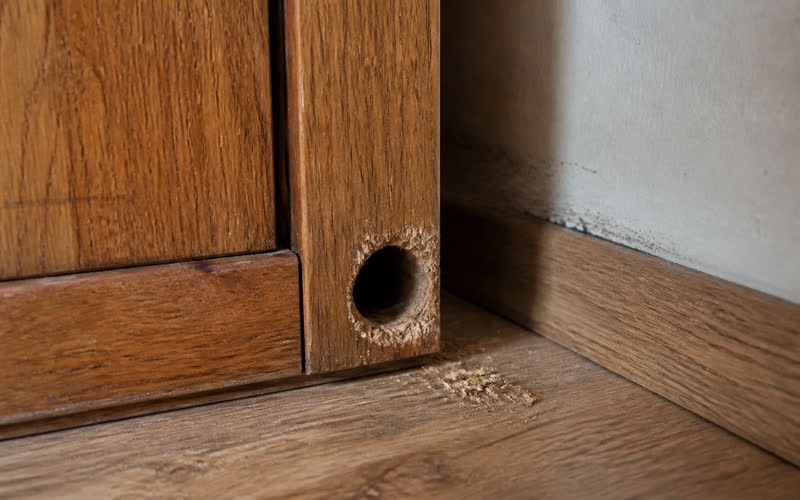
Species are identified from evidence, not assumptions. Black rat droppings are proportionally thinner and longer — about 10–14 mm, curved like a banana, with more pointed ends, whereas the brown rat's are shorter, thicker and blunt-ended. The second difference is location. The brown rat leaves grease marks 5–10 cm above the floor along the base of a wall; the black rat leaves them on joists, the tops of pipes, cables and behind the ceiling edge, often a metre or more above floor level. The third sign is gnawing: the black rat damages cable insulation and timber structures at upper levels, not the bottoms of doors. The fourth is sound. Scratching and a rolling noise coming from the ceiling or roof rather than from under the floor is typical of this species. Describe what you have noticed in the form as precisely as you can — the height and the direction of the sound change the whole treatment plan.
Why loft treatment needs a different station layout
The standard perimeter scheme — stations along the building's outer wall and in the basement — does not work for the black rat, because it does not move at that level. In a loft the points go on routes that already exist: along joists, at the roof edge, near ventilation outlets, on the compacted trails in the insulation and at the nest entrance. The station must be secured so it cannot fall between joists or be moved; on a sloping surface it is fastened to the structure. Points are recorded on a plan, because finding them from memory in a loft a month later is hard. In addition, the transition between the loft and the inside of the house is inspected — ventilation shafts, stack outlets, the stairwell hatch — because these are the routes by which the animal comes down into the flats. At the follow-up visit, consumption is assessed by level: if it is only up top, the focus of the treatment stays up top.
Tree branches and overhead lines that need cutting
Removing entry routes for this species means working on the upper part of the building and its surroundings. First, tree branches: anything reaching closer than about two metres from the roof edge, the eaves or the façade is a bridge, and autumn pruning removes that bridge. Thick branches running parallel to the roof matter especially. Second, climbing plants — usually climbing roses or ivy on a wall — give a continuous vertical route the animal uses even at night in the rain; clearing the bottom metre away from the wall breaks that route. Third, cables and pipes: smooth collars can be fitted to them, or sections where the surface becomes too slippery to hold on to. Fourth, gaps at the roof edge and eaves, unscreened ventilation outlets and damaged fascia boarding — every opening over 15 mm needs sealing with metal mesh. If you are planning this work, describe the building's height and roof type in the form.
Frequently asked questions
How do I tell it from a brown rat?
By the tail: on a black rat it is longer than the body.
Is it more dangerous?
The risks are similar; what differs is where it lives and where treatment goes.
Where should I look for it?
In lofts and roof structures, not the basement.
Does the black rat occur in Riga at all?
It is far rarer than the brown rat, but it does occur on some sites — more often in older building stock with timber roof structures, near the port, and in warehouses storing dry goods. In practice that means that with sounds in the loft and traces at upper levels this species should be taken seriously, not ruled out as impossible.
How can I tell whether the loft has black rats or mice?
The best guide is the size of the droppings: black rat droppings are 10–14 mm long, mouse droppings 3–6 mm. The second indicator is sound. Mice make a fine, rapid rustling; a rat makes a heavier, slower scratching and a clearly audible rolling or dragging. The third is gnaw marks: a rat's bite is wider and deeper, with two visible incisor grooves.
Will cutting back branches on its own solve the problem?
No. Removing branches and climbing plants breaks the entry route, but it changes nothing for animals already nesting in the loft — they simply stay inside. The right order is to reduce the existing population first, then seal the openings at the roof edge, and only then count on a new group finding it difficult to get in.